

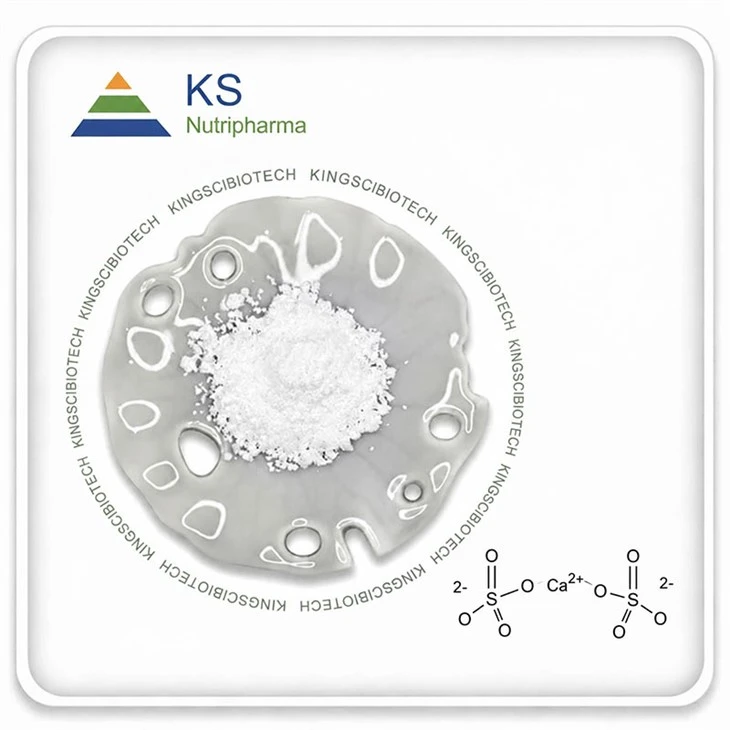
What is Calcium Sulfate Powder?
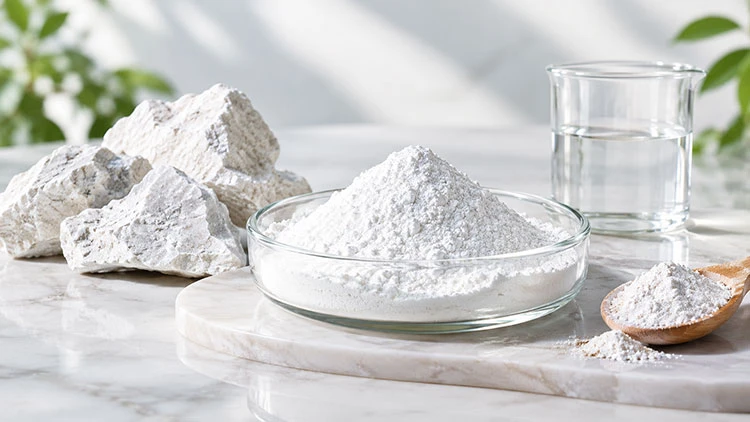
Calcium Sulfate Powder is an inorganic calcium salt with the chemical formula CaSO₄, which is used in a wide range of applications as a functional raw material in the food industry, construction industry, industrial production, and selected agricultural applications. It may exist as anhydrous, hemihydrate, or dihydrate, depending on its hydration state, and have different physical characteristics and processing properties. The grade to be used depends on the manufacturer's application, their requirement for purity, particle size, moisture content, and industry standards. In food processing, it can be used as a firming agent, a coagulant in tofu production, and/or a calcium source in certain food formulations, in accordance with local regulations. In construction/building materials, various forms are employed in gypsum-based systems, plaster, and other systems that demand controlled setting behavior. The performance of these applications is influenced by the hydration properties, solubility, and interaction with other formulation ingredients. It is important that industrial buyers understand that there are differences between food grade and technical grade, and construction grade materials, and that each type of material has its own defined specification and acceptable uses. The manufacturers should take into account the following: calcium sulfate content, chemical composition, particle size distribution, appearance, moisture content, limits of heavy metals (if applicable), and certificates of analysis. The packaging, storage, and transport should be taken into account as well to ensure the uniformity of the material quality throughout the supply chain.
COA
| Test Item | Specification | Result |
| Appearance | White to Slightly Yellowish-White Powder | White Powder |
| Odor | Odorless | Odorless |
| Identification - Calcium | Positive | Pass |
| Identification - Sulfate | Positive | Pass |
| Calcium Sulfate Assay (Dried Basis) | ≥98.0% | 99.2% |
| Loss on Drying | 19.0–23.0% | 20.5% |
| Fluoride (F) | ≤0.0030% | 0.0012% |
| Lead (Pb) | ≤2 mg/kg | 0.5 mg/kg |
| Selenium (Se) | ≤0.0030% | 0.0005% |
| Arsenic (As) | ≤3 mg/kg* (reference) | 0.8 mg/kg |
| Mercury (Hg) | ≤1 mg/kg* (reference) | 0.1 mg/kg |
| Cadmium (Cd) | ≤1 mg/kg* (reference) | 0.2 mg/kg |
| Heavy Metals (as Pb) | ≤10 mg/kg | 4 mg/kg |
| Chloride (Cl) | ≤100 mg/kg* (reference) | 35 mg/kg |
| Iron (Fe) | ≤50 mg/kg* (reference) | 20 mg/kg |
| Sodium (Na) | ≤0.20%* (reference) | 0.08% |
| Zinc (Zn) | ≤0.0020%* (reference) | 0.0008% |
| Strontium (Sr) | ≤0.05%* (reference) | 0.01% |
| Insoluble Matter | ≤0.50%* (reference) | 0.15% |
| pH (Aqueous Suspension) | 6.0–8.0* (reference) | 7.0 |
| Particle Size | Customer Specification | 95% Passes 100 Mesh |
| Bulk Density | For Reference Only | 0.75 g/mL |
| Total Plate Count | ≤1,000 CFU/g* (reference) | 500 CFU/g |
| Yeast and Mold | ≤100 CFU/g* (reference) | 50 CFU/g |
| Coliforms | ≤10 CFU/g* (reference) | Not Detected |
| Escherichia coli | Absent in 10 g* (reference) | Not Detected |
| Salmonella | Absent in 25 g* (reference) | Not Detected |
| Conclusion | Conforms to the Applicable Product Specification | PASS |
Are you interested in our products? Just contact us directly or email donna.zh@kingsci.com to obtain further information and free samples!
Key Ingredients
Calcium Sulphate Powder is mostly made up of calcium sulfate (CaSO₄), which is an inorganic compound that has the chemical formula CaSO₄. It does not contain any specific extract or blend of several effective chemicals, but rather the chemical compound calcium sulfate. It can be supplied anhydrous (CaSO₄) or as calcium sulfate hemihydrate (CaSO₄·1/2 H₂O) or as calcium sulfate dihydrate (CaSO₄·2 H₂O), depending on the hydration state, which affects not only the composition of the material but also its functional properties. They vary in their water content, crystal structure, and process behavior; therefore, water content is a critical specification for buyers from industry and developers of formulations. The main mineral element of commercial interest is calcium, and the sulfate part is responsible for the overall chemical properties and functionality of the compound in various production processes. But these are different analytical parameters and do not necessarily represent the same values. Calcium sulfate content, elemental calcium concentration, and moisture content are not interchangeable. The parameters most relevant for procurement are: calcium sulfate assay, hydration form, loss on drying or loss on ignition (if applicable), particle size distribution, and limits of certain impurities. The analytical method should be chosen based on the product grade and the applicable standards; the certificate of analysis will contain batch-specific results.
Process
1. Raw Material Selection and Inspection
The natural gypsum (CaSO₄·2H₂O) is chosen based on its purity, mineral composition, and its appropriateness for the product grade.
2. Crushing and Size Reduction
The large-sized gypsum is broken into small particles using an industrial crusher so that it can be ground further.
3. Grinding and Screening
The crushed material is milled and then screened to ensure the particle-size distribution and uniformity of the powder.
4. Thermal Processing
Gypsum is thermally treated to remove some or all of its chemically bound water, to produce calcium sulfate hemihydrate or anhydrous calcium sulfate. Processing temperature and residence time are dependent on the form desired in the end product. This is not the case for products that are supplied as dihydrate.
5. Cooling and Classification
Cool and classify or further mill if needed to attain particle-size and handling requirements.
6. Quality Control
Quality control testing is conducted on the final Powdered Calcium Sulphate to ensure the powder has the correct amount, is at the correct hydration level, has the correct particle size, correct moisture or loss on ignition, and the correct amount of relevant impurities, based on its intended grade and applicable standards.
7. Packaging and Storage
Moisture-proof bags or bulk containers are used for packing qualified powder. The batch identification, certificates of analysis, and proper storage conditions contribute to product traceability and quality throughout distribution.
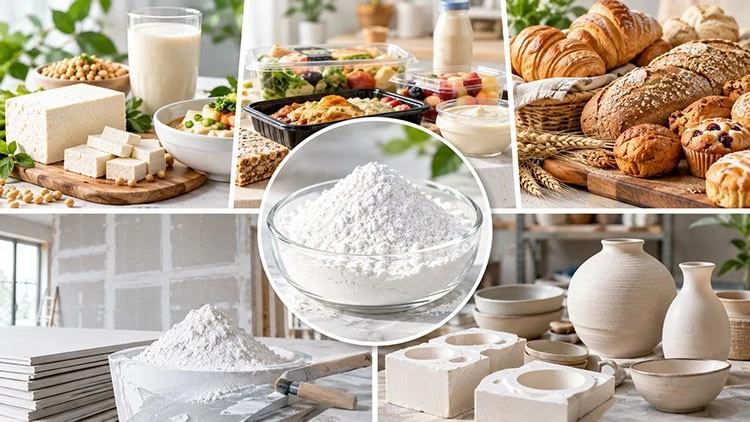
Suitable For
1. Tofu and Plant-Based Food Consumers
In appropriate tofu-making processes, Calcium Sulfate is used as a coagulant. It is used by consumers who buy traditional tofu, plant-based protein foods, and ready-made plant-based protein foods.
2. Consumers of Processed Foods
Food-grade calcium sulfate can be added to certain processed foods, provided the regulations permit. The end user market refers to those that buy packaged food that has been prepared to meet certain texture, processing, or composition standards.
3. Bakery and Prepared-Food Buyers
It can be used in some food processing applications depending on the food formulation and local regulations. Its downstream users are bakery products and prepared bakery products with compliant formulation, sold to consumers.
4. Users of Gypsum-Based Building Products
Gypsum plaster, gypsum boards, and other building products like plaster use construction-grade calcium sulfate. End users are homeowners, tenants, property developers, and building occupants who occupy or reside in spaces that have been built or retrofitted using these materials.
5. Consumers of Ceramic and Molded Products
Some of the calcium sulfate varieties are used to make molds for ceramics, casting, and other industrial processes. Products that are created will be used by homeowners, hobbyist craftsmen, and customers who buy ceramic finished products.
6. Buyers of Agricultural Products
In some grades for soil management and agriculture, suitable grades are employed. They are used by farmers, commercial growers, and gardeners who buy agricultural products with specific soil and crop requirements.
FAQ
1. What is the main component of calcium sulfate powder?
It consists primarily of calcium sulfate (CaSO₄) that can be anhydrous, hemihydrate, or dihydrate depending on how hydrated it is.
2. What industries use calcium sulfate powder?
The food processing grade, construction materials, ceramics and some agricultural uses are where calcium sulfate powder is used.
3. How do manufacturers choose the right calcium sulfate grade?
Manufacturers should consider the purpose, level of purity, water content, particle size, and industry standards prior to purchase.
4. What quality parameters should buyers check when sourcing calcium sulfate powder?
Relevant parameters are the calcium sulfate content, the hydration state of the material, the particle-size distribution, and its moisture level, as well as relevant impurity limits. A Batch COA assists in ensuring that the product meets the agreed specifications.
5. Is calcium sulfate powder available for bulk purchasing?
Availability in bulk depends upon the production capacity of the supplier and product specifications. The buyer must make sure the required grade, packaging, minimum order quantity, and documentation requirements are met before ordering.
Certifications
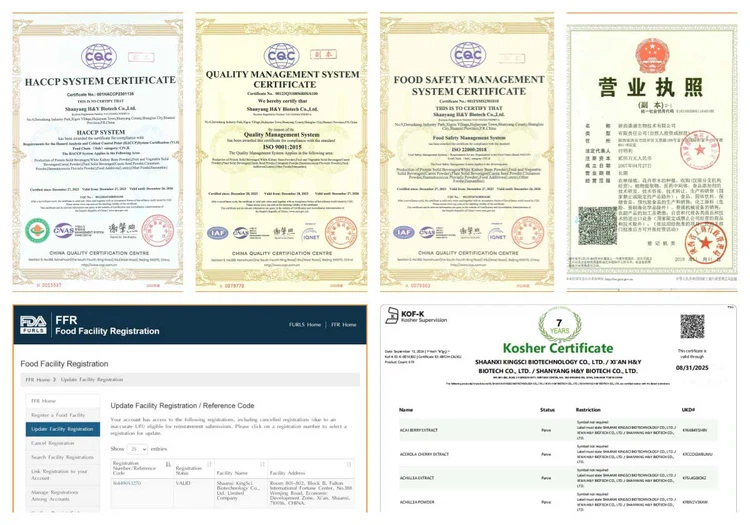
American warehouse

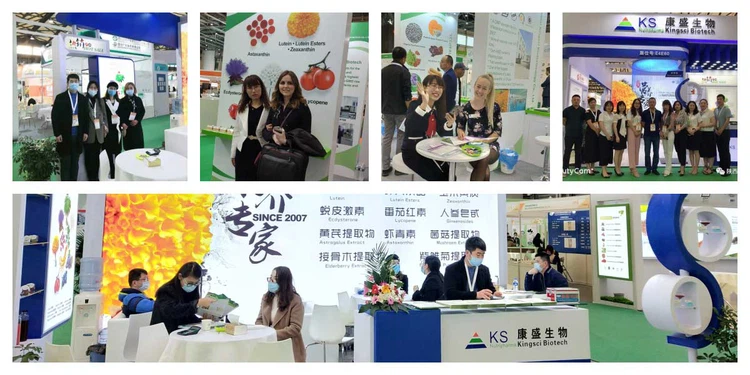
Exhibitions
Hot Tags: calcium sulfate powder, China, manufacturers, suppliers, factory, wholesale, price, pricelist, quotation, bulk, in stock, KOSHER, ISO, HACCP


