

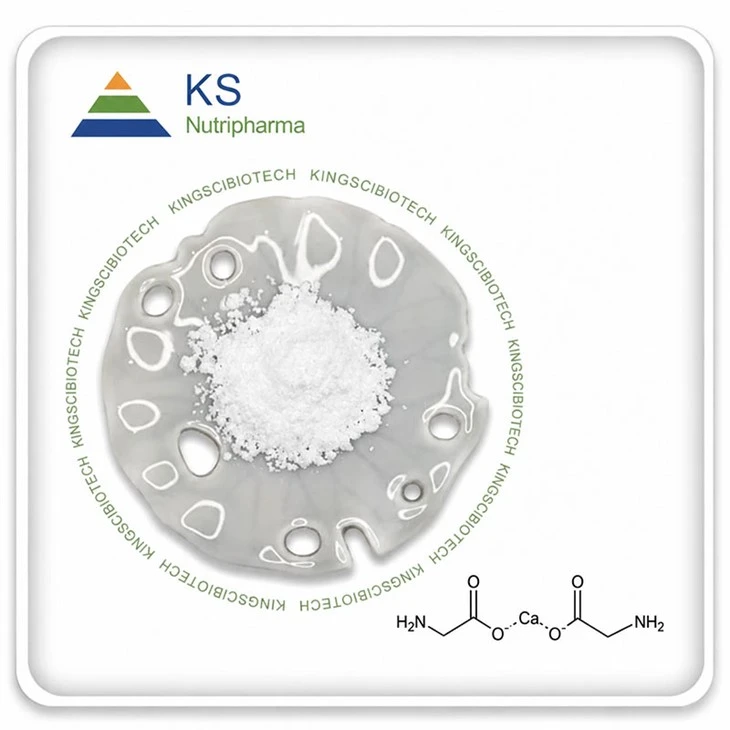
What is Pure Calcium Bisglycinate Powder?
Pure Calcium Bisglycinate Powder is a chelated calcium ingredient that is ideal for manufacturers creating nutraceutical formulations, mineral complexes, and specialty nutritional products. It is composed of calcium bound to an amino acid, glycine, for its particular compositional properties and its ability to be compatible with various formulations. Assessment of the calcium content of the product is not the only criterion to consider when choosing an ingredient, but additional factors such as the calcium chelation characteristics, the method of assay, the solubility profile, moisture content, and batch consistency. It can be used as a calcium bisglycinate raw material in capsule and tablet formulations, powdered mineral formulations, mineral blends, mineral powder for dry formulations, and other dry formulations, depending on the finished-product requirements. It is suitable for various applications based on the content of elements, particle characteristics and processing conditions, as well as on interactions with other components of the blend. Manufacturers should check the product specification and analytical documentation to ensure the product is correct and meets the required quality before adding it to commercial production. For procurement and formulation development, the technical information relevant to the product includes the Certificate of Analysis (COA), specification sheet, test methods, heavy metal limits, microbiological parameters, and recommended storage conditions.
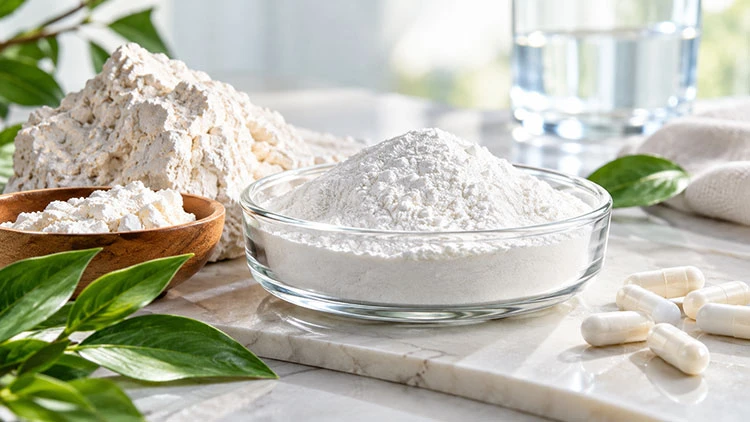
COA
| Item | Specification | Result |
| Appearance | White to Off-White Powder | White Powder |
| Identification | Positive | Complies |
| Calcium Content | ≥20.0% | 21.20% |
| Assay / Purity | ≥ 98.0% | 98.50% |
| Glycine Content | ≥ 25.0% | 26.80% |
| Loss on Drying | ≤ 2.0% | 1.20% |
| pH (1% Aqueous Solution) | 5.0–8.0 | 6.5 |
| Particle Size | 100% Passes 80 Mesh | Complies |
| Heavy Metals (as Pb) | ≤ 10 ppm | Complies |
| Lead (Pb) | ≤ 2.0 ppm | Complies |
| Arsenic (As) | ≤ 1.0 ppm | Complies |
| Cadmium (Cd) | ≤ 1.0 ppm | Complies |
| Mercury (Hg) | ≤ 0.1 ppm | Complies |
| Total Plate Count | ≤ 1,000 CFU/g | Complies |
| Yeast and Mold | ≤ 100 CFU/g | Complies |
| Escherichia coli | Negative | Negative |
| Salmonella | Negative | Negative |
Are you interested in our products? Just contact us directly or email donna.zh@kingsci.com to obtain further information and free samples!
Features
Calcium Bisglycinate Powder is unique in its amino acid chelate structure, which has a chemical composition different from that of traditional calcium inorganic chelators due to the chelation of calcium with the amino acid glycine. It is usually available in a white to off-white powder, and the color, particle size, bulk density, and flow properties will depend upon the process used for its production and the grade. Typically, the elemental calcium content of a calcium bisglycinate grade is around 18–20%, but this can be checked by referring to the supplier's specification and batch-specific Certificate of Analysis (COA). It should be tested for water solubility in controlled conditions because the dissolution and dispersion behaviour might differ in different formulations depending on the pH, temperature, concentration and/or composition of the raw materials; a clear solution should not be taken for granted. Important factors to consider for formulation chemists are the pH of the ingredient in a given aqueous formulation, moisture, particle size distribution, and compatibility with other minerals, organic acids, carriers, and processing aids. The parameters can influence the uniformity of powder blending, filling, and the physical stability of the final product. When making dry blends, particle size matching and density differences between the materials should be evaluated to minimize segregation during mixing and handling, and moisture exposure should be minimized to prevent changes in powder characteristics in storage.
How to Store Properly?
1. Keep Original Packaging Sealed
Keep in its original (sealed by Kingsci) container until use. Don't needless open because it will break the seal and expose the ingredient to the environment.
2. Choose a Dry Storage Area
Store in a dry and clean warehouse, away from water, steam, and high humidity. After opening, the powder may have moisture contact, which may impact the handling properties.
3. Maintain Stable Temperature Conditions
Keep under conditions of temperature recommended in the product documentation. Do not pack near heating appliances or where there is a large temperature difference.
4. Protect Against Contamination
Ensure that the ingredient is kept away from cleaning chemicals, strong-smelling materials, and other raw materials that it is not related to. When transferring powder to production equipment, use clean and dry dispensing tools.
5. Reseal Opened Packages Promptly
Securely close the inner packaging after every dispensing. If transferring to a storage container, use a clean, dry, food-grade container with an appropriate lid.
6. Follow Warehouse Inventory Procedures
Store packages on clean pallets or shelving, not the floor. Ensuring good batch identification and maintain stock rotation and traceability with a first-expired, first-out system.
7. Check Packaging Before Production
Before using, inspect packages for tears, damaged seals, or any indications of damage. If there are unexpected changes in appearance and/or handling characteristics in the Calcium Bisglycinate Powder, bring the batch to the attention of the quality assurance team for evaluation.
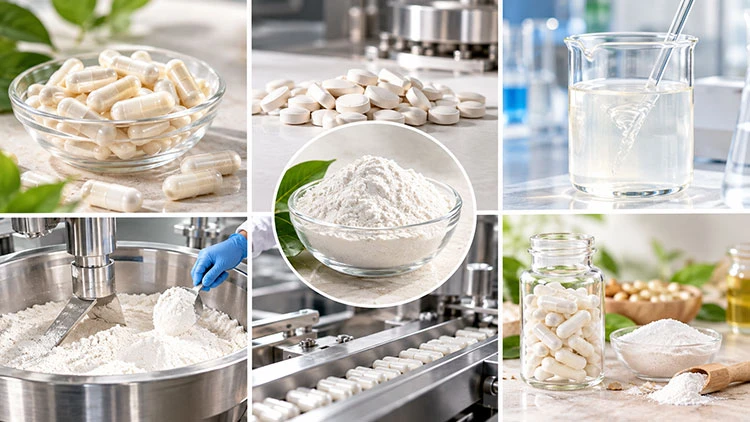
Recommended Use
1. Capsule Formulations
Avoid blending calcium bisglycinate with incompatible excipients prior to blending; it is advisable to pre-blend Calcium Bisglycinate with an appropriate excipient to ensure a uniform distribution. To assess the particle size, bulk density, and flowability of capsules for consistent filling.
2. Tablet Formulations
Determine the compatibility of compressibility with binders, fillers, disintegrants, and lubricants. Evaluate the time and compression for blending and optimize to obtain appropriate tablet strength and consistency of manufacture by conducting pilot trials.
3. Liquid Formulations
Slowly add the powder, stirring gently. Test the solubility, dispersion, pH, temperature, and sediment formation of the intended liquid system. Check if this desired concentration can be maintained without undesirable precipitation.
4. Multi-Ingredient Blends
When mixing calcium bisglycinate with other ingredients (minerals or functional ingredients), determine particle size, density, and compatibility of ingredients. A staged blending process can aid in enhancing distribution and minimising segregation.
5. Process Optimization
Do small-scale trials to determine suitable addition sequences and mixing parameters for commercial production. Ensure uniformity of the blend and check the specifications of the finished product with the use of proper analysis.
6. Inclusion Level
Calculate addition amount based on the product specification, declared elemental calcium content in the product, and formulation requirements. Do not use an average inclusion rate for all dosage forms and product designs.
FAQ
1. What is Pure Calcium Bisglycinate Powder?
Calcium Bisglycinate Powder is an ingredient made up of calcium and glycine that is a calcium amino acid chelate. It can be used as a raw material in the formulation of nutritional and mineral products.
2. What specifications are available for Calcium Bisglycinate Powder?
Specifications can include the calcium element content, the specification of appearance, limits of moisture, and limits of impurities. It is the responsibility of the buyer to check the grade and analytical data with the supplier before placing an order.
3. What applications is Pure Calcium Bisglycinate Powder suitable for?
It can be evaluated in capsule, tablet, powder blend, and selected liquid formulations depending on the solubility and processing requirements and specifications of the finished product.
4. What quality documents are available for bulk purchases?
Depending on the product's requirements and the availability of the relevant documents from the supplier, the following documents may be included: Certificate of Analysis (COA), Technical Data Sheet (TDS), Safety Data Sheet (SDS).
5. How should Calcium Bisglycinate Powder be stored?
Store in the original sealed container in a clean, dry place. Store and follow up the storage instructions and shelf life given in the product documentation.
Certifications
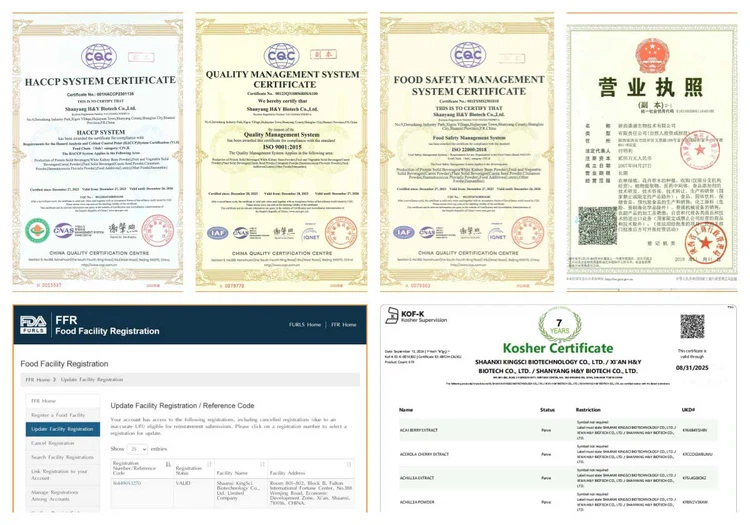
American warehouse

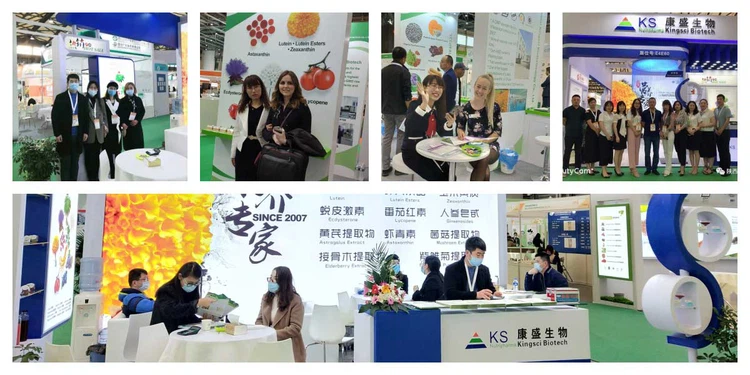
Exhibitions
Hot Tags: pure calcium bisglycinate powder, China, manufacturers, suppliers, factory, wholesale, price, pricelist, quotation, bulk, in stock, KOSHER, ISO, HACCP


