

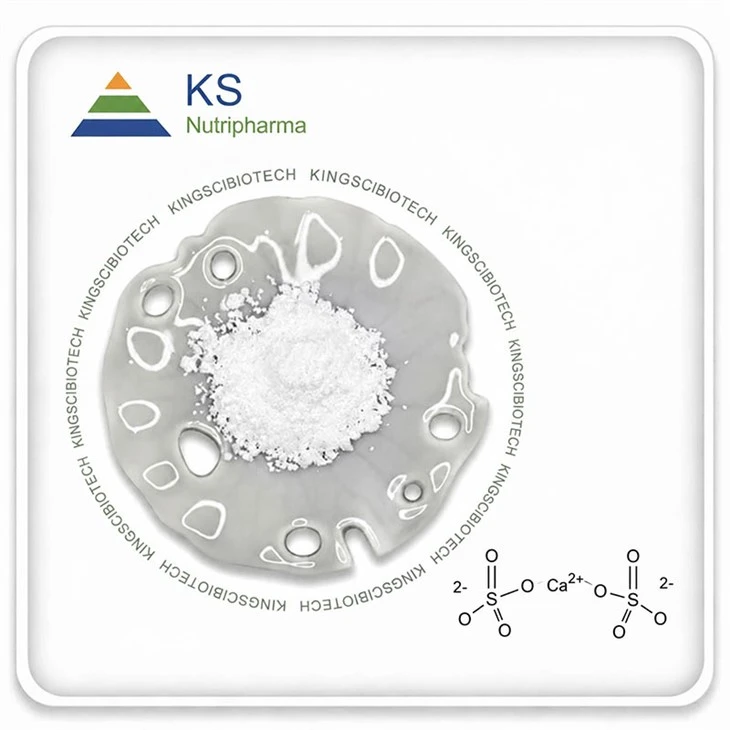
What is Powdered Calcium Sulphate?
Powdered Calcium Sulphate is an industrial mineral raw material that is useful because of its controllable particle size, powder handling properties, and ability to be used in manufacturing processes where solid material characteristics are required to be consistent. Its chemical formula is CaSO₄, and it comes in several forms of hydration: dihydrate, hemihydrate, and anhydrous calcium sulphate. In addition to its chemical composition, the characteristics used by a manufacturer and formulation developer will depend on its behaviour when it is fed, blended, moulded, and subsequently processed. The moisture content and hydration state of the powder can impact the ability to store the product, the uniformity of the product made, and powder flowability, and the powder's particle-size distribution can influence these flow properties. The chosen grade should be appropriate to the forming technique and desired properties of the ceramic mould and gypsum-based processes, respectively. In acceptable food processing applications, the food-grade material conforming to the relevant food industry standards should be indicated by the buyer instead of the general industrial standard. The purchaser can compare fineness, bulk density, flowability, assay, moisture limits, and batch-to-batch consistency in various products as per their production needs during product evaluation. These parameters will need to be checked against technical specifications and a certificate of analysis (if applicable) for a batch.
COA
| Item | Specification | Result | Test Method |
| Appearance | White crystalline powder | White crystalline powder | Visual |
| Identification | Positive for calcium and sulphate | Conforms | Chemical Test |
| Calcium Sulphate Dihydrate (CaSO₄·2H₂O) | ≥ 98.0% | 98.60% | Chemical Analysis |
| Calcium (Ca) | 22.0–23.5% | 23.10% | ICP-OES |
| Sulphate (SO₄²⁻) | 53.0–56.0% | 55.00% | Gravimetric Method |
| Loss on Drying | 18.0–21.0% | 19.80% | USP / Gravimetric |
| pH (5% Suspension) | 6.0–8.0 | 6.8 | pH Meter |
| Chloride (Cl⁻) | ≤ 0.05% | 0.02% | Titration |
| Fluoride (F⁻) | ≤ 30 mg/kg | 12 mg/kg | Ion-Selective Electrode |
| Arsenic (As) | ≤ 3 mg/kg | 0.5 mg/kg | ICP-MS |
| Lead (Pb) | ≤ 2 mg/kg | 0.3 mg/kg | ICP-MS |
| Cadmium (Cd) | ≤ 1 mg/kg | 0.1 mg/kg | ICP-MS |
| Mercury (Hg) | ≤ 1 mg/kg | 0.05 mg/kg | ICP-MS |
| Water-Insoluble Matter | ≤ 0.5% | 0.15% | Gravimetric Method |
| Particle Size | 95% Passes 100 Mesh | 98% Passes 100 Mesh | Sieve Analysis |
| Bulk Density | 0.8–1.2 g/mL | 1.0 g/mL | Bulk Density Test |
| Total Plate Count | ≤ 1,000 CFU/g | 100 CFU/g | Plate Count Method |
| Yeast and Mold | ≤ 100 CFU/g | 20 CFU/g | Plate Count Method |
| E. coli | Absent in 10 g | Absent | Microbiological Test |
| Salmonella | Absent in 25 g | Absent | Microbiological Test |
Are you interested in our products? Just contact us directly or email donna.zh@kingsci.com to obtain further information and free samples!
Recommended Dosage
The recommended dose of Calcium Sulfate Powder varies according to the amount in the product, its hydration state, the purpose of its application, as well as the regulations in the target market. The manufacturers should set the initial levels of inclusion in the formulation based on trials and should modify them based on technical requirements and final product specifications. If a proper food-grade coagulant like it is used, the preliminary range of 2–5 g/1000 g of soy milk can be tested in the tofu production process. This provides a starting point for process development, but is not a universal dosage as the concentration of soy milk, temperature, and coagulation conditions may alter the dosage. For other food uses, there is no general guideline available for the acceptable inclusion rate; its level should be set based on the type of food in question and the local legislation. Manufacturers should take into account the actual calcium sulphate assay and state of hydration (how it is hydrated) when calculating the contribution of the active compound. According to the theory, the elemental calcium content of anhydrous and dihydrate calcium sulphate is about 29.4% and 23.3%, respectively, by weight, if the compounds are pure. These values can aid formulating calculations but are not to be used for batch calculations.
Application
1. Food Ingredient Manufacturing
In some cases, the food-grade calcium sulphate is used as a food ingredient in the formulations that are approved based on their technical functions to meet the requirements of the products. When choosing an appropriate grade, ingredient manufacturers consider purity, particle size, and food standards.
2. Plant-Based Food Production
In tofu-making, the coagulant used is usually it. The grades and addition rates of plant-based food producers are determined based on soy milk composition, processing specifications, and finished product specifications.
3. Food Processing and Texture Control
It can be used in certain applications as a firming agent or in association with other identified processing applications. It is only suitable if it is part of a food category, a formulation design, and the regulations of the destination market.
4. Functional Food Formulations
In specific formulations, where calcium is needed in the formulation and the use is permitted, food-grade calcium sulphate can be taken into consideration. Elemental calcium content, specifications of ingredients and compatibility with the overall formulation should be verified by the manufacturer.
5. Ingredient Blending and Premix Production
Calcium Sulphate Powder supplied to the ingredient suppliers or premix producers is measured based on the particle-size distribution, blending characteristics, and other raw materials. Several factors help to determine if a specific grade is suitable for the intended production process.
6. Commercial Food Manufacturing
Food manufacturers need to have consistent raw-material requirements, batch traceability, and quality documentation. A grade suitable for the application should be accompanied by a Certificate of Analysis and satisfy the appropriate requirements for it.

Safety
Generally, it can be used in specified food processing applications if it complies with the relevant food-grade standards and is used in compliance with local regulations. It is safe only when it is chemically pure, contains a small amount of impurities, is used for a certain purpose, and exposure occurs under certain conditions. Calcium Sulphate is not a common food allergen and does not have high allergenicity, but this does not mean that all people are unlikely to have an allergic reaction to all products containing it. Food-grade material should conform to appropriate limits for contaminants; toxicological evaluations and safety testing should be carried out as per applicable standards. Certifications like ISO or cGMP are not a guarantee of the safety of all grades in all applications, but rather are based on quality management and manufacturing processes. Inhalation and contact with the eyes can be irritating with a lot of airborne powder, so attention to dust generation and minimising inhalation is an appropriate handling precaution. Only grades approved for a specific purpose should be used, and food uses and inclusion levels should adhere to regulations for the respective market. Safety should be evaluated based on verified composition, product grade, route of exposure, and conditions of use, not assumed to be the same for all grades.
FAQ
1. What forms of powdered calcium sulphate are available?
Powdered calcium sulphate comes in a variety of forms, such as dihydrate, hemihydrate, and anhydrous, depending on the specification and use of the product.
2. Can powdered calcium sulphate be combined with other food ingredients?
Yes, if allowed, it can be added to appropriate formulations. Compatibility is related to ingredients used, moisture, processing, and desired characteristics.
3. How should powdered calcium sulphate be stored?
Keep in a secure, dry place; out of direct sunlight, out of dampness, and away from contamination. Store according to the grade-specific instructions.
4. What should be evaluated before using powdered calcium sulphate in a formulation?
Evaluate its grade, hydration form, purity, particle size, and compatibility with the formulation. Ensure the purpose of the intended use is in line with the local regulations.
5. Is a sample of powdered calcium sulphate useful for product development?
A sample is used to determine initial information on powder handling, mixing characteristics, and processing compatibility before conducting larger-scale formulation trials.
Certifications
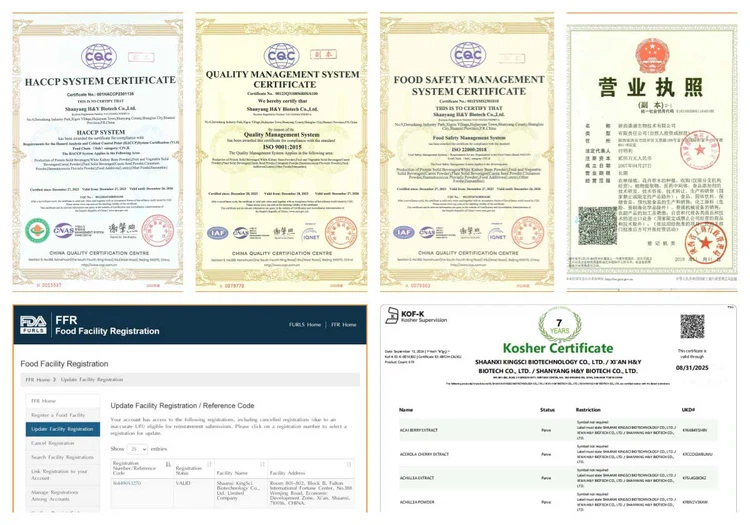
American warehouse

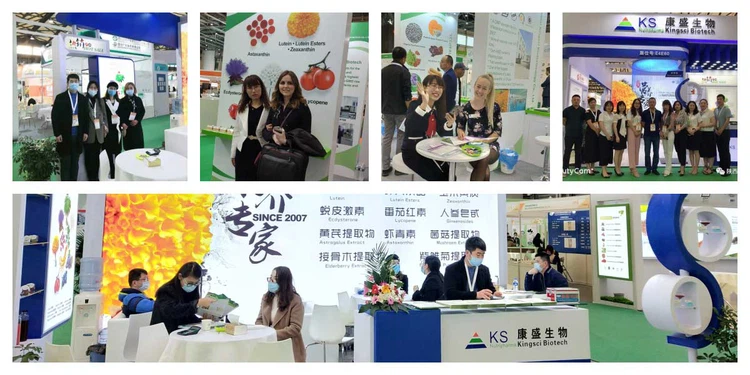
Exhibitions
Hot Tags: powdered calcium sulphate, China, manufacturers, suppliers, factory, wholesale, price, pricelist, quotation, bulk, in stock, KOSHER, ISO, HACCP


