

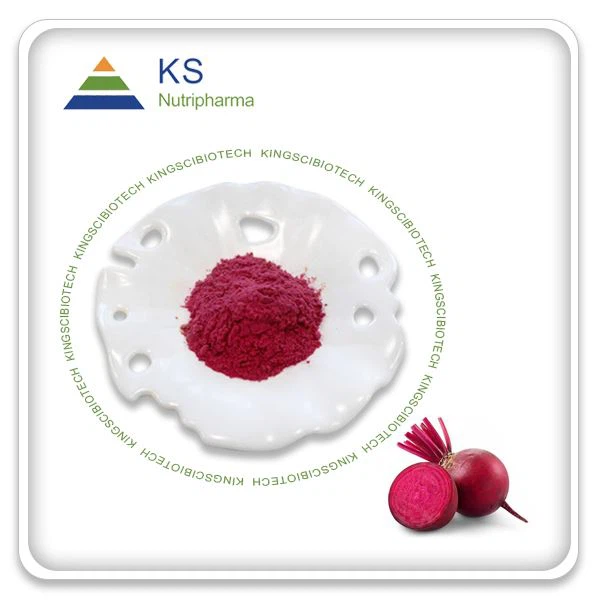
What is E162 Beetroot Red?
E162 Beetroot Red is a natural food colorant made by a well-selected beetroot (Beta vulgaris) by controlled extraction and concentration in aqueous form, which is standardized to be relied upon in a uniform color performance in commercial usage. The coloring components are mainly betalains, with one being betacyanins, which give a red to purplish-red color that is highly sought after in food, beverage, and other specialty ingredient production sectors where clean label and plant-based solutions are needed. It has been appreciated due to the fact that it has a clear regulatory position as an approved natural colorant in most countries around the world, it can be used in conjunction with clean-label formulations, and it matches consumer trends toward synthetic dye alternatives. It is normally available as a liquid concentrate or spray-dried powder in industrial applications, and its usage is determined by the manufacturers, who have the freedom to choose the format that best fits their processing, storage, and dosing requirements. It excels specifically in beverages, confectionery, all dairy-based products, bakery fillings, and plant-based products in which it may provide a homogeneous colouration without contributing alien flavors, provided it is well formulated. Nevertheless, since betalain pigments are heat, light, oxygen, and extreme PH sensitive, industrial users need to consider processing parameters, matrix, and packaging solutions during product development to maintain product color during shelf life. This has made it particularly appropriate in processes with mild thermal conditions as well as controlled pH conditions.

COA
| Parameter | Specification | Test Method | Result |
| Betalain Content (Total) | Present | UV-Vis Spectrophotometry | Present |
| Betanin Content (Main Pigment) | Present | HPLC | Present |
| Moisture / Water Content | Liquid: ≤ 80%; Powder: ≤ 8% | Karl Fischer / Gravimetric | 75% (liquid) / 7% (powder) |
| pH (1% solution) | 4.0–6.0 | pH Meter | 5 |
| Solubility | Complete in water | Visual / Solubility Test | Pass |
| Ash Content | ≤ 5% | Gravimetric | 3% |
| Heavy Metals – Lead (Pb) | ≤ 1.0 mg/kg | ICP-MS | 0.5 mg/kg |
| Heavy Metals – Arsenic (As) | ≤ 1.0 mg/kg | ICP-MS | 0.3 mg/kg |
| Heavy Metals – Cadmium (Cd) | ≤ 0.5 mg/kg | ICP-MS | 0.2 mg/kg |
| Heavy Metals – Mercury (Hg) | ≤ 0.1 mg/kg | ICP-MS | 0.05 mg/kg |
| Microbiological – Total Plate Count | ≤ 1,000 CFU/g | ISO 4833-1 | 500 CFU/g |
| Microbiological – Yeast & Mold | ≤ 100 CFU/g | ISO 21527 | 50 CFU/g |
| Microbiological – E. coli | Not detected | ISO 16649 | Not Detected |
| Microbiological – Salmonella | Not detected | ISO 6579 | Not Detected |
Are you interested in our products? Just leave a message on this page or Contact Us Directly to get free samples and more professional support!
Main ingredients
Beetroot Red Colouring has a functional color which is motivated by its naturally occurring betalain hues; the betacyanins are the active constituents that are dominant and most key in its characteristic hue of red to purplish-red. The most commonly used of these is betanin, which is the main and most common color and which provides most of the color intensity and commercial value, with related betacyanins like isobetanin and probetanin bringing out the depth of the hue and the tonal value. Betaxanthins are also found in minor amounts, giving slight yellow-orange undertones, which can affect the total shade depending on the conditions of formulation. These water-soluble colours are supplemented with naturally co-extracted beetroot solids, which contain trace carbohydrates and organic acids, which can alter solubility and process behaviour, although these ingredients do not determine the colouring activity. The essential quality parameters, in terms of industry, are concentration, stability, and standardization of betanin, which is a substance that defines the strength of color, consistency of batch, and performance in food and beverage processing sectors.
Process
1. Raw Material Selection and Pre-Processing
Food-grade beetroot is obtained depending on pigment levels, maturity, and traceability, followed by washing, sorting, and mechanically slicing or pulping to enhance surface area and enhance extraction and reduce pigment loss.
2. Aqueous Extraction
The solubility of betalain pigments, especially betacyanins, is facilitated by the extraction of the prepared beetroot material in water under specified temperature and pH conditions. In this step, an optimisation is done to achieve a balance between extraction yield and colour integrity at an industrial level.
3. Solid–Liquid Separation
The extracted slurry is filtered or centrifuged to eliminate all insoluble plant fibers and residues to get a clarified liquid containing the pigments to be further refined and standardised.
4. Purification and Concentration
To make the extract stronger in color, the clarified extract is concentrated using either vacuum evaporation or membrane-based technologies. In other types of commercial processes, the mild purification step is used to decrease the unwanted sugars or off-color constituents without altering the natural profile.
5. Standardization
The extracted slurry is diluted to set the color intensity and hue, with water or authorized carriers. This move guarantees consistency between batches, which is critical when dealing with customers who need predictable formulary performance.
6. Drying or Liquid Formulation
According to the market demand, the standardized extract is either delivered as a stabilized liquid extract or is spray dried into a powder by using appropriate food-grade carriers to improve handling, dosing precision, and shelf life.
7. Quality Control and Packaging
Final Beetroot Red E162 products are compared to in-house and regulatory requirements on color value, moisture, solubility, microbial limits, and heavy metals before being repacked in bulk industrial containers, which are meant to be shipped to all parts of the world.

Suitable For
As a manufacturer, the Red Beet Food Coloring end products sold under E162 would be targeted at wide consumer segments that are mainstream and looking for foods and drinks that have naturally obtained colouration and clear labelling of ingredients. The colorant finds application in general-retail consumer packages, families, younger demographics, lifestyle-oriented purchasers, and plant-based, clean-label, or aesthetically pleasing formulations are utilized in such products as beverages, confectionery, dairy alternatives, bakery, and prepared foods. It also fits the brands in markets where the use of natural colors and the avoidance of synthetic dyes are major factors to purchase, which are highly regulated, such as eco-conscious and label-aware consumer groups. Here, it would be used as an appearance and appearance component of the product, meaning that it helps with product appearance and brand positioning without suggesting functional, therapeutic, or disease-related benefits.
Certificate

Factory

Exhibitions

Hot Tags: e162 beetroot red, China, manufacturers, suppliers, factory, wholesale, price, pricelist, quotation, bulk, in stock, KOSHER, ISO, HACCP


