


What is Red Grape Skin Extract?
Red Grape Skin Extract is a naturally derived colorant substance that is extracted and refined to provide the red coloring (stabilized) of the outer layers of red grapes used in industry. Manufacture-wise, it is a functional color solution, not a nutritional or bioactive ingredient, which has to be compliant with formulation, processing, and regulatory needs in large-scale production. The extract is commonly produced through food-grade procedures to extract grape-skin colorants and is standardized based on the color strength, solubility, and physical consistency, which provide consistent and guaranteed performance and stability across batches. It has been considered to be useful in commercial applications due to its ability to support clean-label initiatives, botanical origin, and flexibility to various product systems, such as liquid, semi-solid, and dry systems. Manufacturers choose this ingredient to obtain red to purplish-red colorations that conform to the fruit-based, naturally positioned product concepts and ensure control in the expression of shade throughout processing, storage, and distribution. Its flexibility in a variety of formats facilitates an easy addition to automated production lines and compound formulations, which makes it applicable to global supply chains and production under private label. In general, is an upscale, regulation-aware red colourant product to push the customers who are enterprise-level and want to buy a natural alternative to the synthetic colourants.

COA
| Item | Specification | Method | Result |
| Product Name | Red Grape Skin Extract | - | Conforms |
| Color Additive | Anthocyanins (E163) | - | Conforms |
| Botanical Source | Vitis vinifera L. | - | Conforms |
| Part Used | Grape Skin | - | Conforms |
| Function | Natural Food Colorant | - | Conforms |
| Appearance | Red to dark purple powder | Visual | Conforms |
| Color Shade | Red–Purple | Visual | Conforms |
| Odor & Taste | Neutral to slightly characteristic | Organoleptic | Conforms |
| Coloring Matter | Anthocyanins | - | Conforms |
| Total Anthocyanins | ≥ 10.0% | UV-Vis | Conforms |
| Color Value (E¹%₁cm, pH 3.0) | ≥ 50 | UV-Vis | Conforms |
| Loss on Drying | ≤ 8.0% | ISO / USP | Conforms |
| Ash | ≤ 10.0% | ISO | Conforms |
| pH (1% aqueous solution) | 2.5 – 4.5 | USP | Conforms |
| Solubility | Soluble in water | Visual | Conforms |
| Particle Size | ≥ 95% pass 80 mesh | Sieve | Conforms |
| Total Heavy Metals | ≤ 10 ppm | ICP-MS | Conforms |
| Lead (Pb) | ≤ 2 ppm | ICP-MS | Conforms |
| Arsenic (As) | ≤ 1 ppm | ICP-MS | Conforms |
| Cadmium (Cd) | ≤ 1 ppm | ICP-MS | Conforms |
| Mercury (Hg) | ≤ 0.1 ppm | ICP-MS | Conforms |
| Total Plate Count | ≤ 5,000 CFU/g | ISO 4833 | Conforms |
| Yeast & Mold | ≤ 500 CFU/g | ISO 21527 | Conforms |
| E. coli | Not detected / 10 g | ISO 16649 | Conforms |
| Salmonella | Not detected / 25 g | ISO 6579 | Conforms |
Are you interested in our products? Just leave a message on this page or Contact Us Directly to get free samples and more professional support!
Features
The property of Grape Skin Extract is a set of physical and chemical characteristics that make the product a technically efficient natural colorant in the formulation and process design. Their red color is mainly due to anthocyanin pigments, which are soluble in water and have color expression responsive to pH, enabling the formulators to make small adjustments in shade intensity and hue in acidic to slightly neutral systems. The extract is usually highly dispersible in aqueous matrices and is available in standardized liquid or powder form with a regulated particle size and moisture content to aid uniform handling and dosing. Stability-wise, its color performance depends on factors like pH, temperature, light exposure, and presence of metal ions, which contribute to the fact that it is suitable in applications where these factors are well controlled during processing and storage. The pigment profile chemically assists in the predictability of the strength of color and repeatability in a batch when standardized by the color value or the amount of anthocyanin. These inherent attributes allow product formulators to make formulations that have predictable visual effects, to determine compatibility with other natural components, and to maximize processing parameters without the use of synthetic color systems, which offer convenient technical support for manufacturing at an industrial scale.
How to Store Properly?
1. Store in a Cool, Controlled Environment
Stoke the product within a controlled-temperature warehouse as a means of reducing the loss of pigment in the product and color uniformity within its intended shelf life.
2. Protect from Direct Light Exposure
Even though the product has been packed to industry standard, it is recommended that the product be stored without being exposed to direct sunlight and bright artificial light, since this preserves the colors across time.
3. Maintain a Dry Storage Area
Store the product in a dry place to avoid the absorption of moisture, caking, or alteration of the flow characteristics, particularly in powder forms.
4. Keep Original Packaging Intact Until Use
The provided packaging will be able to guard against the environmental conditions; the opening should be done according to the production requirements, and the resealing should be conducted as soon as possible and in a safe manner.
5. Avoid Proximity to Reactive Substances
Keep them apart with the strong oxidizing agents, volatile substances, or strong-smelling substances to avoid possible quality effects.
6. Apply Standard Inventory Rotation Practices
First-in, first-out (FIFO) inventory management should be used to achieve consistency in performance and efficiency in use between cycles of Grape Peel Extract production.

Recommended Usage
In the case of the manufacturer, Red Grape Skin Powder can be included in different product types, taking into consideration its aspects of physicochemical characteristics, to ensure even distribution and color stability. When used as a powder or dry material like capsules and tablets, it is suggested to combine the extract with carrier excipients or flow agents to avoid fretting and obtain a uniform distribution of color in the batch. In liquid-based formulations, such as syrups, drink bases, or emulsions, gradual addition with agitation control can be used to maintain homogeneity and limit pigment loss, and pH adjustment can be taken into consideration to get the best possible color results. In the case of softgel or encapsulated formats, the extract may be dissolved in solvents or oil carriers that are compatible, and then the extract may be encapsulated so that the fill content and appearance are uniform. In all formats, processing conditions (temperature, shear, light exposure) during mixing or filling processes can be closely observed to maintain the color preservation of the extract, so that manufacturers can provide products with consistent visual quality and performance of the products that can be reliably reproduced in large-scale production.
Certifications
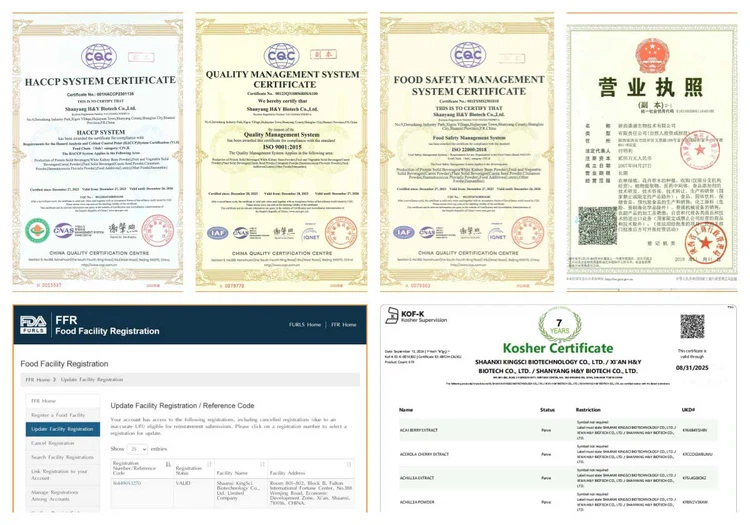
American warehouse

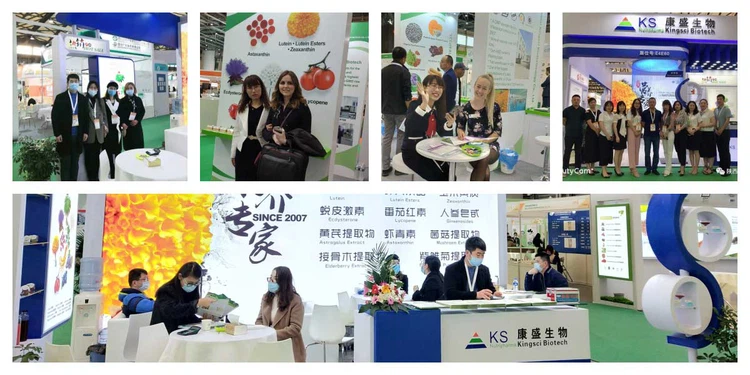
Exhibitions
Hot Tags: red grape skin extract, China, manufacturers, suppliers, factory, wholesale, price, pricelist, quotation, bulk, in stock, KOSHER, ISO, HACCP


