

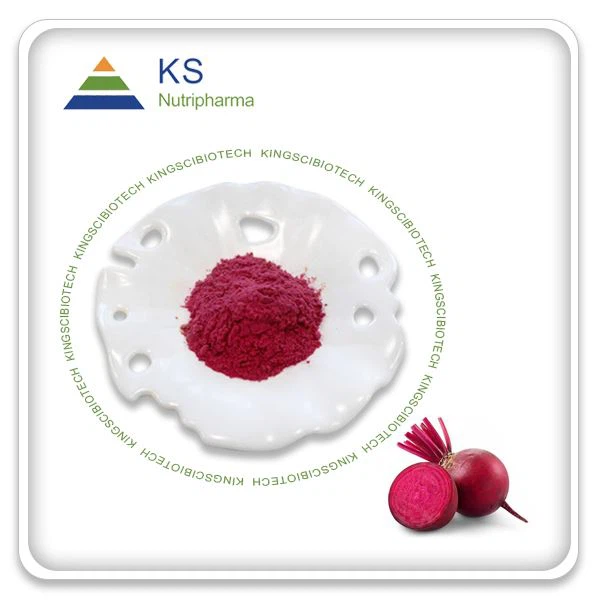
What is Beetroot Red Colouring?
Beetroot Red Colouring is a natural food colouring derived from red beet ( Beta vulgaris ) using a process of controlled extraction and purification of its water extract, which concentrates its naturally occurring betalain pigments, which are mainly betanin. In industrial use, it is provided as a standard liquid or powder ingredient with fixed color strength, solubility, and stability values, and is therefore suitable for use in industrially consistent formulations. It is presently appreciated as a plant-based ingredient, clean-label, and regulatory-feasible colour in numerous worldwide markets, where it is often considered an ingredient of natural colour or vegetable-based colouring other than a synthetic dye. It is also used in making manufacturing cases where the vivid red to reddish-purple colour can be added to neutral to mildly acidic systems, and it can blend easily with aqueous formulations without the use of emulsifiers. Manufacturers of food and beverages and ingredients have widely applied it in foods, including confectionery, bakery fillings, dairy-type products, plant-based alternatives, sauces, seasonings, and especially in functional ingredient blends where appealing appearance and transparency on labels are key purchasing factors. The color expression of it depends on its processing condition like heat, light exposure, oxygen, and pH; therefore, suppliers, in general, provide technical advice on formulation compatibility, dosage range, and processing controls to enable color consistency at scale.

COA
| Item | Specification | Result | Test Method |
| Appearance | Red to dark red powder | Conforms | Visual |
| Odor & Taste | Characteristic | Conforms | Organoleptic |
| Identification | Positive | Conforms | TLC |
| Coloring Components | Betalains | Conforms | UV-Vis |
| Main Pigment | Betanin (present) | Conforms | HPLC |
| Loss on Drying | ≤ 8.0% | Conforms | USP <731> |
| pH (1% solution) | 4.0 – 6.5 | Conforms | USP |
| Solubility | Water soluble | Conforms | Visual |
| Heavy Metals (as Pb) | ≤ 10 ppm | Conforms | ICP-MS |
| Lead (Pb) | ≤ 3 ppm | Conforms | ICP-MS |
| Arsenic (As) | ≤ 2 ppm | Conforms | ICP-MS |
| Cadmium (Cd) | ≤ 1 ppm | Conforms | ICP-MS |
| Mercury (Hg) | ≤ 0.1 ppm | Conforms | ICP-MS |
| Total Plate Count | ≤ 10,000 CFU/g | Conforms | USP <61> |
| Yeast & Mold | ≤ 100 CFU/g | Conforms | USP <61> |
| Escherichia coli | Negative | Conforms | USP <62> |
Are you interested in our products? Just leave a message on this page or Contact Us Directly to get free samples and more professional support!
Market Trends
The overall market trend of the Beetroot Red indicates a definite macro-level change of the larger natural food colourants segment, fuelled, in the first place, by industrial requirements of plant-based ingredients and clean-label solutions. In the world food and beverage manufacturing sector, there has been a consistent increase in the use of natural color as formulators react to customer and regulatory demands to disclose ingredients and components, with beetroot and other botanical origins taking one of the top places in the newer product launches. This move is justified by the fact the market on the beetroot red and other natural colorants is predicted to continue to grow steadily, and the analysis has indicated that the market is likely to continue growing in the next decade as manufacturers extend the use of these colorants to beverages, bakery and confectionery items, dairy alternatives and other processed lines in order to meet the changing formulation strategies. The performance is being improved by advancements in extraction, stabilization, and formulation technologies to make them more feasible in industrial applications despite barriers to application, like cost differentials and processing stability limitations in comparison to synthetic dyes. In the region, the demand is high with high adoption in Europe, Asia-Pacific, and North America, where clean-label and plant-based tendencies are still the highest, and competition among ingredient suppliers still supports innovation and development of supply chains.
Why is Beetroot Red Colouring Popular?
1. Scientifically recognized pigment system
It is based on the group of better-known natural plant pigments, the betalains, with well-established color properties and stability attributes, enabling the predictability and manageability of behaviour in industrial preparations.
2. Multiple functional roles in formulations
Besides delivering red to reddish-purple colors, it is also capable of good water solubility and formulation compatibility to allow easy incorporation into a host of food and beverage uses.
3. Strong clean-label compatibility
Being a vegetable-based ingredient, helps simplify ingredient labels and is compatible with clean-label and other products positioning tactics, including the idea of plant-based products.
4. Established regulatory acceptance
It is widely used in the global markets since its use is not new, and it does not conflict with the regulations to be used in the natural colour regulations, making it less complicated to comply.
5. Alignment with synthetic color replacement trends
The growing repackaging trend in favor of synthetic dyes has resulted in beetroot red becoming a viable natural alternative to synthetic dyes, which offers both visual performance and natural sourcing effectiveness.
6. Driven by downstream consumer expectations
The rising desire by consumers to purchase commodities manufactured using natural ingredients remains a compelling force in the making of sourcing choices, which supports the need to have Beetroot Red E162 used in the commercial supply chains.

Product Direction
1. Naturally tinted beverage bases and concentrates
E162 Beetroot Red is adjustable to produce red or pink visual profiles in ready-to-mix syrups, beverage bases, and powdered drink concentrates, to aid product differentiation, but to provide a source of color of plant origin.
2. Visually enhanced plant-based formulations
Used to enhance or homogenize the color in vegetable food systems like alternative proteins, vegetable blends, or grain-based food systems, where natural redness helps to identify the product.
3. Color-forward confectionery and inclusions
Incorporated into gummies, jellies, coating or decorative inclusions to provide bright colors of natural coloration in a product intended to be attractive to the eye and positioned on the clean label.
4. Natural color solutions for bakery fillings and toppings
Added to fruit-style fillings, icings, glazes, or layers, where continuous, consistent red colors are needed on batches or processing cycles.
5. Seasoning blends and dry mix systems
Applied in the powdered seasoning blends, dry soup base, or instant mix system to provide a natural impact of color without the addition of synthetic colouring.
6. Premium dessert and frozen product components
Used in dessert sauces, frozen novelties, and semi-finished dessert products, in which plant-based coloring treats the high-end and natural branding ideas.
7. Custom color systems and compound blends
Applied either as custom color blends or with other natural coloring to get proprietary colors in branded product lines.
Certificate

Factory

Exhibitions

Hot Tags: beetroot red colouring, China, manufacturers, suppliers, factory, wholesale, price, pricelist, quotation, bulk, in stock, KOSHER, ISO, HACCP


