


What are Lycopene Beadlets?
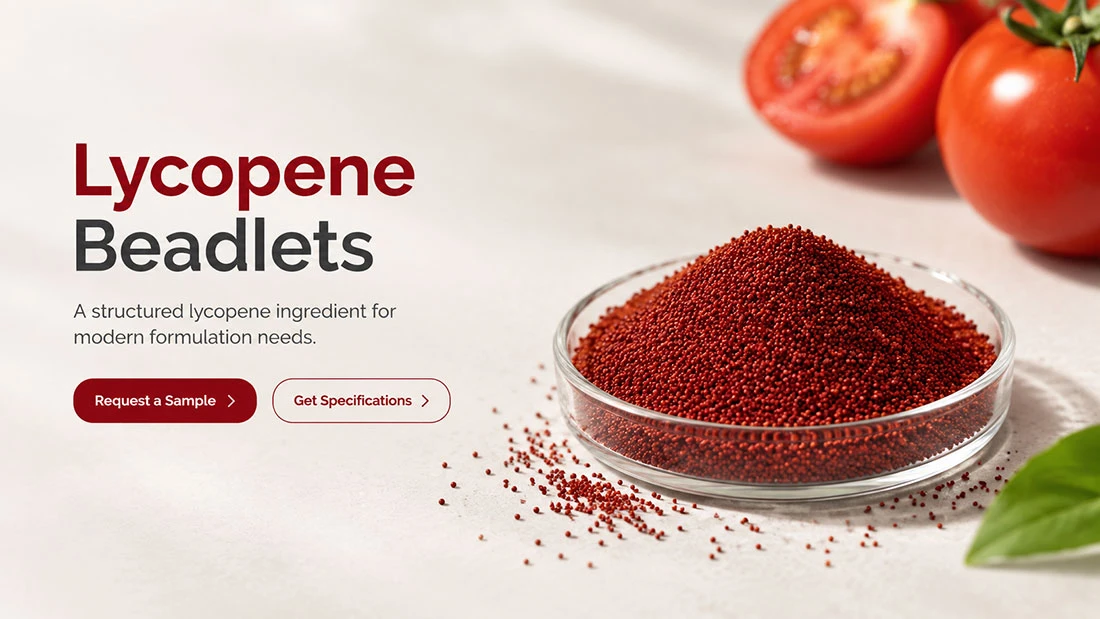
Lycopene Beadlets are lycopene in a structured dry formulation, ideal for manufacturers who require lycopene handling and formulation that is defined by a particulate form. The beadlet format transforms it into a small particle size that can be used to assess the potential for dry blending, controlled dosing, encapsulation, and other solid-product production methods.
The beadlet form is based on a different concept from conventional powder, which is related to the physical organization of the ingredient. This is particularly significant when the characteristics of the particles, handling, and incorporation into a finished formulation become important considerations.
COA
| Item | Specification | Result |
|---|---|---|
| Lycopene Content | ≥10.0% | 10.10% |
| Appearance | Dark Red Beadlets | Dark Red Beadlets |
| Beadlet Size | 1–2 mm | 1.3 mm |
| Encapsulation Efficiency | ≥95% | 96% |
| Bulk Density | 0.45–0.55 g/cm³ | 0.50 g/cm³ |
| Acidity (as Oleic Acid) | ≤1.0% | 0.60% |
| Moisture Content | ≤5.0% | 3.80% |
| Lead (Pb) | ≤2 ppm | 1.4 ppm |
| Arsenic (As) | ≤1 ppm | 0.2 ppm |
| Cadmium (Cd) | ≤1 ppm | 0.10 ppm |
| Mercury (Hg) | ≤0.1 ppm | 0.03 ppm |
| Solvent Residue | ≤0.05% | 0.02% |
| Total Plate Count | ≤1,000 cfu/g | 450 cfu/g |
| Yeast & Mold | ≤100 cfu/g | 40 cfu/g |
| E. coli | Negative | Negative |
| Salmonella | Negative | Negative |
| Staphylococcus aureus | Negative | Negative |
You can contact us directly or email donna.zh@kingsci.com to obtain further information and free samples.
What Makes the Beadlet Format Different?
Unlike other methods, Lycopene Beadlet Powder is not based on the concentration of active ingredients, but on the particle size.
Conventional powder contains mostly finely divided particles, while a beadlet is a particle formed from a structured matrix that contains lycopene in the matrix.
This difference affects the behaviour of the ingredient in the manufacture of a product.
Defined Particle Structure
The beadlet format gives a more well-defined physical form than the fine powder format. The particle size and bulk properties of the final formulation can thus be included in the assessment.
Dry Ingredient Handling
Manufacturers who are using dry raw-material systems, where controlled transfer, weighing and blending are needed, can use beadlets.
Formulation Flexibility
An evaluation of the particulate format is possible in various solid formulations such as capsules, tablets, sachets and nutritional premixes.
Controlled Raw-Material Specification
Manufacturers can also check other parameters like particle size, bulk density, moisture content, and encapsulation efficiency, in addition to lycopene assay, to choose a beadlet specification.
How Lycopene Beadlets Are Made?
Making beadlets requires more than just making a bigger particle of lycopene.
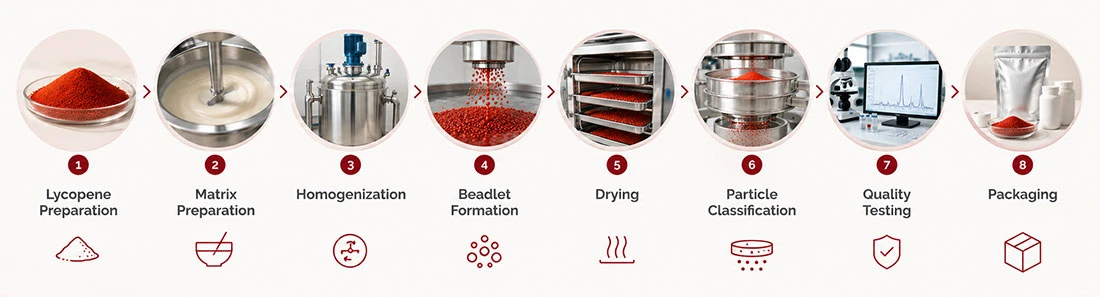
The active ingredient is compounded into a specific particle size form in a carrier/matrix system. In the process, the matrix formulation, process conditions, drying, and particle formation technology all affect the physical properties of the final product – the Lycopene Beads.
A typical production sequence includes:
Lycopene Preparation → Matrix Preparation → Homogenization → Beadlet Formation → Drying → Particle Classification → Quality Testing → Packaging
The actual processing parameters may vary according to the desired specification and application.
Key Parameters for Raw-Material Evaluation
When selecting Lycopene Beadlets for a commercial formulation, several parameters should be reviewed together.
|
Parameter |
Why It Matters |
|
Lycopene Assay |
Determines the active concentration supplied by the ingredient |
|
Particle Size |
Influences blending, dosing, and physical behavior |
|
Particle Uniformity |
Supports consistency during raw-material handling |
|
Bulk Density |
Important when calculating blend volume and filling behavior |
|
Moisture |
Can affect physical stability and handling |
|
Encapsulation Efficiency |
Indicates the proportion of active incorporated within the beadlet structure |
|
Microbiological Quality |
Required for appropriate food and supplement applications |
|
Heavy Metals |
Part of routine raw-material quality control |
Formulation Areas
Lycopene Beadlets will be of interest, especially when a defined dry ingredient is desired in formulations.
Capsules
The beadlet format can be considered for hard-shell capsule formulations, especially in the case of more than one dry active ingredient.
Tablets
It may be added to vitamin, mineral and botanical extract-based tablet premixes and other functional ingredients. Evaluation of compression behaviour and uniformity of the blends should be carried out during development.
Sachets & Stick Packs
Powdered nutritional products in individual serving packages could be considered a particulate format. The uniformity of the blended mixture and segregation of the particles should be assessed in case of multiple ingredients.
Nutritional Premixes
Beadlets can be added to premixes that are composed of botanicals, minerals, vitamins and carotenoids. With regard to the complete blend, particle size and bulk density should be taken into account.
The following are some of the functional food formulations selected:
Beadlets can be assessed in terms of processing conditions and physical specifications of the finished food system if a dry lycopene ingredient is needed.

Lycopene Beadlets vs Lycopene Powder
The two formats should not be treated as interchangeable raw materials.
|
Consideration |
Lycopene Powder |
Lycopene Beadlets |
|
Physical form |
Fine powder |
Structured particles |
|
Particle characteristics |
Powder-based |
Defined beadlet structure |
|
Dry blending |
Suitable |
Suitable |
|
Handling |
Fine-powder handling |
Particulate handling |
|
Dosing evaluation |
Based mainly on powder weight |
Based on assay and particle characteristics |
|
Solid dosage applications |
Tablets, capsules, premixes |
Tablets, capsules, premixes |
|
Particle-size control |
Powder specification |
Beadlet specification |
|
Main selection factor |
Assay and powder properties |
Assay + particle properties |
Selecting the Right Beadlet Specification
The specification of the beadlet may vary from formula to formula.
For instance, the assay and bulk density are more important to a capsule manufacturer, whereas a manufacturer of a multi-ingredient product may be more interested in particle size and uniformity of the blend.
Before manufacturers enter into production, they need to specify:
1. Target Lycopene Content
Calculate the beadlet size to be used for a given level of activity and work out the beadlet addition needed.
2. Particle Requirements
Discuss particle size and particle distribution regarding other ingredients of the blend.
3. Processing Conditions
Assess mixing, compression, filling, drying, and other production processes that could impact the beadlet structure.
4. Packaging Environment
Take into account moisture, exposure to oxygen, light, and temperature during storage and distribution.
5. Finished-Product Stability
The stability of the final product should be assessed, not only based on the stability of raw materials but also on the conditions under which the product is intended to be stored.
Storage and Handling
Lycopene Beadlets should be kept in a cool, dry place out of direct sunlight, excessive heat, and moisture.
When not in use, store tightly in the original container. Avoid excessive exposure to air and moisture during production, and immediately close the bottle after sampling.
Recommended storage conditions should be those provided with the product and in the product's stability data.
Why Manufacturers May Consider Lycopene Beadlets
The beadlet format may offer a starting point for formulation development processes that is different from the traditional lycopene powder.
It could be especially beneficial if a project needs to:
Structured Particles
A definite particle size and not a fine powder.
Dry-Blend Compatibility
The format of an ingredient that is appropriate to be evaluated in multi-component dry blends.
Particle-Based Specification
The option to take into account particle size and bulk density in addition to the active content.
Solid Dosage Flexibility
A system that can be used in capsules, tablets, sachets, and nutritional premixes.
Technical Selection Options
A specification may be assessed based on the desired requirements for the product, as it is produced.
From Raw Material to Finished Product
Choosing a lycopene ingredient should begin with the manufacturing process rather than the ingredient name alone.
A practical evaluation pathway is:
Finished Product → Dosage Form → Manufacturing Process → Required Lycopene Level → Particle Requirements → Beadlet Specification → Stability Evaluation
This approach allows manufacturers to determine whether Lycopene Beadlets are the appropriate format before moving from laboratory trials to commercial production.

FAQ
What are Lycopene Beadlets?
Lycopene Beadlets are a particulate version of lycopene that is structured so that the lycopene is bound into a carrier or matrix, and the particles are small. The format is suitable for manufacturers who need a defined dry ingredient format.
What is the difference between Lycopene Beadlets and Lycopene Powder?
The main difference is that one is in a physical form and the other is not. Lycopene Powder is supplied as a fine powder, and Lycopene Beadlets are in the form of structured particles. This can affect handling, particle size, bulk density, and blending properties.
What are Lycopene Beadlets used for?
They may be assessed for capsules, tablets, capsules containing nutraceuticals, capsules containing structured dry lycopene ingredients, sachets, and certain functional food formulations.
What beadlet size is available?
Presently, the beadlets are used in the range of 1- 2 mm. This is because the actual particle size may need to be confirmed with reference to the specification for the batch chosen.
Can Lycopene Beadlets be used in tablets?
Yes. Tablet formulations are a suitable option for their evaluation, but during product development, the blend uniformity and compression properties, as well as particle distribution and formulation properties, should be evaluated.
Can Lycopene Beadlets be used in capsules?
Yes. The structured dry format can be included in capsule formulations, provided that there is no compatibility issue with the entire powder formulation and capsule filling process.
Are Lycopene Beadlets suitable for premixes?
Yes. They can be used as a component of a nutritional premix mixture of several active ingredients. During the premix development process, the particle size, particle density, and segregation characteristics should be investigated.
Is fermentation the main feature of this product?
No. Fermentation or production source is a technical aspect of the lycopene raw materials, which is not the main positioning of this product page. The main difference with this product is that it is in beadlet form.
Can Kingsci provide samples?
Yes. Samples can be sent for particle properties, blend compatibility, and processing and finished product suitability testing.
Can the specification be discussed for a specific formulation?
Yes. For evaluation of suitable beadlet specifications, the manufacturers can supply the target dosage form, required level of lycopene, blending process, and other technical requirements.
Certificate

Factory

Exhibitions

Hot Tags: Lycopene Beadlets, bulk lycopene, China, manufacturers, suppliers, factory, wholesale, price, pricelist, quotation, bulk, in stock, KOSHER, ISO, HACCP


