


What is St. John's Wort Extract Hypericin?
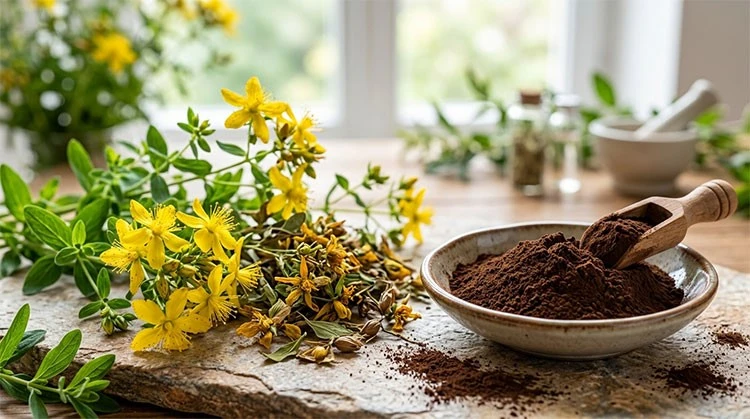
St. John's Wort Extract Hypericin is a standardized, botanical extract that is extracted and standardized for the hypericin content, one of the major naturally occurring naphthodianthrone compounds in Hypericum perforatum L. The raw plant material is harvested at the flowering stage, dried, extracted, and purified by a controlled process to yield the target constituents in a concentrated form before being transformed into a stable powder or liquid extract form, which can be used in industrial production. The last component is usually adjusted to a specific hypericin ratio, giving batches with the same chemical characteristics and control. The main applications of this type of extract are in the manufacturing and formulation industry as a botanical raw material where consistency, traceability, and standardized levels of active markers are critical for consistent and scalable production. It can be supplied in various concentration grades, carrier systems, and physical forms, depending on the supplier's capability, for various processing needs, including blending, encapsulation, and additional formulation development.
cOA
| Item | Specification | Result | Test Method |
| Appearance | Dark red to reddish-brown fine powder | Complies | Visual |
| Odor | Characteristic herbal odor | Complies | Organoleptic |
| Taste | Slightly bitter | Complies | Organoleptic |
| Hypericin Content | 0.5% (UV / HPLC) | 0.55% | HPLC |
| Hyperforin (optional) | ≤ 5.0% | 3.20% | HPLC |
| Particle Size | 100% pass 80 mesh (or customized) | Complies | Sieve analysis |
| Loss on Drying | ≤ 5.0% | 3.10% | USP <731> |
| Ash Content | ≤ 5.0% | 2.60% | USP <281> |
| Heavy Metals (as Pb) | ≤ 10 ppm | <10 ppm | ICP-MS |
| Lead (Pb) | ≤ 2 ppm | 0.8 ppm | ICP-MS |
| Arsenic (As) | ≤ 1 ppm | 0.3 ppm | ICP-MS |
| Cadmium (Cd) | ≤ 1 ppm | 0.2 ppm | ICP-MS |
| Mercury (Hg) | ≤ 0.1 ppm | 0.02 ppm | ICP-MS |
| Residual Solvents | Meets USP / ICH Q3C | Complies | GC-MS |
| Pesticide Residues | Complies with EU/USP limits | Complies | GC-MS / LC-MS |
| Total Plate Count | ≤ 10,000 CFU/g | 1,200 CFU/g | USP <2021> |
| Yeast & Mold | ≤ 100 CFU/g | 45 CFU/g | USP <2021> |
| E. coli | Negative | Negative | USP <2022> |
| Salmonella | Negative / 25g | Negative | USP <2022> |
| Staphylococcus aureus | Negative | Negative | USP <2022> |
Looking for bulk supply or product details?
Request A Free Sample or Bulk Quote to get COA, pricing, and fast delivery options.
Benefits
1. Defined Marker Standardization
St John's Wort Extract gives a defined amount of hypericin, giving the manufacturers a known chemical composition from one batch to another, which means that there is less variation in the final product.
2. Reliable Raw Material Consistency
The ingredient's controlled extraction and standardization processes provide stability of quality features, assisting in the predictability of the product formulation and development in industrial-scale production.
3. Flexible Formulation Integration
It can be used in a variety of manufacturing systems (blending matrices, encapsulated dosage forms, and dry mix) in its powder or extract form without significant process changes.
4. Strong Supply Chain Traceability
Full traceability from the plant source to the final extract is usually part of the professional-grade production, providing for procurement transparency and easing up the process of supplier qualification for manufacturers.
5. Good Compatibility with Industrial Processing Systems
Generally, the material is formulated to be compatible with the standard industrial equipment to facilitate mixing, filling, and downstream processing.
6. Documentation and Quality Support Advantage
Technical documentation like COA, specification sheet, analytical reports, etc., are generally submitted by suppliers and are used as a supporting piece of information for customer qualification, internal QA systems, and regulatory review within supply chains.
Applications and Synergies
It is used primarily as a standardized botanical intermediate in the formulation of the industrial product, where it can be used as a chemically-defined plant-derived ingredient for multi-component formulations and product design. In manufacturing settings, it may be blended into intricate botanical formulations alongside various other plant extracts, excipients, and carrier substances as a means of achieving certain formulation goals like altering the product texture, dispersion properties, or ingredient profile in end products. The standardized nature of the dye also enables it to be used in product testing for compatibility with other natural dyes, extracts containing flavonoids, and matrices of lipids or water, thus helping product developers to create stable formulations that comprise multiple components. In R&D, it is often used together with other botanical actives to evaluate the processing behaviour, solubility interactions, and stability performance under various production conditions, from a synergy point of view. In addition, Hypericum Perforatum Extract can also be used in specialized premixes or intermediate mixes formulated with the aim of achieving efficiency in the manufacture of products downstream, especially in large-scale production lines where consistency and integration of the production process are essential.

Uses
1. Botanical Raw Material for Standardized Formulations
As a defined plant-derived ingredient in which the amount of hypericin can be controlled in the product design and therapeutic effect, and is repeatable in the formulation process.
2. Ingredients for Multi-Component Premixes
Hypericin Extract is often used in custom-made premix systems to ease dosing operations and enhance the quality and efficiency of blending in large-scale production.
3. Functional Reference Material in Analytical Development
Used as a laboratory and research and development botanical marker for method development, chromatographic profiling, and plant extract system quality benchmarking.
4. Component in Color-Associated Botanical Blends
Used in formulation research, specifically in the use of naturally pigmented plant extracts, it can be used to support research on colour stability, uniformity of dispersion, and colour uniformity in the end formula of the finished product.
5. Intermediate in Contract Manufacturing Supply Chains
Provide an intermediate botanical source for contract manufacturers who make standardized herbal-based formulations, enabling a more efficient sourcing and manufacturing process.
6. Material for Process Optimization Trials
Applied to pilot-scale and industrial trials to assess blending behavior, powder flow properties, and compatibility of powders in various production technologies and equipment systems.
Certifications
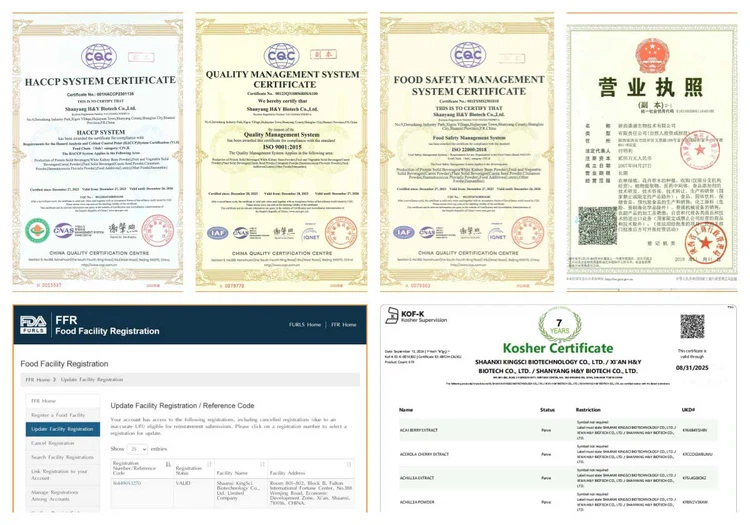
American warehouse

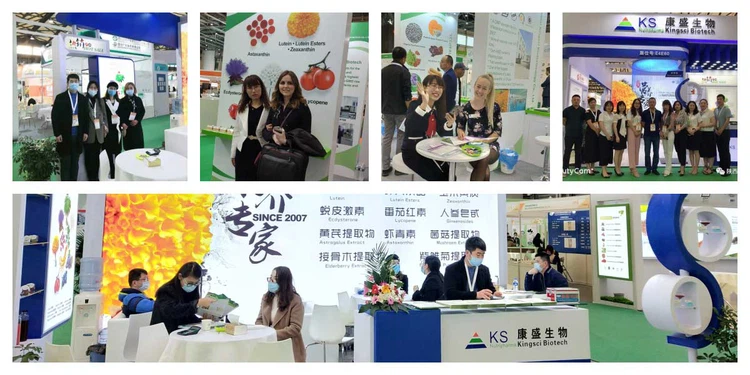
Exhibitions
Hot Tags: st. john's wort extract hypericin, China, manufacturers, suppliers, factory, wholesale, price, pricelist, quotation, bulk, in stock, KOSHER, ISO, HACCP


