


What is Malabar Tamarind Extract?
Malabar Tamarind Extract is a standardised botanical extract derived as a farmed product out of the dried rind of Garcinia gummi-gutta (Tropically grown Malabar tamarind), an Indian and Southeast Asian fruit. The outer rind of the fruit is bought to market in commercial ingredient production an extract is extracted and concentrated in carefully monitored methods to get a fine powder or granulated extract with a specific composition, usually by amount of hydroxycitric acid (HCA) as one of the quality indicators. It is a plant-based raw material that is utilized by nutraceutical companies, functional food manufacturing firms, and contract formulation firms to create products that have consistent botanical ingredients, with specified parameters. The extract finds use in industry formulation due to its standardized profile, which makes each batch consistent with one another and enables ingredient purchasers to have control over the accuracy of formulations made in large-scale manufacturing. The ingredient is usually provided in mass packaging sizes specially designed for the industrial buying sector, allowing easy incorporation into capsule combinations, powdered formulation platforms, and multi-botanical ingredient systems created by the product manufacturers.

COA
| Test Item | Specification | Result | Test Method |
| Appearance | Light Yellow to Yellowish Brown Powder | Light Yellow Powder | Visual |
| Odor | Characteristic | Conforms | Organoleptic |
| Identification | Positive | Positive | TLC |
| Assay (HCA) | ≥ 60.0% | 60.85% | HPLC |
| Loss on Drying | ≤ 5.0% | 3.12% | USP |
| Ash | ≤ 5.0% | 2.41% | USP |
| Particle Size | 95% pass 80 mesh | Conforms | USP |
| Bulk Density | 0.40 – 0.70 g/ml | 0.55 g/ml | USP |
| Heavy Metals | ≤ 10 ppm | < 10 ppm | ICP-MS |
| Lead (Pb) | ≤ 2 ppm | 0.42 ppm | ICP-MS |
| Arsenic (As) | ≤ 2 ppm | 0.31 ppm | ICP-MS |
| Cadmium (Cd) | ≤ 1 ppm | 0.08 ppm | ICP-MS |
| Mercury (Hg) | ≤ 0.1 ppm | 0.02 ppm | ICP-MS |
| Total Plate Count | ≤ 10,000 CFU/g | 1,200 CFU/g | AOAC |
| Yeast & Mold | ≤ 1,000 CFU/g | 120 CFU/g | AOAC |
| E. coli | Negative | Negative | AOAC |
| Salmonella | Negative | Negative | AOAC |
Are you interested in our products? Just leave a message on this page or Contact Us Directly to get free samples and more professional support!
Features
There are a few unique physicochemical properties of Garcinia Cambogia Extract that render it an attractive botanical component to be used in formulation development. The extract has come to be standardized based on the level of its hydroxycitric acid (HCA), a naturally occurring organic acid that is focused on the fruit rind of the fruit, which presents a well-defined compositional marker that facilitates analytical verification and specification control. Physically, the ingredient is usually provided as a light beige to off-white powder with a fairly good dispersibility in aqueous systems, and therefore formulators can use it in dry blends, powdered beverage bases, and in capsule or tablet matrices without requiring significant processing modifications. The extract itself has a slightly acidic profile caused by its organic acid composition, which can be used in the formulation design to balance flavors and control the pH when used in powdered drink mixes or botanical ingredient complexes. Stability-wise, it is manufactured well, which is normally done in a controlled drying and concentration process, which helps to maintain the good distribution of the particle size and manageable hygroscopic characteristics when storing and handling the product. The properties enable ingredient developers and product formulators to incorporate the extract in multicomponent systems with predictable processing performance to enable the ingredient to be a technically workable botanical raw material in the manufacturing of nutraceutical and functional ingredients.
How to Store Properly?
1. Maintain a Cool and Dry Storage Environment
Upon delivery, the extract ought to be kept in a well-ventilated warehouse where the temperature and humidity are in a steady state. The environmental moisture can be kept at a low level to keep the powder flowing and to avoid the formation of clumps throughout the extended storage.
2. Keep the Original Sealed Packaging Intact
The product is packaged professionally and is packaged in bulk transportation and storage in professionally sealed wrappers by our company. It is recommended that the original packaging not be opened until the time of usage, so the manufacturing companies can maintain the stability of the product and avoid exposing it to the environment.
3. Avoid Direct Sunlight and Heat Sources
Garcinia Extract should be placed out of direct sunlight, heat appliances, or hot places. The physical properties and the general quality of the botanical extract can be preserved with the help of a shaded storage place.
4. Store Separately From Strong Odors or Volatile Materials
Since the botanical powders can get contaminated with odors around, it is suggested to isolate the product from volatile chemicals, fragrances, or highly scented raw materials in the warehouse.
5. Reseal Securely After Partial Use
In case the production utilizes the entire material, the leftover product must be resealed right away with the initial inner packaging of the product or with a comparable food packaging technique to ensure a minimal amount of air and moisture access.
6. Implement Standard Inventory Rotation Practices
The manufacturers will be encouraged to adhere to the conventional warehouse management practice, including first-in, first-out (FIFO), in order to utilize the material within its suggested shelf life and in good condition to formulate.

Recommended Usage
Formulation and manufacturing-wise, Garcinia cambogia Fruit Extract may be used in various dosage forms by utilizing the conventional nutraceutical processing methods, and its powdered counterpart can be mixed flexibly with other dry or liquid ingredients. During the manufacture of capsules, the extract is usually pre-mixed with appropriate excipients, e.g., flow agents, or vegetable-based carriers, to enhance the homogeneity of the powder as well as encapsulation stability in terms of filling. In the case of tablet production, to formulate the extract, granulated blends of the extract are commonly produced by dry mixing or controlled wet granulation methods, and such incorporation facilitates better compressibility as well as facilitates uniform tablet weight and hardness during high-speed tableting procedures. When creating liquid or suspension-based preparations, a continuous agitation of the extract with aqueous systems may be performed with or without stabilizing agents or natural solubilizers in order to provide an even-spread distribution of the extract, or to increase the clarity of the final product or suspension stability. In all these dosage forms, the product developers primarily aim at ensuring the controlled dispersion of particles, stable ratios in the formulation, and compatibility with other botanical ingredients in the formula, in a way that it can serve as a consistent plant-derived ingredient in the nutraceutical and functional products manufacturing systems at the industry level.
Certifications
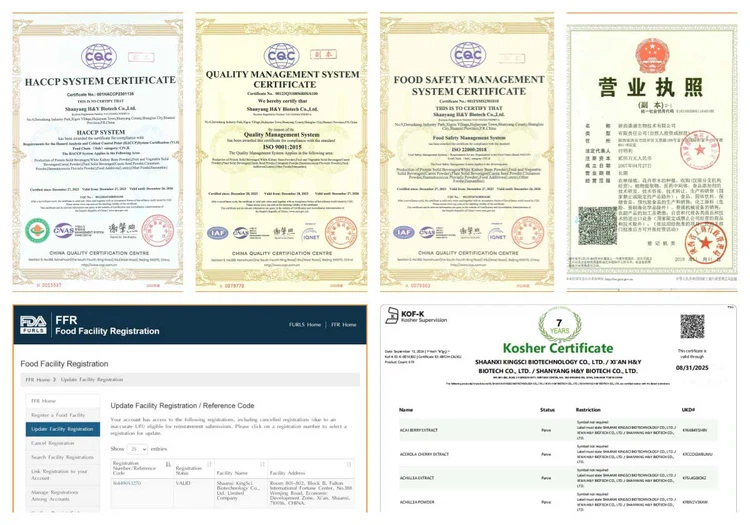
American warehouse

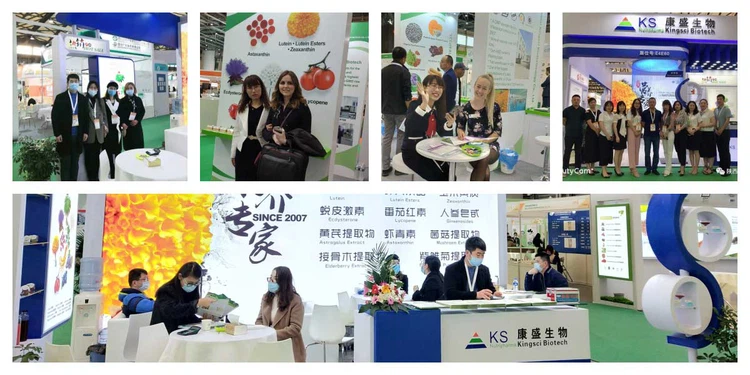
Exhibitions
Hot Tags: malabar tamarind extract, China, manufacturers, suppliers, factory, wholesale, price, pricelist, quotation, bulk, in stock, KOSHER, ISO, HACCP


