


What is Saw Palmetto Standardized Extract?
Saw Palmetto Standardized Extract is a quality-controlled botanical extract standardized to maintain the naturally occurring fatty acids and plant sterols, which are used as marker compounds to ensure quality specification and formulation for the industry. It is generally produced using solvent extraction, supercritical CO₂ extraction, or other controlled concentration processes to help formulate for uniformity, raw material traceability, and compatibility with nutraceutical, dietary supplement, functional food, and personal care manufacturing applications as compared to conventional powdered botanicals. The stability of its composition profile, adaptability of its production capacity, and its ability to be formulated into various dosage forms such as capsules, tablets, softgels, sachets, gummies, and blended botanical systems make this extract a valuable ingredient. It is typically available as a fine powder of brown to off-white colour, or as a soft extract material, both having a controlled moisture content and a typical botanical smell suitable for industrial storage and transportation. In addition, a growing number of global buyers are looking at suppliers that have GMP, ISO, HACCP, Kosher, Halal, and third-party analytical documentation that can help formulate products, produce private-label products, and provide ingredients to other countries.

COA
| Test Item | Specification | Result | Method |
| Product Name | Saw Palmetto Standardized Extract | Conforms | - |
| Botanical Source | Serenoa repens (berries) | Conforms | Botanical ID |
| Appearance | White to yellow-brown fine powder | Conforms | Visual |
| Odor | Characteristic botanical odor | Conforms | Organoleptic |
| Fatty Acids Content | 25% | Conforms | HPLC |
| Particle Size | 80 mesh or customized | Conforms | Sieve analysis |
| Loss on Drying | ≤ 5.0% | 3.20% | USP |
| Ash Content | ≤ 5.0% | 2.80% | AOAC |
| Bulk Density | 0.35–0.65 g/mL | 0.52 g/mL | Tapped density |
| Total Heavy Metals | ≤ 10 ppm | Conforms | ICP-MS |
| Lead (Pb) | ≤ 2.0 ppm | Conforms | ICP-MS |
| Arsenic (As) | ≤ 1.0 ppm | Conforms | ICP-MS |
| Cadmium (Cd) | ≤ 1.0 ppm | Conforms | ICP-MS |
| Mercury (Hg) | ≤ 0.1 ppm | Conforms | ICP-MS |
| Total Plate Count | ≤ 10,000 CFU/g | Conforms | USP |
| Yeast & Mold | ≤ 1,000 CFU/g | Conforms | USP |
| E. coli | Negative | Negative | USP |
| Salmonella | Negative | Negative | USP |
| Ethanol (if used) | ≤ 5000 ppm | Conforms | GC |
| Methanol | ≤ 3000 ppm | Conforms | GC |
Looking for bulk supply or product details?
Request A Free Sample or Bulk Quote to get COA, pricing, and fast delivery options.
Source
Saw Palmetto Extract is derived from the ripe fruit of the palm Serenoa repens, which is a slow-growing species found in coastal areas and subtropical forests of the southeastern United States, especially Florida. Fruits are small, dark reddish purple, and have been harvested as a botanical raw material in the past; today, the fruits are widely utilized in the ingredient production systems of modern times. The commercial production generally starts with the harvesting of ripe and ripe-ripe berries, which are subsequently cleaned, dried, milled, and concentrated using standardized extraction processes to ensure a uniform extraction ratio of naturally occurring fatty acids, sterols, and lipid-soluble compounds. Ethanol extraction, supercritical CO₂ extraction, or other controlled processing technologies can be used by manufacturers to meet specific composition standards and formulate for stability depending on industrial requirements and regional regulatory preferences. The extract produced is used generally as a natural source in the formulation of functional products, dietary supplements, and nutraceutical applications, and the raw material traceability, specification consistency, and ability to supply in a scalable manner are regarded as vital procurement requirements by buyers and formulation companies.
History
It is most closely associated with the natural occurrence of Serenoa repens berries in the coastal regions of the Southeast United States and the subtropical woodlands found throughout the whole Southern United States. The Native American people in Florida and nearby regions used the berries as elements in their local botanical resources, and early American settlers saw the plant as a valuable crop and trade item. The late 1800s and early 1900s witnessed a rise in the use of saw palmetto berries as ingredients in the growing market for botanical products in North America and Europe, with growing interest in their cultivation, collection from wild areas, and industrial processing. With the advent of the modern nutraceutical manufacturing age, technological advances in extraction led to the development of standardized extracts containing controlled fatty acid and sterol content, which now enabled consistency, specification control, and compatibility in large-scale formulations. In the present day, Saw Palmetto Fruit Extract is extensively sourced, processed, and traded as a quality-controlled raw material derived from a plant in the global supply chain of the dietary supplement, functional product, and botanical formulation industries.

Precautions
1. Specification Consistency:
The manufacturers should check the fatty acid standardisation levels, extraction process, as well as physical properties to ensure that the raw material corresponds to the requirements of formulation and production.
2. Quality Documentation:
Certificates of Analysis, microbiological testing, heavy metal testing, and other manufacturing certifications should be reviewed for compliance and quality control of the supply chain.
3. Formulation Compatibility:
Commercial production of capsules, tablets, softgels, gummies, powdered blends, and other delivery systems should be considered in the evaluation of Saw Palmetto Berry Extract.
4. Processing Stability:
The behavior of the extract in various processing methods (mixing, granulation, encapsulation, and storage) should be evaluated to ensure the product has a stable performance.
5. Sensory Characteristics:
Manufacturers might choose flavor masking, coating, or blending in formulation development due to the characteristic botanical odor or colour profile of the extract.
6. Storage Conditions:
For specification consistency during warehousing and transportation, bulk materials should be stored in a sealed, dry, and cool environment to avoid direct light and moisture.
7. Batch-to-Batch Control:
Incoming inspection and standardised quality testing ensure consistency of batches that are produced and minimise formulation variation.
Certifications
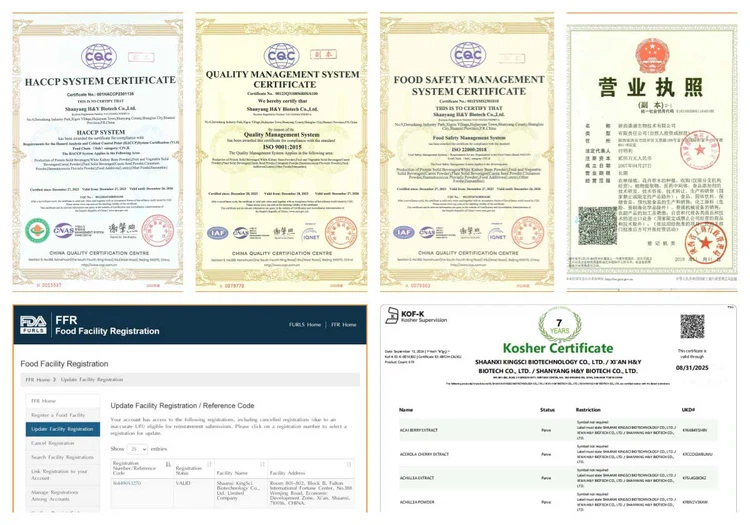
American warehouse

Exhibitions
Hot Tags: saw palmetto standardized extract,Saw Palmetto Standardized Extract Powder,China, manufacturers, suppliers, factory, wholesale, price, pricelist, quotation, bulk, in stock, KOSHER, ISO, HACCP


