


What is Black Elderberry Extract?
Black Elderberry Extract is a concentrated botanical ingredient manufactured using berries of Sambucus nigra, which have reached their mature stage of growth and development, through controlled processes of extraction, which do not interfere with the natural anthocyanins, flavonoids, and polyphenolic compounds. In the case of buyers, it is generally appreciated as a multifunctional raw ingredient utilized in the development of dietary supplement blends, functional foods, beverages, gummies, syrups, as well as cosmetic or wellness-focused consumer health products. The extract is popular among manufacturers due to its strong color strength, consistent pigment profile, and clean-label source, and it is suitable for use in brands that aim at plant-based, fruit-derived actives of the same consistent quality. Typical characteristics of commercial specifications are standardized content of anthocyanin, optimal moisture, and low impurity content. The extract comes in most cases as either a free-flowing powder or as a concentrated liquid, which is easily incorporated into production lines, keeping in mind the notions of solubility, dispersibility, and compatibility with various delivery systems. Since the product will be marketed to the formulation industry and not to end-customers, the communication approach is based on its compositional properties, processing stability, traceability, botanical identity, and scalable manufacturing.

COA
| Item | Specification | Result | Method |
| Appearance | Purple-red fine powder | Complies | Visual |
| Odor & Taste | Characteristic | Complies | Organoleptic |
| Identification | Positive | Complies | TLC |
| Active Ingredient | ≥10% Anthocyanins (UV) or ≥25% Polyphenols (UV) | 12.3% Anthocyanins | UV-VIS |
| Particle Size | 95% pass 80 mesh | Pass 80 mesh (98%) | Screening |
| Loss on Drying | ≤5.0% | 3.20% | AOAC |
| Ash | ≤5.0% | 2.50% | AOAC |
| Solubility | Good solubility in water | Complies | Observation |
| Total Plate Count | ≤10,000 cfu/g | 3,200 cfu/g | USP |
| Yeast & Mold | ≤1,000 cfu/g | 210 cfu/g | USP |
| Coliform | ≤100 cfu/g | <10 cfu/g | USP |
| E. coli | Negative | Negative | USP |
| Salmonella | Negative | Negative | USP |
| Staphylococcus aureus | Negative | Negative | USP |
| Heavy Metals (Total) | ≤10 ppm | 1.8 ppm | ICP-MS |
| Lead (Pb) | ≤3 ppm | 0.32 ppm | ICP-MS |
| Arsenic (As) | ≤2 ppm | 0.18 ppm | ICP-MS |
| Cadmium (Cd) | ≤1 ppm | 0.05 ppm | ICP-MS |
| Mercury (Hg) | ≤0.1 ppm | <0.01 ppm | ICP-MS |
| Total Pesticides | Complies with EU/USP limits | Complies | GC-MS |
Are you interested in our products? Just leave a message on this page or Contact Us Directly to get free samples and more professional support!
Features
Elderberry Extract is distinguished by a naturally high concentration of anthocyanins, which predetermines the deep purple-to-violet color intensity and high light-absorption value of the material and its application as a practical botanical component and as a natural coloring dye in compound formulations. It has a polyphenol-rich profile that has been attributed to significant antioxidant properties on standard analytical assays (including ORAC or total phenolic content), but its water-soluble matrix enables it to be effectively used in dispersion in beverage systems, in powders, and in semi-solid applications without the use of aggressive emulsifiers. The extract exhibits an intermediate level of pH sensitivity- it is most color stable in acidic conditions, and this is noteworthy in formulators involved in ready-to-drink beverages, gummies, and flavored nutrition products. It is also batch-dependent in viscosity and particle-size properties, and these parameters can be adjusted under the conditions of spray-drying, selection of carriers, and extraction concentration. To the industrial user, temperature, exposure to light, and the amount of oxygen also affect its stability, and therefore it is advisable that the packaging is optimized and that the processing steps are controlled to maintain the quality of the color and the integrity. The physical and chemical characteristics enable it to be a versatile raw material in which product developers can design the formulations to achieve a balance between color, solubility, sensory characteristics, and polyphenol level according to the requirements of the varied final product format.
How to Store Properly?
1. Store in a Cool, Dry Environment
Store the product in a low-temperature warehouse (preferably less than 25 ℃) to reduce thermal degradation and preserve the stability of the natural color compounds of the product.
2. Protect From Direct Light Exposure
Though our packaging has already blocked the light, manufacturers are still encouraged to stash the cartons out of proximity with strong lights or windows so that the pigments would not fade gradually.
3. Maintain Low Humidity Levels
It is always necessary to keep the storage facility dry and the humidity below 60 percent to prevent the uptake of moisture, which may influence the flowability, solubility, or stability of the microorganisms.
4. Keep Containers Tightly Sealed
Open bags or drums when necessary and close them when they are closed. Reducing the air exposure would avoid changes that could lead to the loss of physical integrity of the extract and minimize oxidation-induced changes.
5. Avoid Storing Near Odor-Emitting Materials
Sambucus Black Elderberry Extract has a tendency to absorb external odors with time; hence, its storage should be kept away in mixed warehouses that contain spices, essential oils, and volatile raw materials.
6. Use the "First-In, First-Out" (FIFO) Principle
Turnover Stock should be turned over according to the production date to maintain the uniformity of quality in formulation and eliminate the possible risk of having old stocks.
7. Prevent Excessive Stacking Pressure
Never pile lots of pallets than what is advised because this may cause undue pressure that may weaken the structural packaging and influence the homogeneity of the particles.

Recommended Usage
Pure Elderberry Extract can be used effectively as an effective raw material in various dosage formulations by varying blending and processing conditions to maintain the color and polyphenol activity of the extract. During the manufacturing of capsules and tablets, one often mixes the powder, which has been dried by spray-drying, with flow agents, or other suitable carriers, to achieve uniform distribution and prevent agglomeration, and then mixes the mixture gently to avoid streaking of the pigment or settling of the particles; tablet formulators often carefully balance the compression force to obtain uniform appearance but not affect disintegration properties. The extract should be dispersed in moderated agitation in slightly acidic conditions in liquid use, like syrups, ready-to-drink formulas, or drops of the extract as that is used in liquids, which preserves color stability without undue heat exposure that may cause anthocyanin restructuring. When using a semi-solid or gummy system, the extract is usually incorporated into the cooled system so that the extract is not exposed to high temperatures and gives a uniform, appealing appearance. In any form, manufacturers normally control solubility, choice of carrier, and processing temperature to guarantee easy incorporation without altering the natural sensorial and visual properties of extracts, which can be easily incorporated in various product development lines.
Certifications
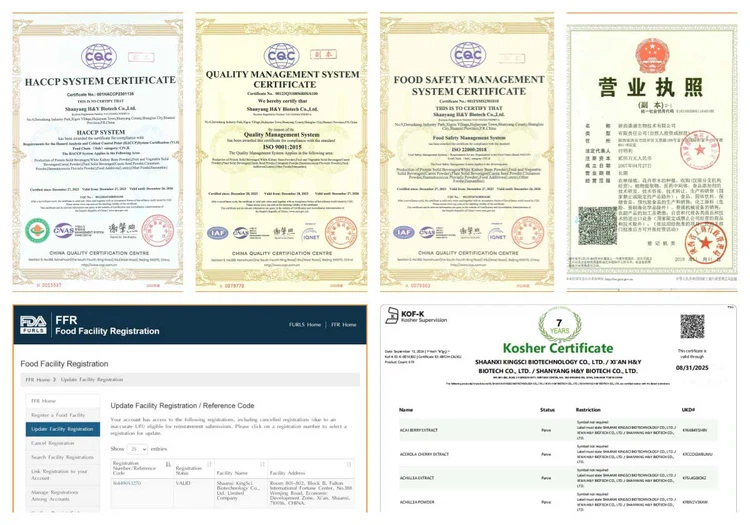
American warehouse

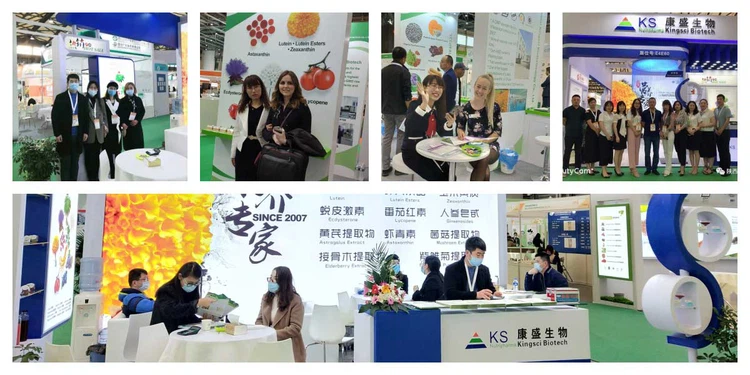
Exhibitions
Hot Tags: black elderberry extract,Black Elderberry Extract Powder,China, manufacturers, suppliers, factory, wholesale, price, pricelist, quotation, bulk, in stock, KOSHER, ISO, HACCP


