


What is Celery Extract Powder?
Celery Extract Powder is a general term used to refer to a concentrated botanical ingredient mainly composed of celery seeds (Apium graveolens), extracted, purified, and spray-dried to produce a free-flowing, stable powder to be used in industries. It is more often standardized than extracts of other plant parts because it has a well-defined composition, which contains naturally occurring compounds, like flavonoids and volatile constituents, which help give consistent performance in formulation systems. It is a desirable ingredient due to its stable dispersibility, controllable flavor levels with the right formulations, and compatibility with most product matrices, such as dry blends, encapsulations, and liquid concentrates. It is commonly fed with tailored specifications like extract ratio, carrier type, particle size distribution, and active marker levels, allowing manufacturers to match the material with particular processing and product development needs. Supply and quality are normally supported by standardised documentation, such as certificates of analysis, contaminant controls, and by meeting international quality standards, which promotes effective sourcing and regulatory compliance.

cOA
| Item | Specification | Result | Test Method |
| Appearance | Brown yellow fine powder | Complies | Visual |
| Odor | Characteristic | Complies | Organoleptic |
| Taste | Characteristic | Complies | Organoleptic |
| Apigenin (Marker) | ≥ 5% | 5.23% | HPLC |
| Sieve Analysis | 100% pass 80 mesh | Complies | CP2020 |
| Loss on Drying | ≤5.0% | 3.25% | CP2020 |
| Ash Content | ≤5.0% | 2.41% | CP2020 |
| Bulk Density | 40–60 g/100ml | 48 g/100ml | CP2020 |
| Heavy Metals | ≤10 ppm | Complies | ICP-MS |
| Lead (Pb) | ≤2.0 ppm | Complies | ICP-MS |
| Arsenic (As) | ≤2.0 ppm | Complies | ICP-MS |
| Cadmium (Cd) | ≤1.0 ppm | Complies | ICP-MS |
| Mercury (Hg) | ≤0.1 ppm | Complies | ICP-MS |
| Total Plate Count | ≤10,000 CFU/g | Complies | AOAC |
| Yeast & Mold | ≤1,000 CFU/g | Complies | AOAC |
| E. coli | Negative | Complies | AOAC |
| Salmonella | Negative | Complies | AOAC |
Looking for bulk supply or product details?
Request A Free Sample or Bulk Quote to get COA, pricing, and fast delivery options.
Features
Celery Extract has a series of physicochemical properties that render it technologically useful in formulation development and manufacturing processes. It is generally a hygroscopic, free-flowing fine powder whose solubility is highly dispersible in aqueous systems when processed with suitable carriers and has a range of solubility depending on extraction solvents and standardization levels. An extract has a specified mix of naturally present flavonoid and volatile aromatic compounds that contributes to a typical herbal profile and could necessitate optimized dosage or masking of flavor in sensitive preparations. In terms of stability, it has a reasonably good shelf stability, under controlled conditions, although it is advisable that it be shielded against excessive heat, light, and moisture, to maintain its compositional integrity, especially of volatile fractions. The particle size distribution and bulk density can be designed to facilitate homogeneous mixing, flowability, and compatibility with automated production lines, essential in scalable production. Moreover, the extract can be incorporated into different delivery systems, and its compatibility with typical excipients and carriers means that the extract will not have a dramatic effect on the structure of the matrices.
How to Store Properly?
1. Maintain a Cool and Controlled Temperature Environment
Keep the product in a dry warehouse at a convenient temperature, preferably less than 25 °C, to reduce degradation of sensitive constituents in plants and to provide stability of the product in bulk storage.
2. Protect from Moisture and Humidity Exposure
Even though the product is professionally sealed, it must be stored in a low-humidity atmosphere because the powder is slightly hygroscopic and can take up moisture as soon as it is exposed to it, which will affect the flowability and uniformity.
3. Avoid Direct Light and UV Exposure
Store containers in the shade or where direct sunlight or brighter artificial lights are scarce because, over time, the stability of naturally occurring compounds can be affected, as well as the characteristics of products can be changed.
4. Keep Packaging Intact Until Use
Keep the packaging that the supplier supplied, still, in its original sealed form until the time of production. The standardized packaging is meant to offer protection against environmental factors and ensure that the products are not harmed.
5. Reseal Properly After Partial Use
When the container is to be batch processed, make sure that it is reclosed properly (e.g., inner liner closure or secondary sealing) to avoid ingress of air and moisture.
6. Segregate from Strong Odors and Reactive Materials
Store Celery Seed Extract out of the presence of substances with a strong odor or volatile chemicals since botanical powders could adsorb external odors, which can interfere with the results of formulations.
7. Implement FIFO Inventory Management
Use a First-In, First-Out (FIFO) system so that old batches are consumed before new ones, which will allow us to keep the quality of the products constant and minimize the chances of long storage with an expired shelf life.

Recommended Usage
Apium graveolens Extract is commonly used as a standardized botanical ingredient in a variety of dosage forms, and processing strategies are based on its physicochemical dynamics. It is often combined with flow-enhancing excipients like microcrystalline cellulose or silica in capsule systems to enhance uniformity of contents and encapsulation efficiency and bulk density to suit capsule fill weight needs. In the case of tablet applications, it is commonly incorporated into granulations, be it dry or wet, based on desired hardness and disintegration characteristics, taking into consideration its natural cohesion as a particle and possibly the use of binders to achieve compressibility and reduce friability. Pretreatment to avoid agglomeration and to increase wettability, particularly when using higher concentrations or multi-ingredient systems. Pre-dispersion in an appropriate carrier or solvent is advisable in liquid or semi-liquid systems, although emulsification or homogenization can also be used to provide uniform dispersion. In all forms, optimization of inclusion levels should be based on standardization parameters and sensory effects, compatibility with other actives, excipients, and processing conditions like heat or shear, should be performed.
Certifications
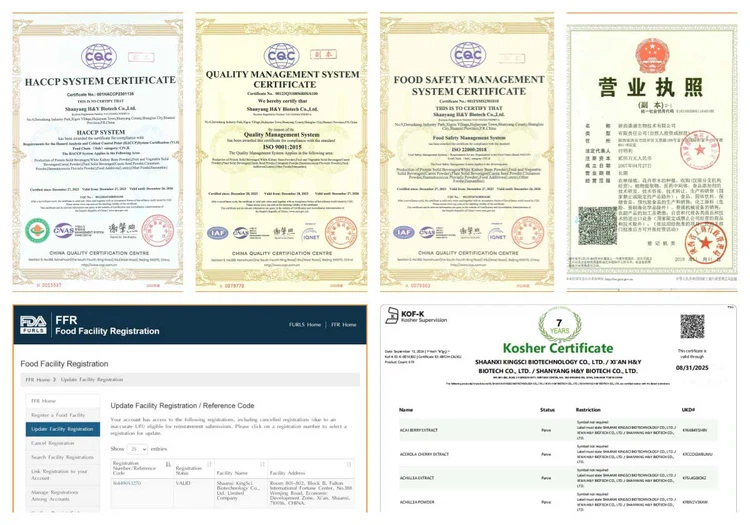
American warehouse

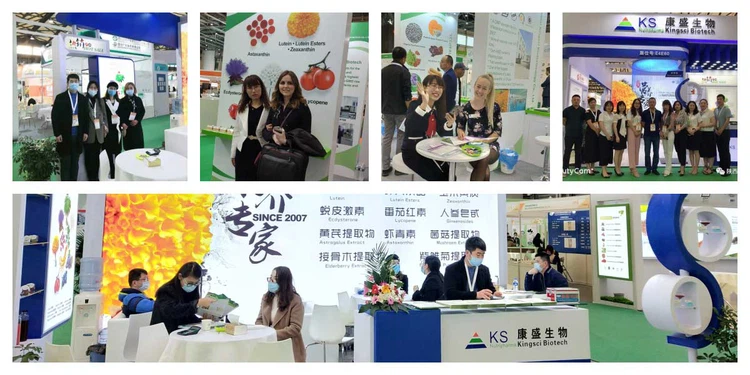
Exhibitions
Hot Tags: celery extract powder, China, manufacturers, suppliers, factory, wholesale, price, pricelist, quotation, bulk, in stock, KOSHER, ISO, HACCP


