


What is Mulberry Fruit Extract?
Mulberry Fruit Extract is a plant extract botanical ingredient derived from the ripe fruit of the Morus genus and produced via extraction, filtration, and concentration, standardized into liquid or powdered forms for use in manufacturing. It has a naturally abundant composition comprising anthocyanins, flavonoids, polyphenols, organic acids, and naturally occurring sugars, with the amount of anthocyanins being used as a quality control marker for specification grading and batch-to-batch consistency. It is extensively used in industrial applications as a versatile botanical raw material that aids in formulation development for food, beverage, cosmetic, and specialty ingredient systems, especially in applications where natural color contribution, fruit-derived taste and aroma notes, or botanical labeling is needed. Its two-fold use as a natural ingredient with dual functionality as a coloring agent and botanical extract is appreciated by manufacturers for its contribution to product positioning in "clean label" and plant-based formulations. Depending on the processing level and concentration, it can be provided in various grades to suit different formulations, such as beverages and powdered beverage mixes, fruit blends, and multi-botanical products. For cosmetic and personal care applications, it's used in skincare products like emulsions, masks, and cleansers, where fruit-based ingredients are used to enhance sensory and natural ingredient claims.

COA
| Item | Specification | Result | Test Method |
| Appearance | Purple-Red to Dark Purple Fine Powder | Conforms | Visual |
| Odor & Taste | Characteristic (Slightly Sweet & Fruity) | Conforms | Organoleptic |
| Assay (Anthocyanins) | ≥ 25.0% | 26.34% | UV-Vis |
| Particle Size | 100% Pass 80 Mesh | Conforms | Sieve Analysis |
| Loss on Drying | ≤ 5.0% | 3.08% | USP <731> |
| Ash Content | ≤ 5.0% | 2.15% | USP <281> |
| Bulk Density | 0.40–0.65 g/mL | 0.54 g/mL | USP Method |
| Heavy Metals (Total) | ≤ 10 ppm | < 10 ppm | ICP-MS |
| Lead (Pb) | ≤ 2.0 ppm | 0.73 ppm | ICP-MS |
| Arsenic (As) | ≤ 1.0 ppm | 0.28 ppm | ICP-MS |
| Cadmium (Cd) | ≤ 1.0 ppm | 0.16 ppm | ICP-MS |
| Mercury (Hg) | ≤ 0.1 ppm | 0.04 ppm | ICP-MS |
| Total Plate Count | ≤ 10,000 CFU/g | 1,500 CFU/g | USP <2021> |
| Yeast & Mold | ≤ 1,000 CFU/g | 95 CFU/g | USP <2021> |
| E. coli | Negative | Negative | USP <2022> |
| Salmonella | Negative | Negative | USP <2022> |
| Staphylococcus aureus | Negative | Negative | USP <2022> |
Looking for bulk supply or product details?
Request A Free Sample or Bulk Quote to get COA, pricing, and fast delivery options.
Features
Mulberry Fruit Extract Powder is a complex mixture of pigments (anthocyanins, flavonoids, and polyphenols), organic acids, and low molecular weight carbohydrates, which are responsible for the reddish to purplish appearance, and the intensity of the colour depends on concentrations and pH. The anthocyanins in the extract are highly sensitive to pH, and as such, the color of the extract can be used to control pigmentation in systems where variability in pigment behaviour is desired. Typically, this extract is presented as a fine powder or concentrated liquid with good water dispersibility, allowing for application in beverage products, emulsions, and for reconstitution into powdered products. Its solubility characteristics are very much carrier-dependent and extraction-dependent, with spray-dried powder (which is often used) being formulated for improved flow and blendability in dry mix applications. It has to be considered in terms of light, temperature, and oxidation stability, as polyphenolics tend to break down under extreme processing conditions and, as such, can be encapsulated or carrier matrices used in industrial formulations for improved stability. It's well tolerated by other botanical extracts and natural acids in formulation, but pH is a critical technical factor as it can affect both the development of colour, as well as the stability of certain compounds.
How to Store Properly?
1. Controlled temperature storage
It's desirable to store the extract in a controlled environment, preferably not near high-temperature sources or temperature variations. Stable temperature and humidity conditions help maintain product integrity and prevent undue degradation of sensitive compounds.
2. Protection from light exposure
It is also advisable to store the extract in a dimly lit area since fruit-based extracts may be sensitive to light damage and colour changes. Secondary packaging is sometimes used in the warehouse, such as dark or light-tight containers.
3. Moisture and humidity management
It is also important to keep the storage space dry and at a humidity level. For powders, exposure to moisture should be avoided to avoid caking, clumping, or altering the powder flow properties, which are critical for ease of weighing and blending.
4. Sealed container handling after opening
When opened for use in production, the container should be securely resealed after use. This will minimise the air change and oxygen exposure from the environment, which can affect the consistency of repeated production.
5. Segregated raw material storage system
It's also recommended to store Bulk Mulberry Fruit Extract away from volatile substances that have a strong aroma or are chemically active ingredients. This avoids cross-contamination and helps maintain its original appearance and characteristics in multiple ingredient storage.
6. First-in-first-out (FIFO) inventory management
Users in the industry generally follow a FIFO (first-in-first-out) stock rotation policy to limit the time older material is stored and encourage batch rotation. This ensures consistent results in formulation and minimises batch-to-batch variations.

Recommended Usage
Mulberry Fruit Extract can be incorporated into various dosage forms using conventional industrial mixing methods based on the extract's formulation (powder or liquid) and the formulation system used. In capsule formulations, the extract is generally incorporated in the dry powder form and pre-mixed with adequate excipients (e.g., flow agents, carriers) to ensure powder homogeneity in the system and stable capsule production; low-shear mixing is usually recommended to preserve the homogeneity of the system without compromising particle integrity. In tablets, it can be added to the bulk powder mixture in the premixing phase to ensure uniform distribution with other botanical or functional ingredients prior to granulation; it can also be used in direct compression modes, if the flowability and compressibility of the powder mixture are adjusted by formulation. In liquid formulations, such as beverages and liquid supplements, it is typically pre-dispersed in water-phase ingredients under gentle mixing to ensure complete wetting and even distribution of colour; care is taken to balance the pH of the system to ensure stability and maintain colour and appearance. In emulsion systems, it is generally pre-dispersed in the water phase before emulsification to help facilitate uniform dispersion within the system.
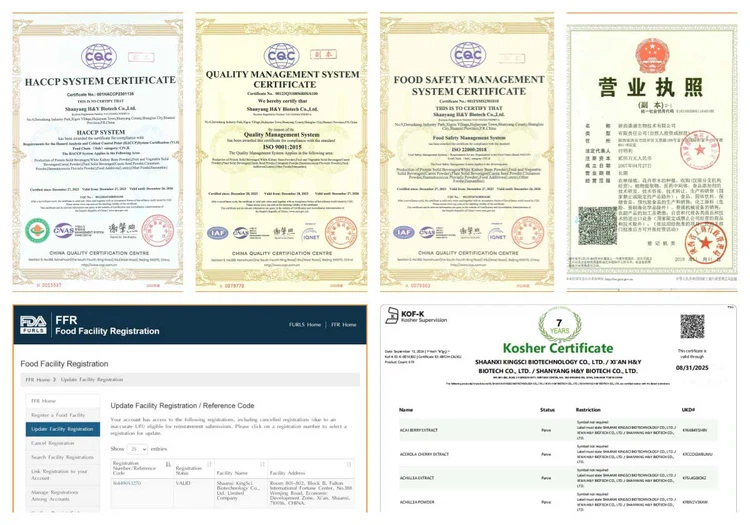
Certifications
American warehouse

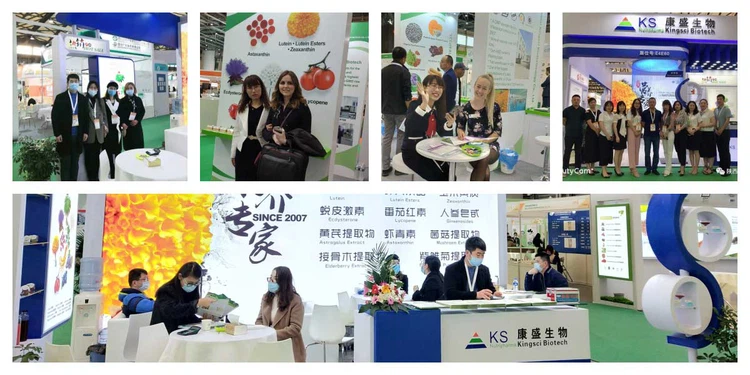
Exhibitions
Hot Tags: Mulberry Fruit Extract, mulberry fruit extract powder


