


What is Glabridin Cyclodextrin Complex?
Glabridin Cyclodextrin Complex is a supramolecular inclusion ingredient that was created by entraping about 10% glabridin, an active flavonoid of licorice root, within cyclodextrin molecules by complexing the glabridin using sophisticated host-guest chemistry. The design of this structure is made to overcome inherent constraints of conventional glabridin, specifically its low solubility in aqueous, sensitivity to light and oxidation, and poor formulation compatibility. The cyclodextrin cavity protects the glabridin core against environmental degradation in addition to increasing its dispersibility in water-based systems, allowing better performance to be maintained on a broader selection of formulation matrices. From a formulation science and industrial application viewpoint, this complex has been shown to enhance physicochemical stability greatly, enabling manufacturers to obtain greater control of shelf-life, as well as less variation in processing and storage. The encapsulation also facilitates better permeability and bioavailability at the formulation level, which is particularly important to topical delivery systems where the equal distribution and effective contact with the application surface are essential. The cyclodextrin-complexed form has a better compatibility in emulsions, serums, gels, and other contemporary delivery systems than the standard raw material and does not require an overuse of solubilizers or stabilizing agents to achieve a good compatibility in the final product, making it easier to formulate and potentially simplifying the cost-in-use.
COA
| Item | Specification | Result | Method |
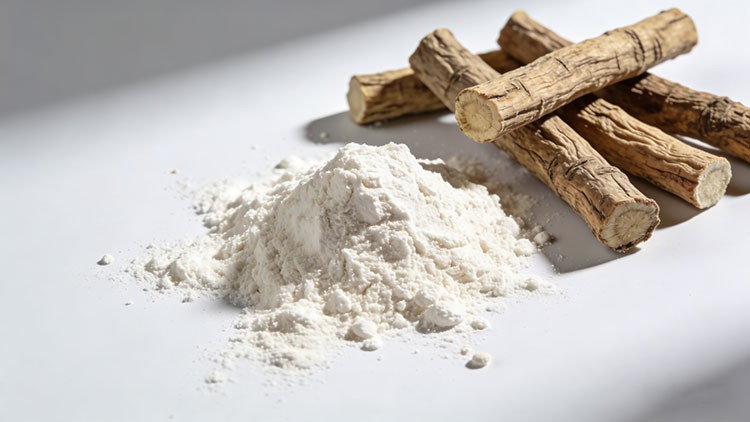
| Appearance | Off-white powder | Complies | Visual |
| Odor | Characteristic, mild | Complies | Organoleptic |
| Glabridin Content (%) | 10 ± 1% | 10.10% | HPLC |
| Cyclodextrin Content (%) | ≥ 85% | 86.50% | HPLC |
| Loss on Drying (%) | ≤ 5% | 3.20% | USP <731> |
| Residue on Ignition (%) | ≤ 1% | 0.80% | USP <281> |
| Bulk Density (g/mL) | 0.35–0.50 | 0.42 | USP <616> |
| pH (1% solution) | 4.5–7.0 | 5.8 | pH Meter |
| Lead (Pb) | ≤ 10 ppm | 6 | ICP-MS |
| Arsenic (As) | ≤ 10 ppm | 4 | ICP-MS |
| Cadmium (Cd) | ≤ 10 ppm | 2 | ICP-MS |
| Mercury (Hg) | ≤ 10 ppm | 1 | ICP-MS |
| Total Plate Count | ≤ 1000 CFU/g | 320 | USP <2021> |
| Yeast & Mold | ≤ 100 CFU/g | 45 | USP <2021> |
| E. coli | Negative | Negative | USP <2022> |
| Salmonella | Negative | Negative | USP <2022> |
Technical Characteristics
The technical properties of Water Soluble Glabridin Powder lie in its supramolecular inclusion structure in which cyclodextrin serves as a molecular host in order to entrap glabridin, thus converting a rather lipophilic and unstable compound into a more water-soluble, structurally-protected, and formulation-friendly active. This host-guest system allows increased resistance to external stressors like light, heat, and oxidation, and dispersion uniformity and decreased crystallization or phase separation risk in complex formulations. Simultaneously, the inclusion process contributes to a more efficient interfacial interaction and delivery in topical systems, which allows the formulators to obtain a consistent performance and reduce their reliance on auxiliary solubilizers. Technologically, in the broad market context, this set of technical benefits is much more in line with the rapidly growing need for naturally derived but technologically optimized ingredients, as brands and manufacturers react to consumer demands of transparency, sustainability, and high-performance plant-based actives. The integration of a botanical-based ingredient with high-end encapsulation is an excellent representative of one of the current trends in the industry: the use of green chemistry and delivery creativity to close the disjuncture between the positioning of natural ingredients and the needs of scalable production processes.
Glabridin Cyclodextrin Complex VS Glabridin Powder
1. Water Solubility and Dispersion Behavior
The cyclodextrin inclusion complex- The cyclodextrin inclusion complex greatly increases the aqueous dispersibility of the active so that the active can be more readily incorporated in aqueous or semi-aqueous systems with less excessive dependence on co-solvents or surfactants. This leads to more definite and solid formulations.
Glabridin Powder: Glabridin is a lipophilic compound that is insoluble in water to a very small extent and therefore necessitates solubilizers, emulsifiers, or oil phase incorporation, which may complicate formulation and make the system sensitive.
2. Stability (Light, Heat, Oxidation)
Glabridin Cyclodextrin complex: The host-guest encapsulation is able to offer the protective microenvironment enabling enhanced resistance to photodegradation, thermal stress, and oxidation, which supports extended shelf life and a greater predictability in processing and storage.
Glabridin Powder: It is more likely to be destroyed by light, oxygen, and high temperatures, which will cause the loss of potency and increase handling or packaging needs.
3. Permeability and Functional Delivery Efficiency
Oligomer of Glabridin Cyclodextrin Complex: Interfacial interaction and distribution. The inclusion system improves the efficiency of delivery and more uniform behavior over the application surfaces.
Glabridin Powder: The dispersion and aggregation tendencies can be limited, which may inhibit uniform distribution, which may lower the functional efficiency of end formulations.
4. Bioavailability at the Formulation Level
Glabridin Cyclodextrin Complex: Enhanced solubilization and molecular dispersion will assist in increasing the apparent bioavailability in topical systems and thus make more use of the active in the formulation matrix.
Glabridin Powder: The solubility and dispersion of glabridin are also low, and in water-based or low-oil systems, these can limit effective availability.
5. Formulation Compatibility and Processing Efficiency
Glabridin Cyclodextrin Complex: Provides an extended range of compatibility with modern delivery systems, serums, gels, and lightweight emulsions, and makes processes simpler by eliminating the complicated process of solubilizing the complex.
Glabridin Powder: More appropriate when using oil-based systems, but may necessitate further formulation modifications that may add complexity to the development time and complexity to the processing.
6. Consistency and Industrial Scalability
Glabridin Cyclodextrin Complex: This is generally standardized (e.g., 10% active) and has a better batch-to-batch consistency and can be scaled easily to large-scale production.
Provided it is controlled, higher assay materials (e.g., 90%+) are more sensitive to the environmental factors and thereby can cause variability.
Where to buy Glabridin Cyclodextrin Complex?
Kingsci is one such company that uses a range of technology called cyclodextrin inclusion technology to make Supramolecular Glabridin Powder that is usually standardized at approximately 10%. In modern cosmetic and personal care systems, these chemicals give improved dispersion, stability, and compatibility. This ingredient is indicative of a wider industry trend, which is the integration of plant-based ingredients with performance delivery systems, which allows brands to be in line with the market trends towards natural-origin, high-performing, and clear formulations. To the buyers, direct suppliers such as Kingsci can simplify the procurement process, offer consistent batching, and offer technical services based on the industrial production requirements.
Are you interested in our products? Just Leave A Message on this page or Contact Us Directly to get free samples and more professional support!
Certificate

Factory

Exhibitions

Hot Tags: glabridin cyclodextrin complex, China, manufacturers, suppliers, factory, wholesale, price, pricelist, quotation, bulk, in stock, KOSHER, ISO, HACCP


