



What is Gardenia Fruit Extract?
Gardenia Fruit Extract is a botanical extraction that has been specifically formed out of the mature fruit of Gardenia jasminoides and refined by means of controlled extraction and purification measures to provide a stable, usage-ready ingredient in industrial production. In perspective, it is placed as a fruit-based extract whose origin is well known, whose composition is predictable, and whose adaptability to formulation systems is high, hence it can be used as an intermediate or functional input but not as a final consumer product. It is appreciated in commercial production, particularly due to its uniformity, ability to be incorporated easily in both water-based and composite systems, and because it enables products to be innovative in the context where both natural sourcing, transparency of ingredients, and efficiency of formulation are desired. This extract is usually chosen on technical criteria like the assay range, solubility behavior, tolerance to process, and compatibility with large-scale manufacturing processes by enterprise buyers. Provided on the basis of standardized quality schemes and complete technical documentations, it is used in the development of downstream products, the manufacture of own-label products, as well as international trade needs, yet it is not a medicine with a non-medical positioning in parallel with clean formulation policies and a responsible market communications policy.

COA
| Test Item | Specification | Test Method | Result |
| Appearance | Fine powder, free-flowing, brownish-yellow | Visual | Fine powder, brownish-yellow |
| Odor | Characteristic botanical odor | Organoleptic | Characteristic |
| Taste | Slightly bitter | Organoleptic | Slightly bitter |
| Moisture (%) | ≤ 8.0 | Loss on Drying | 5.5 |
| Ash (%) | ≤ 5.0 | AOAC 923.03 | 3.2 |
| Particle Size | 100% pass 80 mesh | Sieve Analysis | 100% pass 80 mesh |
| Solubility | Soluble in water, ethanol | Visual/Analytical | Soluble in water & ethanol |
| Total Iridoid Glycosides (%) | ≥ 20 | HPLC | 22.5 |
| Crocin Content (%) | 2.0–5.0 | HPLC | 3.6 |
| Lead (Pb, ppm) | ≤ 5 | ICP-MS | 2.3 |
| Arsenic (As, ppm) | ≤ 3 | ICP-MS | 1.1 |
| Mercury (Hg, ppm) | ≤ 0.1 | ICP-MS | 0.05 |
| Cadmium (Cd, ppm) | ≤ 1 | ICP-MS | 0.4 |
| Total Plate Count (CFU/g) | ≤ 1000 | USP <61> | 350 |
| Yeast & Mold (CFU/g) | ≤ 100 | USP <61> | 25 |
| E. coli | Negative | USP <62> | Negative |
| Salmonella | Negative | USP <62> | Negative |
Are you interested in our products? Just leave a message on this page or Contact Us Directly to get free samples and more professional support!
Features
The physical and chemical properties that contribute to the uniqueness of Gardenia Extract, to some extent, render it technically appealing in formulation development, especially in mass production contexts. The extract is usually in fine, free-flowing powder or concentrated liquid that is highly dispersible, meaning it is easy to incorporate in water based or blended system without complex processing modifications. It is chemically composed of well-characterized, mostly water-soluble phytochemical fractions, which exhibit quite stable characteristics and behavior under typical processing conditions, despite moderate heat treatment and a wide pH range, which allows flexibility in formulation. Its naturally occurring pigment components have a predictable chromatic performance when standardized, thus making it predictable in the finished products. Formulation-wise, it is quite compatible with other botanical extracts, carriers, and excipients, and makes it less likely that it will precipitate or separate into phases upon mixing and storage. Such a combination of properties gives a dependable, technically workable botanical ingredient to the formulators.
How to Store Properly?
1. Controlled Environment Storage
Keep the product packaged in a clean and dry warehouse area free of air vents that could cause the ambient temperature to change rapidly, and without any high-heat exposure that may cause a change in its physical integrity with time.
2. Protection From Moisture and Humidity
Despite the extract being provided in a packing that helps to protect it against moisture, it should not be stored near wet environments and direct contact with water to prevent the formation of clumps, degradation, and alteration in flowability following an opening.
3. Avoidance of Direct Light Exposure
The material must be kept out of direct sunlight or high artificial light sources since even long-term exposure to light can affect the color stability or other sensitive physicochemical characteristics.
4. Sealed Handling After Opening
After the original packaging has been opened, one should immediately put back the remaining material in the original packaging using suitable closures or put it in airtight containers to reduce the exposure to air and other environmental contaminants.
5. Segregation From Odor-Active Materials
The extract should not be kept in the presence of strong-smelling chemicals or unprocessed materials, which might lead to cross-odor absorption. It is better to store it separately when keeping it.
6. FIFO Inventory Management
Incorporating a first-in, first-out (FIFO) inventory can be useful to make sure that Gardenia Florida Fruit Extract is consumed within its recommended shelf-life to aid in the stability of production and traceability in the downstream.

Recommended Usage
As a manufacturing aspect, Gardenia Jasminoides Fruit Extract is normally used as an ingredient of a functional formulation that needs a controlled dispersion and distribution across the various dosage forms. In the manufacture of capsules, it may often be mixed with appropriate carriers or excipients to enhance flowability and maintain a constant fill weight, and particle size is considered so that the particle size does not segregate during encapsulation. In the case of making the tablet, the extract is usually added in the granulation or blending step, whereby compression behavior and moisture sensitivity are compromised by selecting the right binder and compression parameters to ensure tablet integrity and appearance. Liquid formulations are typically dispersed or dissolved under controlled agitation, typically during the initial mixing stage to ensure homogeneity, and filtration or stabilization operations are used as necessary to ensure clarity and consistency. In all the forms, manufacturers generally test mixing time, shear conditions, and addition order in pilot trials so that batch-to-batch reproducibility of the extract is attained, and the extract is a versatile and technically convenient ingredient.
Certifications
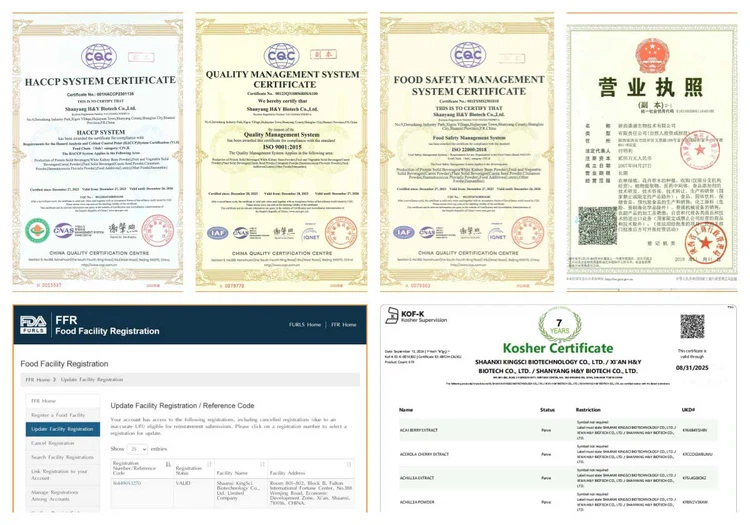
American warehouse

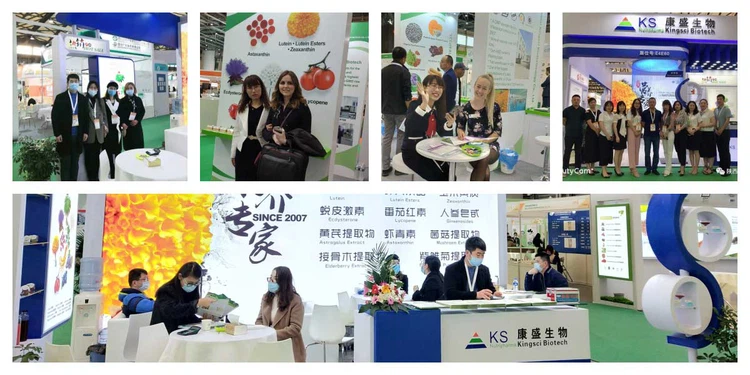
Exhibitions
Hot Tags: gardenia fruit extract, Gardenia Extract,China, manufacturers, suppliers, factory, wholesale, price, pricelist, quotation, bulk, in stock, KOSHER, ISO, HACCP


