


What is Saffron Extract Powder?
Saffron Extract Powder offers a convenient dry extract form that can be used by manufacturers to add saffron to commercial products.
An extract can be specified by measurable features that relate to the purchase of raw material and quality control, whereas with whole saffron material this is not possible. Manufacturers might be interested in either extraction ratio or Crocin and/or Safranal or all three of these parameters depending on the application.
With the different specification requirements of the final product, Kingsci can provide different levels of specifications. The specification itself need not be restricted in terms of the number of marks that can be allocated. A combined specification, e.g., Crocin ≥10% and Safranal ≥2%, may be needed for a formulation.
This flexibility is an advantage such that the raw material does not need to be chosen according to the target formulation of the product, but can be selected based on the actual formulation target.

Technical Profile
|
Parameter |
Details |
|
Product Name |
Saffron Extract Powder |
|
Botanical Source |
Crocus sativus L. |
|
Plant Part |
Stigma |
|
Form |
Fine Powder |
|
Appearance |
Red to reddish-orange powder |
|
Extraction Solvent |
Ethanol / Water |
|
Specification |
Ratio extract and/or standardized Crocin and Safranal |
|
Identification |
TLC |
|
Certifications |
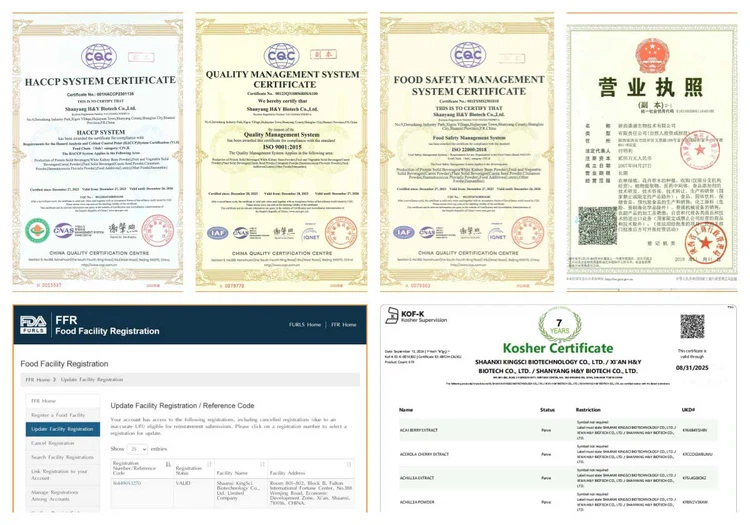
ISO 9001, ISO 22000, HACCP, KOSHER |
What Makes Saffron Extract Different?
The saffron comes from the stigma of Crocus sativus L., whereas botanical extracts are from the leaves, roots, bark, or fruit.
Its typical components are a number of natural compounds such as Crocin, safranal, and picrocrocin, which are known to be related to the chemical and sensory properties.
Different uses of these compounds in Saffron Extract evaluation by manufacturers.
Crocin is an important carotenoid compound found in saffron and is used as a marker in the specification of the standardized saffron extract due to its characteristic color.
An aromatic component that is responsible for the special aroma and can be used as another specification parameter is called Safranal.
Another naturally occurring component is picrocrocin, which gives saffron its distinctive taste.
However, it does not have to contain only one of these constituents, as they are different aspects of the raw material.

Specification Can Follow the Formulation
There is no standard saffron specification for commercial ingredients that can be applied to all ingredients.
If a manufacturer is creating a botanical supplement, they might want to have a certain level of Crocin in their supplement. Other formulations could need to have a certain Safranal level. If it is a more technically defined product, both the components, Crocin and Safranal, shall have to meet the minimum requirements.
Kingsci will work with various specification methods, such as:
Extraction Ratio
If the formulation and purchasing specification is mainly based on the concentration ratio between the botanical raw material and finished extract, such as 10:1 or 20:1, ratio specifications can be used.
Crocin Standardization
Crocin can be specified to varying concentrations depending on the particular formulation desired. Specifications can be created at various levels including 2%, 5%, 10% or 20% or another agreed level.
Safranal Standardization
Safranal could also be a specification parameter, and requirements can be as low as ≥0.1%, as high as ≥1% or ≥2% depending on the intended application.
Combined Markers
If a specific chemical profile is desired by the customer, Crocin and Safranal may be specified.
For example:
Crocin ≥10% + Safranal ≥2%
Such a combined specification can better meet the need for raw materials than the extraction ratio can.
The final specification should be agreed upon, depending on the specification of the formulation objective, analytical requirement, and specification for the finished product.
How to Read a Saffron Extract Specification
There are various specification systems that do not necessarily equate to each other and provide information about the properties of the extract.
The ratio of an extraction is 10:1. Does not directly reflect the concentration of Crocin or Safranal.
Crocin percentages are used to specify the amount of Crocin in the extract.
A Safranal percentage is used to specify the desired level of Safranal.
Combined Specification gives specifications for multiple characteristics.
This is a key factor to consider when comparing suppliers, especially. Crocin and Safranal content in Saffron Stigma Extract may be the same or different, while the marker profile might be different for two saffron extracts with the same extraction ratio, and the Safranal specification might be different for two extracts with the same Crocin content.
Therefore, the manufacturers should take into consideration the real analytical specifications and the test methods, and not only the extraction ratio.
From Botanical Material to Finished Powder
The quality of Crocus Sativus Extract depends on the quality of the raw material used, along with the extraction, concentration, drying, and final quality control process.
The stigmas of Crocus sativus L. are processed to obtain the desired extract, and then the extract is converted into dry powder, which is suitable for handling, ingredients, and formulation.
During processing, processing conditions can affect the physical and chemical properties of the end product. Hence, all the above raw-material selection, raw-material extraction parameters, concentration, drying, and storage will all play a role in obtaining batch consistency.
The final analytical specification is also crucial in supplier qualification for applications since it provides a quantitative set of criteria for comparing and approving raw materials.
You can contact us directly or email donna.zh@kingsci.com to obtain further information and free samples.
Physical Characteristics Matter in Formulation
Pure Saffron Extract is available in dry powder form, but the characteristics in a finished product will depend on the formulation.
Manufacturer(s) should consider:
The ability to handle and flow powders.Handling and flow of powders.
Particle size
Moisture content
Dispersion
Solubility
Color contribution
Aroma
Taste
The ability to mix with other ingredients.Mixing qualities with other ingredients.
The stability of the product during processing and storage.
Saffron may be used at varying inclusion rates; the natural color and aroma of the saffron may become relevant at each of these inclusion rates. They should therefore be evaluated in the end product (finished formulation) and not just based on the botanical name.
Application Opportunities
It can be added to different products as a standardised botanical ingredient.
Nutraceutical Products
Its powder is suitable for testing in capsules, tablets, sachets, stick packs, powdered form, and multi-botanical products.
The chosen specification is appropriate for the manufacturer's chosen marker profile and proposed inclusion level.
Functional Beverages
The Saffron Extract could be used as an ingredient in powdered beverage mixes and other functional beverage ideas.
In these products, the manufacturer needs to consider the dispersion, color, fragrance, flavor, processing, and stability of the end product.
Functional Foods
The powder may be used in selected nutrition powders, bars, and confectionery products and other food formulations using a botanical ingredient suitable for saffron.
The sensory aspect of the extract needs to be tested in the formulation trials.
Personal Care
Additionally, extracts from saffron can be tested in particular cosmetic and personal care products such as creams, masks, serums and botanical mixtures.
When choosing a grade for cosmetic use, one should consider the color, odor, compatibility with the base, stability, and regulatory requirements of the grade selected.

A Practical Route from Sample to Production
Saffron extract selection can be approached as a specification-matching process:
Application → Target Marker → Specification → Sample Evaluation → Technical Approval → Bulk Supply
The target marker can be crocin, Safranal, the ratio of both, or an extraction ratio.
Once the target is determined, the extract can be analysed for its analytical profile, physical properties, sensory attributes, compatibility, and performance in the finished product.
This helps manufacturers to choose a saffron ingredient that meets their actual product requirements, and not just from a standard supplier catalogue.
FAQ
What is Saffron Extract Powder?
Saffron Extract Powder is a dried Saffron extract obtained from the stigmas of Crocus sativus L. It is offered as a quality-controlled ingredient in nutraceutical, food and beverage, as well as certain cosmetic products.
What specifications can Saffron Extract Powder have?
Saffron extract may be used in specification by extraction ratio, Crocin content, Safranal content, or both. Specifications will depend on the application and may be discussed.
Can Crocin and Safranal be specified together?
Yes. Saffron extract can be provided together with the combination of marker requirements. For instance, Customers can ask for a specific content, e.g., Crocin ≥10% + Safranal ≥2% (depending on the availability of the product and validation by analysis).
What is Crocin used for in Saffron Extract?
Crocin is a natural component of saffron and may be used as an analytical marker in the definition of a standard saffron extract specification.
What is Safranal in Saffron Extract?
Safranal is an aromatic component that is naturally found in saffron. This can be used as a specification parameter for manufacturers that need a specified Safranal level.
Can I request a customized Saffron Extract specification?
Yes. Before sample evaluation, manufacturers can consult Kingsci about the desired extraction ratio, the required Crocin concentration, the required Safranal concentration, the required combined concentration of both markers, and their application and quantity.
Certifications
American warehouse

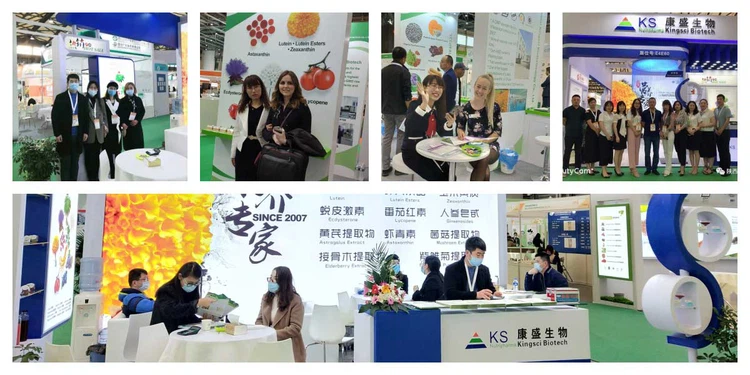
Exhibitions
Hot Tags: Saffron Extract Powder


