

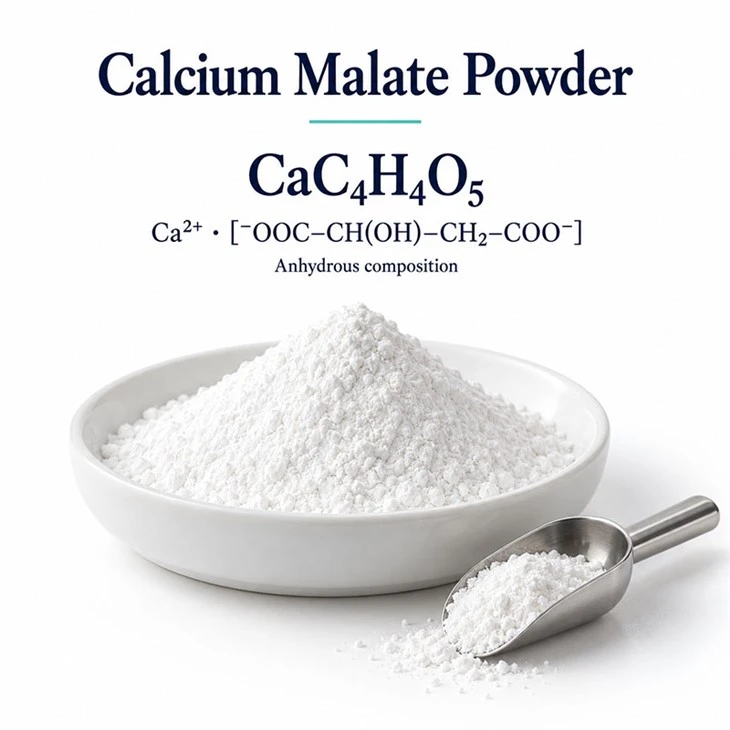
What is Calcium Malate Powder?
Calcium Malate Powder is a calcium salt of malic acid, ideal as a mineral ingredient in nutritional products and supplements, fortified foods, and specialized nutritional formulations. Chemically, it is a combination of calcium and malate; it has potential interest for manufacturers considering organic acid-based calcium sources for specific formulation needs. In commercial ingredient selection, it is unique because of the malate component that can alter the processing performance and solubility of the ingredient as it is used in a specific formulation environment, so it is best to check the calcium malate's application conditions and specifications supplied by the supplier. It can be used as a mineral premix, capsule and tablet formulation, powdered nutrition product, fortified food systems, and other products where the composition of the ingredient fits the intended formulation for the manufacturer. Technical teams should evaluate the calcium elemental concentration, particle size, powder flow, moisture content, and compatibility of the ingredients during product development to ensure proper dosing and batch processing. Organic acid-based formulations and other mineral salt and/or moisture-sensitive formulation components should also be subjected to additional compatibility testing to assess physical stability and processing characteristics. It is important for procurement and quality assurance teams to check whether the product contains the ingredient, the method for the assays, the percentage of elemental calcium present in the product, the levels of impurities, and whether the product meets the required microbiological specifications, and not just its name.
COA
| Item | Specification | Result | Test Method |
| Appearance | White to off-white powder | White powder | Visual |
| Odor | Odorless or characteristic | Odorless | Organoleptic |
| Identification | Positive | Complies | Chemical Identification |
| Calcium Content | ≥17.00% | 17.26% | ICP-OES |
| Assay (Calcium Malate) | ≥98.00% | 98.31% | Chemical Analysis |
| Loss on Drying | ≤ 5.0% | 2.10% | USP / Gravimetric |
| pH (1% Solution) | 5.0–8.0 | 6.5 | pH Meter |
| Particle Size | 100% Passes 80 Mesh | Complies | Sieve Analysis |
| Bulk Density | Report | 0.65 g/mL | Bulk Density Test |
| Arsenic (As) | ≤ 2.0 mg/kg | 0.15 mg/kg | ICP-MS |
| Lead (Pb) | ≤ 2.0 mg/kg | 0.20 mg/kg | ICP-MS |
| Cadmium (Cd) | ≤ 1.0 mg/kg | 0.08 mg/kg | ICP-MS |
| Mercury (Hg) | ≤ 0.1 mg/kg | Not Detected | ICP-MS |
| Total Plate Count | ≤ 1,000 CFU/g | 120 CFU/g | USP / Microbiological Method |
| Yeast and Mold | ≤ 100 CFU/g | 20 CFU/g | USP / Microbiological Method |
| Escherichia coli | Absent in 10 g | Absent | USP / Microbiological Method |
| Salmonella | Absent in 25 g | Absent | USP / Microbiological Method |
Are you interested in our products? Just contact us directly or email donna.zh@kingsci.com to obtain further information and free samples!
Why Choose Calcium Malate?
1. Malate-Based Composition
When choosing raw materials for the formulation of specific products, calcium malate can be used as a calcium ingredient in addition to citrate-, carbonate-, lactate-, and bisglycinate-based Calcium Ingredients.
2. Potential Formulation Flexibility
As a malate, it offers an alternative for the formulation of mineral blends and nutritional formulations, especially when the composition of the minerals used in the formulation should be identical to the acid profile of the product and the ingredient system.
3. Alternative to Carbonate-Based Calcium
It is not a calcium carbonate, but rather an organic acid salt. This difference may be of interest when considering the chemistry of the ingredients, interactions with acids, and processing needs.
4. Useful for Customized Mineral Blends
It can be tested with the other mineral salts in a premix and multi-mineral formulation. Compatibility testing can be used to see if it is the correct composition and processing.
5. Suitable for Diverse Product Formats
It can be considered for various tablet, capsule, powdered nutritional, and fortified food applications depending on the grade and the formulation conditions.
6. Specification-Based Ingredient Selection
When comparing the calcium content of elemental calcium, powder characteristics, impurity limits, and analytical specifications by various calcium sources, it provides a new option for the manufacturers.
How to Choose the Right Calcium Salt?
1. Elemental Calcium Content
Use the concentration of calcium in each salt to find out how much of each ingredient to use and the effect that this will have on the composition and cost of the finished product.
2. Finished Product Format
Take into consideration how the ingredient will be available for use in tablets, capsules, powdered blends, or beverages. The processing efficiency and the consistency of the dosage may be affected by particle size, bulk density, and flow properties.
3. Solubility Requirements
For liquid formulations, consider solubility or dispersion given the actual production conditions (pH, ingredient concentration, etc.). Not all applications need to be completely dissolved.
4. Ingredient Compatibility
Determine interactions with other minerals, organic acids, proteins, and stabilizers. In the pre-liability trials, one can detect precipitation and/or changes in texture or other formulation problems before scale-up.
5. Sensory Characteristics
Consider taste, mouthfeel, color, and appearance – especially for flavored powders and beverages and fortified food products.
6. Quality Specifications
Ask for an up-to-date specification sheet and batch-specific Certificate of Analysis (COA). Test the identity of ingredients, calcium content, limits of impurities, and microbiological tests against your quality requirements.
7. Regulatory Suitability
Ensure that the chosen Calcium Salt meets requirements and is approved for use for the intended purpose in the target market.
8. Supply and Production Costs
Make sure to consider minimum order quantity, delivery time, packaging, batch uniformity, and overall formulation cost, not just the price per kg.
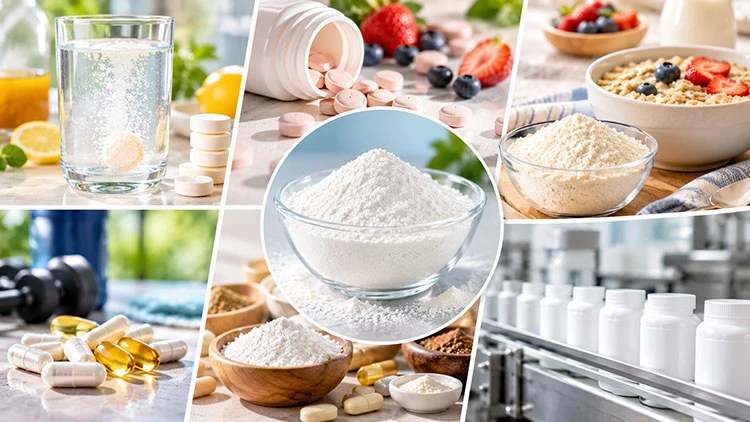
Applications
1. Effervescent and Instant Formulations
Calcium Malate may be used to evaluate instant products containing the minerals, and compatibility testing is required to determine its compatibility with the other ingredients in the product, including acids, carbonates, and other minerals.
2. Chewable Product Development
It can be used in chewable formulations where ingredients may need to be loaded, the tablet hardness needs to be balanced with the masking of the flavor, and ingredient size needs to be considered.
3. Food Fortification Premixes
Evaluate as a calcium source for specific fortification programs, depending on the grade of the ingredient, permitted use, and compositional requirements for the food.
4. Specialty Nutrition Manufacturing
Specialty product developers can consider it when developing mineral profiles for specific product characteristics and/or target consumer groups.
5. Multi-Mineral Ingredient Systems
It can be added to mineral blends that are formulated with the intended level of calcium in the blend, and interactions with other mineral ingredients have been established.
6. Contract Manufacturing and Private-Label Products
It can be evaluated by ingredient suppliers and contract manufacturers for specific formulations for customers, based on verified specifications, processing trials, and destination market requirements.
FAQ
1. What is Calcium Malate Powder?
Calcium Malate Powder is a calcium salt of malic acid for use as an ingredient in specific food and nutritional formulations as a source of calcium.
2. What is Calcium Malate Powder used for?
It can be used in mineral blends, chewables, special nutrition formulations, and approved food fortification products.
3. Is Calcium Malate Powder water-soluble?
It is not as soluble as other grades under different test conditions. Be sure to check the technical data from the supplier before using in liquid formulations.
4. How should Calcium Malate Powder be stored?
Keep in a secure, moisture-free, and uncontaminated location, in a tightly closed container in a cool, dry environment.
5. What documents should buyers request?
Ask for a product specification sheet, batch-specific COA, and technical documents to ensure quality and suitability of application.
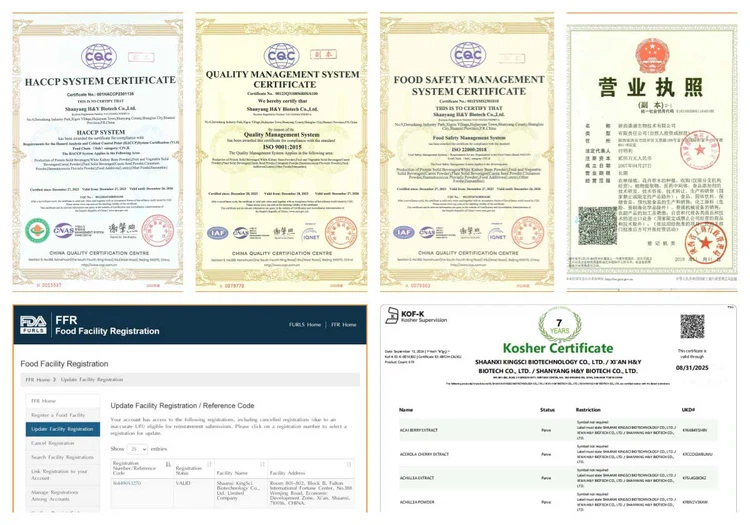
Certifications
American warehouse

Exhibitions

Hot Tags: calcium malate powder, China, manufacturers, suppliers, factory, wholesale, price, pricelist, quotation, bulk, in stock, KOSHER, ISO, HACCP


