

What is Glabridin Extract?
Glabridin Extract is a botanical extract derived from the roots of Glycyrrhiza glabra or licorice. When manufacturers extract and purify glabridin, an isoflavan compound that occurs in small amounts naturally in the botanical material, this compound is extracted and purified to obtain a unique component called glabridin. It is in the global ingredient supply chain in the form of a standardized plant extract, in which there are well-defined specifications of the active content, and this allows uniform quality in an application to industry. The ingredient is mostly distributed to cosmetic manufacturers, formulation labs, and distributors of raw materials that need dependable botanical actives to use in contemporary development of personal-care products. It is a common botanical ingredient in products that underline the use of plant-based actives and the use of natural ingredients. It has a chemical profile comprising phenolic structures that are usually linked to antioxidant properties. It can be utilized in ingredient systems to help stabilize products and to aid the formulation plans of plant-based systems. Since the extract is derived from licorice root, it is also a good fit with clean-label product ideas that promote familiar botanical ingredients and traceable sources of the raw material. Therefore, it is often found in high-end skincare products like serums, emulsions, botanical complexes, and high-end cosmetic bases designed by contract manufacturers and international cosmetic firms.

COA
| Item | Specification | Result | Method |
| Assay (Glabridin) | ≥ 98.0% | 98.25% | HPLC |
| Appearance | White powder | White powder | Visual |
| Odor | Characteristic | Conforms | Organoleptic |
| Identification | Positive | Conforms | HPLC |
| Particle Size | 95% pass 80 mesh | Conforms | Sieve Analysis |
| Loss on Drying | ≤ 5.0% | 2.13% | CP Method |
| Ash Content | ≤ 5.0% | 1.84% | CP Method |
| Heavy Metals | ≤ 10 ppm | <10 ppm | ICP-MS |
| Lead (Pb) | ≤ 2 ppm | 0.42 ppm | ICP-MS |
| Arsenic (As) | ≤ 2 ppm | 0.28 ppm | ICP-MS |
| Cadmium (Cd) | ≤ 1 ppm | 0.09 ppm | ICP-MS |
| Mercury (Hg) | ≤ 0.1 ppm | 0.02 ppm | ICP-MS |
| Total Plate Count | ≤ 1000 CFU/g | 120 CFU/g | AOAC |
| Yeast & Mold | ≤ 100 CFU/g | 20 CFU/g | AOAC |
| E. coli | Negative | Negative | AOAC |
Where to Buy Glabridin Extract?
Just leave a message on this page or Contact Us Directly to get free samples and more professional support!
Features
The Glabridin Powder has a number of unique physicochemical characteristics that render it useful as a cosmetic formulation and ingredient development. Based on the extracts of Glycyrrhiza glabra, it is an isoflavan compound having a polyphenolic structure, which provides the extract with an antioxidant-related chemical profile and interacts with other plant-derived actives. It is used in its standardized form, which is normally presented as a light brown to white powder or concentrated extract, with a relatively low level of moisture and with a controlled particle size, which aids in uniform dispersion during formulation procedures. The compound is also well compatible with most cosmetic ingredient systems, especially emulsions, serums, and botanical complexes, with which it can be used with other plant extracts, oils, and functional cosmetic ingredients. Formulation Formulators tend to use glabridin, where it is preferred that the compound not be highly lipophilic, i.e., higher than in pure water, and in some cases, it is found to be more soluble in particular organic solvents and in oil phases, which will be taken into account by the formulator when creating a delivery system or a base in emulsion. Also, it is regularly manufactured with assay ranges that are well defined based on analytical procedures, e.g., HPLC, which enables formulators to maintain the same level of active content in each production lot.
How to Store Properly?
1. Maintain a Cool and Dry Warehouse Environment
To prevent damage to the physical properties of the extract and the chemical stability, store the material in a controlled, low-humidity, and stable temperature storage area.
2. Keep the Original Sealed Packaging Intact
The manufacturers should ensure the inner liner and outer container are sealed until the material is needed in production, since the product can be packed already to the industry standard.
3. Protect From Direct Light Exposure
Store the containers where there is shading or closed shelving systems so that they will not have to be exposed to strong light over a long period of time, which can cause instability of some sensitive botanical compounds.
4. Avoid Contact With Excess Moisture
Despite the packaging of the extract with protective substances, the maintenance of the storage area at dry conditions helps to avoid moisture uptake and maintains the powder flow consistency.
5. Use Clean Handling Procedures After Opening
In case the container is opened to sample or partially used, close it immediately and with clean materials in order to prevent the introduction of contaminants when handling the container.
6. Store Away From Strong Odor Sources
In the poorly managed environment, Licorice Glabridin may absorb the surrounding odors and thus, maintaining the product in isolation from highly smelling materials is beneficial to retain the original profile of the product.
7. Apply Inventory Rotation Practices
The manufacturers are encouraged to observe conventional inventory management practices, including first-in-first-out (FIFO), so that old batches can be used before the new ones when planning production.

Recommended Usage
Glabridin is commonly used as a functional botanical ingredient in a variety of formulation systems, and the mixing method must be varied depending upon the product system. With cream or lotion emulsions, the extract is typically dissolved or dispersed in the oil phase or a solvent phase that is compatible and then emulsified, and this will aid in the distribution of the extract and also stop localized aggregation in high-shear mixing. In the case of serums and liquids of the essence type, the extract may be added slowly to the aqueous or cosolvent phase under stirring until evenly dispersed. In many cases, preliminary dissolution in an appropriate carrier is added to increase compatibility with the underlying formula. When using the ingredient in the form of a mask (like gel masks or sheet-mask essence liquids), the ingredient is usually incorporated at the cooling step or post-emulsification phase to ensure stability without mixing with the remaining botanical extracts or humectant systems. In the case of ampoule or concentrated bases of skincare, the formulators usually pre-mix the extract with solubilizers or botanical complexes, and then finish the mixing of the batch, after which the active ingredient is uniformly dispersed across the entire final product. In these dosage formats of cosmetics, the concerns the manufacturers have mostly are controlled dispersion, compatibility with the preferred solvent or emulsion system, and gradual incorporation during the mixing process to ensure that there is stable and homogenous ingredient incorporation in the large-scale production of skin care.
Certifications
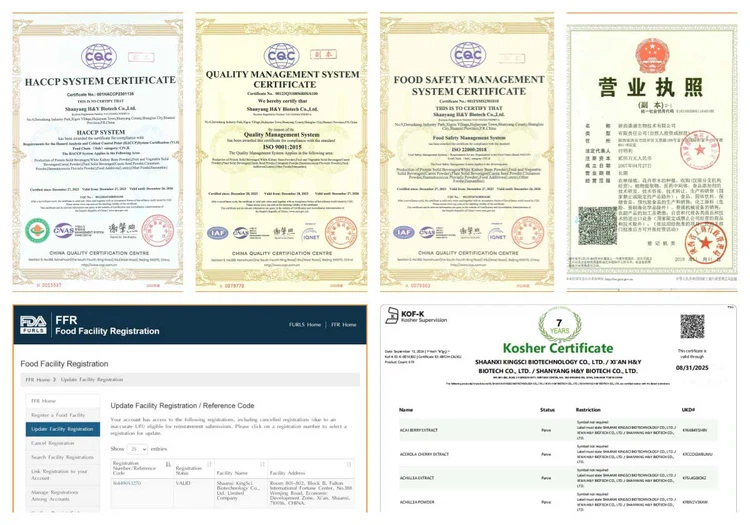
American warehouse

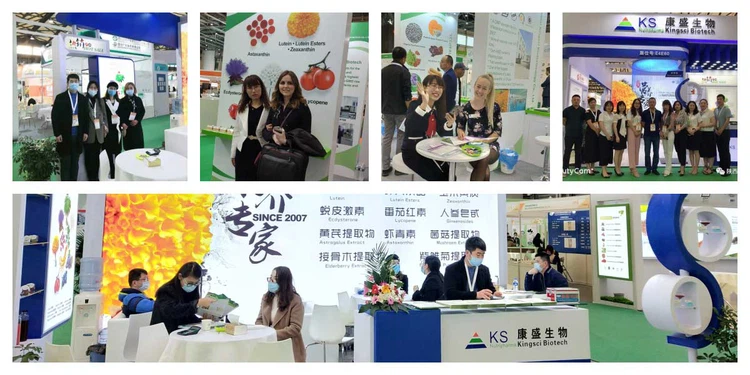
Exhibitions
Hot Tags: glabridin extract, China, manufacturers, suppliers, factory, wholesale, price, pricelist, quotation, bulk, in stock, KOSHER, ISO, HACCP


