


What is Pure Chlorophyll Powder?
Pure Chlorophyll Powder is a very sophisticated chlorophyll-based ingredient that is the result of a selective extraction and purification process to provide a high concentration of compositionally specific green pigment with little use of auxiliary plant factors. It is also a precision input and not a general botanical extract that is more specific to the chlorophyll profile and assists in technical consistency, color control, and formulation control in the industrial setting. Unlike the wider chlorophyll powders, the pure designation is often a narrower specification range, less variation, and more application to the uses where formulation transparency, ingredient standardization, and reproducibility are very important. It is treasured for its consistency in its performance under various processing conditions, such as blending, dispersion, and subsequent conversion into intermediate systems. The fact that its purity can be controlled to a fine line allows the manufacturers to adjust the intensity and shade of colors without adding undesired sensory and compositional parameters, especially in the multi-ingredient systems and contract manufacturing. The powder form enables effective logistics, scalable dosing, and placement in automated manufacturing processes, and allows clean-label and plant-origin positioning where local regulatory frameworks allow it.

COA
| Item | Specification | Result | Method |
| E Number | E140 | E140 | Regulatory Standard |
| Source | Spinach / Alfalfa / Botanical Leaves | Spinach | Supplier Documentation |
| Color | Dark Green Powder | Dark Green Powder | Visual Inspection |
| Chlorophyll Content | ≥ 2.0% (w/w) | 2.10% | UV-Vis Spectrophotometry |
| Color Value (Coloring Power) | ≥ 1200 (per ISO 970) | 1230 | UV-Vis Spectrophotometry / ISO Method |
| Moisture | ≤ 8% | 6.00% | Karl Fischer / Oven Drying |
| pH (1% solution) | 6.0 – 7.5 | 6.9 | pH Meter |
| Solubility | Water Dispersible / Oil Dispersible | Water Dispersible | Visual / Solubility Test |
| Particle Size | 100% through 80 mesh | Pass | Sieving |
| Loss on Drying | ≤ 8% | 6.00% | Gravimetric Method |
| Ash Content | ≤ 5% | 3.20% | AOAC 923.03 |
| Lead (Pb) | ≤ 2 ppm | 1.1 ppm | ICP-MS |
| Arsenic (As) | ≤ 1 ppm | 0.4 ppm | ICP-MS |
| Cadmium (Cd) | ≤ 1 ppm | 0.3 ppm | ICP-MS |
| Mercury (Hg) | ≤ 0.1 ppm | <0.05 ppm | ICP-MS |
| Total Plate Count | ≤ 1000 CFU/g | 400 CFU/g | ISO 4833 |
| Yeast & Mold | ≤ 100 CFU/g | 45 CFU/g | ISO 21527 |
| E. coli | Negative | Negative | ISO 16649 |
| Salmonella | Negative | Negative | ISO 6579 |
Are you interested in our products? Just leave a message on this page or Contact Us Directly to get free samples and more professional support!
Features
Chlorophyll Powder is characterized by a high pigment composition with very well-defined physical and chemical properties, which make it useful in pure formulation. It contains higher levels and less non-pigment plant solids, which leads to high levels of uniform color strength, whereby formulators can produce the required green shade at lower and more predictable levels of inclusions. Physicochemically, the powder generally has a controlled distribution of particle size and low moisture content, enhancing flowability, caking reduction, and enhanced doses in automated production processes. Even the chlorophyll molecules are sensitive to light, oxygen, and pH, and the resulting reactivity is dealt with using standardized processes and stabilization techniques, which assist in preserving the color when subjected to normal manufacturing and storage conditions. Grades may be designed to exhibit a desired dispersion behavior, allowing easy addition to either an aqueous or lipid-based medium with very minimal effects on the texture or appearance. To formulation teams, these characteristics will be reflected in terms of increased reproducibility, scale-up, and confidence in color performance between batches and production settings, and the ingredient will be a technically reliable option in industrial use.
How to Store Properly?
1. Store in a Cool, Controlled Environment
Store the product in a non-heated warehouse without heat sources because high temperatures may accelerate the decay of the pigments and decrease the color permanence.
2. Protect from Direct Light Exposure
Though the product is packed in protective packaging, it should not be stored in direct sunlight or high intensity of artificial light as a secondary storage, where the pigment integrity of the product may be affected during the long winter storage.
3. Maintain a Dry Storage Area
This is to ensure that the storage space is of low relative humidity to avoid moisture intrusion once opened, because high humidity can impact flow characteristics and handling action.
4. Keep Packaging Tightly Sealed After Opening
After the original packaging is opened, seal it as soon as possible and in a secure manner in order to minimize the amount of air and contaminants from the environment when using it in further production activities.
5. Avoid Proximity to Reactive or Odorous Materials
Keep apart strong oxidizing agents, solvents, or high odor materials, as this will reduce chances of cross-interaction or impact on odor, which may affect downstream uses.
6. Use Clean Handling and Transfer Procedures
When repacking or transferring internally, clean and dry tools and containers must be used to ensure the integrity of the Sodium Copper Chlorophyllin Powder products and not to add foreign materials to the powder.
7. Apply First-In, First-Out (FIFO) Inventory Management
Adopt FIFO with the old batches being consumed first, as the consistent batches will provide good color performance, and will be in line with the recorded shelf-life requirements.

Recommended Usage
Green Chlorophyll Powder is usually added as a functional color and formulation ingredient with processing technologies modified to suit the dosage form of interest. In the manufacture of capsules and tablets, the powder is typically pre-mixed with any other excipient that is compatible with the powder in order to achieve homogenous distribution and color stability, and the size of the particle is matched, and low-shear mixing is performed to prevent segregation during compression or encapsulation. The low level of its inclusion and even its color strength enable the formulators to adjust the visual performance readily without significant impact on the tablet hardness, flow, or fill weight. The powder is typically added in a controlled dispersion step in liquid forms, often in a premix to allow the formation of even colors and reduce agglomeration; in order to have a stable appearance throughout the processing, pH control and mixing sequence are the main factors to be considered. In all formats, it is suggested to add gradually under controlled mixing conditions and test as a pilot scale in order to control the dispersion behavior and batch-to-batch reproducibility. The practices allow the manufacturers to incorporate it into a variety of different formulations and retain process stability, visual consistency, and production scale.
Certifications
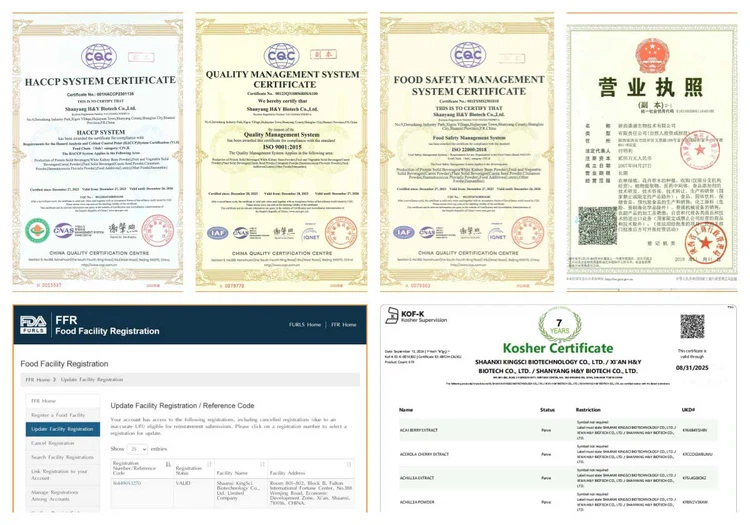
American warehouse

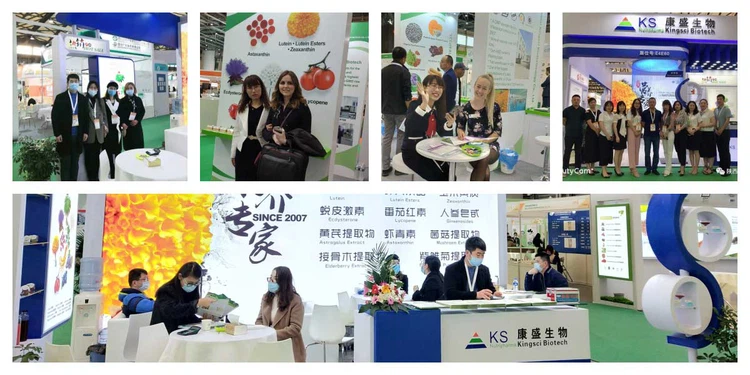
Exhibitions
Hot Tags: pure chlorophyll powder, China, manufacturers, suppliers, factory, wholesale, price, pricelist, quotation, bulk, in stock, KOSHER, ISO, HACCP


