


What is Butterfly Pea Flower Extract?
Butterfly Pea Flower Extract is a standardized botanical ingredient that is produced by extracting the water-soluble components of Clitoria ternatea flowers in a controlled method of extraction and concentration, producing a refined, performance-oriented, and not just milled flower powder. Manufacturing-wise, the extract is mainly appreciated due to its higher color intensity, better batch-to-batch consistency, and higher formulation efficiency; thus, the extract can be used in industrial settings where a high level of color control and scaleability is needed. The extraction process enables manufacturers to concentrate the naturally available blue pigments and minimise the insoluble plant fibers, which enhances greater clarity in the liquid systems, facilitates filtration, and ensures a more predictable behavior during processing, storage, and subsequent formulation. It will be a natural blue color food, beverage, nutraceutical, and personal care ingredient that will be marketed in commercial supply chains as a solution with a standard appearance and clean-label requirement. The extract form allows reduced inclusion levels, easier dosing, and easier integration with automated production lines compared to powder forms. This is especially beneficial to OEM, ODM, and own-label manufacturers on a large scale.

COA
| Item | Specification | Result | Method |
| Botanical Source | Clitoria ternatea L. | Conforms | - |
| Part Used | Flower | Conforms | - |
| Appearance | Fine powder | Conforms | Visual |
| Color | Blue to dark blue | Conforms | Visual |
| Odor & Taste | Characteristic | Conforms | Organoleptic |
| Extract Ratio / Active | ≥ 10% Anthocyanins (UV) or Ratio 10:1 (depending on spec) | 10.8% Anthocyanins | UV |
| Mesh Size | 95% pass 80 mesh | Conforms | USP |
| Loss on Drying | ≤ 5.0% | 3.21% | USP <731> |
| Ash | ≤ 5.0% | 2.85% | USP <281> |
| Solubility | Water soluble | Conforms | - |
| Bulk Density | 0.35–0.75 g/ml | 0.52 g/ml | - |
| pH (1% solution) | 5.0–7.5 | 6.2 | - |
| Heavy Metals | ≤ 10 ppm | < 10 ppm | ICP-MS |
| Lead (Pb) | ≤ 2.0 ppm | < 2.0 ppm | ICP-MS |
| Arsenic (As) | ≤ 1.0 ppm | < 1.0 ppm | ICP-MS |
| Cadmium (Cd) | ≤ 1.0 ppm | < 1.0 ppm | ICP-MS |
| Mercury (Hg) | ≤ 0.1 ppm | < 0.1 ppm | ICP-MS |
| Total Plate Count | ≤ 10,000 cfu/g | < 1,000 cfu/g | USP |
| Yeast & Mold | ≤ 1,000 cfu/g | < 100 cfu/g | USP |
| E. coli | Negative | Negative | USP |
| Salmonella | Negative | Negative | USP |
Are you interested in our products? Just leave a message on this page or Contact Us Directly to get free samples and more professional support!
Features
A set of physical and chemical properties that Clitoria Ternatea Flower Extract is characterized by renders this variety of extract very appealing to formulators who are interested in natural coloration and spontaneous processing behavior. The extract contains substantial quantities of anthocyanin derivatives, which are highly soluble in water, and these give the extract a high chromatic range and enable the extraction to deliver colour at comparatively low levels of inclusion, leading to accurate colour adjustment and economical make-up. Whole plant powders have a higher turbidity than their molecular structure can allow, as it allows them to be well dispersed in aqueous systems and clear solutions, provided they are filtered correctly. The pigments have well-defined pH sensitivity, being stable and appearing blue in neutral to mild alkaline conditions and changing to violet colors when the environment becomes more acidic, which can be exploited by the formulators to maintain color stability or intentionally exploited to produce visual color differentiation. On the side of processing, the extract is well compatible with most of the thermal treatments typically applied in the production of food and cosmetics, when controlled in time and temperature of exposure, and consistent with most of the standard formulation matrices. Moreover, it has a uniform extract profile per batch across batches, the ability to easily control quality, and predictable interactions with other formulation ingredients, which, in technical terms, offers technical certainty in batch production without synthetic color systems.
How to Store Properly?
1. Controlled Ambient Environment
The containers should be stored in a warehouse in a cool, dry and well ventilated place. Constant ambient conditions prevent the amount of moisture picked and the danger of slow corrosion of color as time goes on.
2. Protection from Light Exposure
Do not store the product in direct sunlight or intense artificial light. Extended exposure to light may cause a change in the stability of the pigments; hence, it is advisable to store under shade or in a closed space, even in cases where the bottling or container has not been opened.
3. Packaging Integrity Management
Keep in the original package until use, and the containers should be resealed immediately after each withdrawal. This habit reduces the amount of contact with air and humidity that is unnecessary to it and facilitates the provision of uniform quality across numerous production batches.
4. Segregation from Reactive Materials
Do not store the Blue Pea Flower Extract around substances that are highly acidic, alkaline, or volatile. Physical separation will aid in avoiding unexpected exposure that can affect a color property or the material's behavior.
5. Inventory Rotation and Traceability
A first-in, first-out (FIFO) inventory system should be implemented, and batch identification documents should be maintained. Correct rotation and traceability promote quality control and ensure the proper use of the extract within the suggested storage duration.

Recommended Usage
Fabricationally speaking, Butterfly Pea Flower Tea Extract would be best utilized as a functional ingredient that supports a formulation, wherein concern is made to dispersion, compatibility, and process sequencing of the various dosage forms. In the capsule and tablet systems, the extract is normally pre-mixed with the appropriate carriers or excipients to avoid segregation, uniform distribution, and the pigment to be expressed consistently in the final unit, and low-shear mixing is usually desirable to preserve the integrity of the pigment during dry processing. In the case of making tablets, limiting exposure to moisture in the granulation and compression processes is used to avoid color change and visual differences. When using liquid formulations, the extract must be added to the aqueous phase under controlled agitation to ensure that it fully dissolves, and then the acids, flavours, or other reactive ingredients can be added, which aids in maintaining clarity and consistent color behaviour. In all formats, manufacturers gain the advantage of pilot-scale testing to optimize levels of inclusion, mixing sequence, and processing, which makes the extract integrate with already-established production lines effectively and provide stable performance in terms of functionality and appearance without the need to change the fundamental structure of the formulation.
Certifications
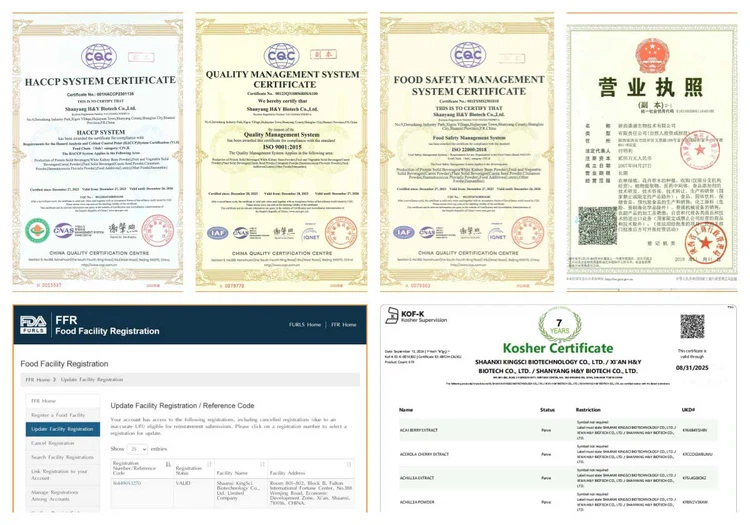
American warehouse

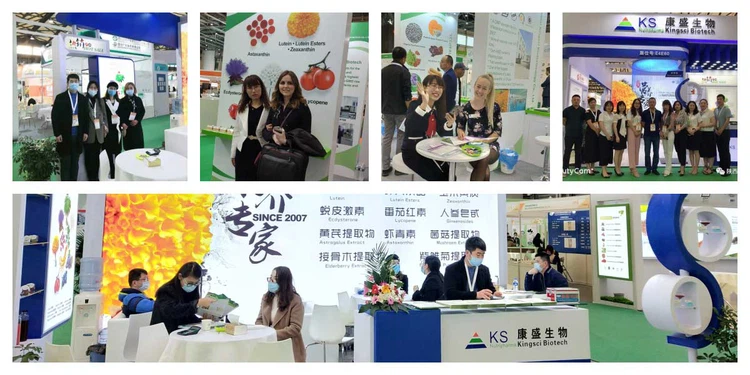
Exhibitions
Hot Tags: butterfly pea flower extract, China, manufacturers, suppliers, factory, wholesale, price, pricelist, quotation, bulk, in stock, KOSHER, ISO, HACCP
