

Manufacturers can enjoy Beta-carotene Oil's benefits of lipid-phase incorporation, assay-based dosing, and controlled carotenoid color. Kingsci offers sunflower-oil suspensions in HPLC grade (5%, 10%, 20%, 30%), where the results are dependent on the process fit, dispersion, and storage.
Beta Carotene Oil Benefits for Formulators
In this context, 'benefits' are not health benefits, but formulation value. Beta-carotene (a provitamin A source) is a lipophilic pigment that is used as a colouring agent in food and in relevant food applications. If it is in an oil suspension, its value is related with the oil formulation that it comes in and its compatibility with the oil-based systems.
1. Oil-phase addition:
Add the suspension to a compatible lipid phase, instead of preparing a separate powder preblend, and measure the suspension.
2. Known carrier:
Sunflower oil helps determine the fit for the existing oil phase and the requirements of the ingredient label.
3. Flexible concentration:
Choose an assay grade that is the same as the batch size, desired content, and dosing precision.
4. Color function:
Yellow to orange-red shades are achieved by using beta-carotene, concentrating on the product matrix and concentration.
These are technical benefits and no indication that one grade is appropriate for all applications.
Beta Carotene Oil for Lipid-Based Products
The direct evaluation of beta-carotene in products in which the lipid phase is compatible is the most direct evaluation of an oil suspension.
1. Softgel fills:
Test the compatibility of fill oil and viscosity, dispersion, filling conditions, and performance of capsule shells.
2. Oil-based liquids:
Control mixing and verify the color and assay uniformity in the oil phase.
3. Fat-containing foods:
Test some of the more common spreads and fat blends. The results will vary with the base fat, the temperature, and the mixing.
4. Emulsified products:
Suspensions are not necessarily water-dispersible. For systems in water, an appropriate emulsifier and homogenization might be required.
Research indicates that the composition of the oil, the ratio of oil to water, the size of the droplets, and the structure of the interface can influence the stability and bioaccessibility of carotenoids in emulsions. An oil carrier is a beginning, but not a guarantee of all performance.
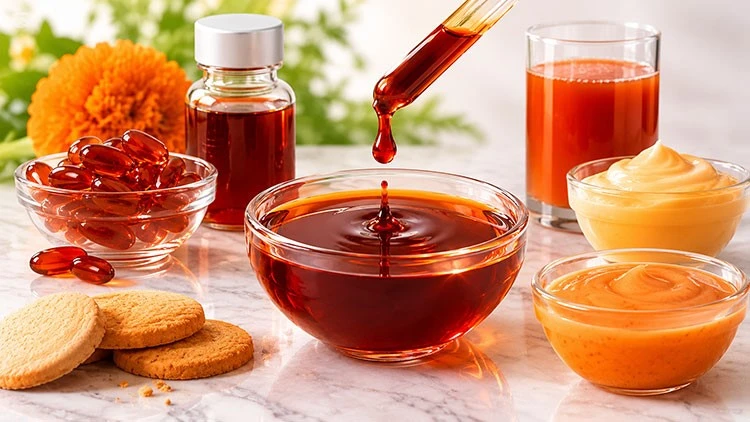
Beta Carotene Oil Dosage and HPLC Assay
Calculate addition from the beta-carotene assay, not the total suspension weight.
1. Use the assay fraction:
A product with a 30% grade has 0.30 g per gram of ingredient (w/w) grade for beta-carotene.
2. Apply the formula:
Input of ingredients = the amount of ingredients needed to get the required amount of active ingredient/assay fraction.
3. Compare grades:
The theoretical inputs for a test batch to provide 3 mg of beta-carotene are 10 mg of 30%, 15 mg of 20%, 30 mg of 10%, or 60 mg of 5% suspension.
4. Check retention:
Final product content may be impacted by the mixing, transferring, heating, and storage processes; check finished product levels as required.
This is a formulating calculation, NOT a daily dose recommendation. Use must conform to product specifications, rules for foods in a specific category, market regulations and validated serving design.
Beta Carotene Oil for Color Consistency
Products coloured in a lipid phase can be processed in an oil format, but the resulting colour of the product cannot be assessed by assay alone.
1. Test in the real matrix:
The colour of a vial may not be the same as that of the bulk oil or final product.
2. Maintain uniformity:
Shade differences can be problematic, as can inconsistencies in the assays due to incomplete mixing.
3. Standardize production:
Ensure that all addition orders, mixing times, temperatures, and sampling points remain the same.
4. Set a target:
Make comparisons between samples under specific lighting and packaging circumstances.
But just because it is a higher assay doesn't mean it will produce a better color. Choose the length of the grade to be used and how well the grade is able to distribute the shade.
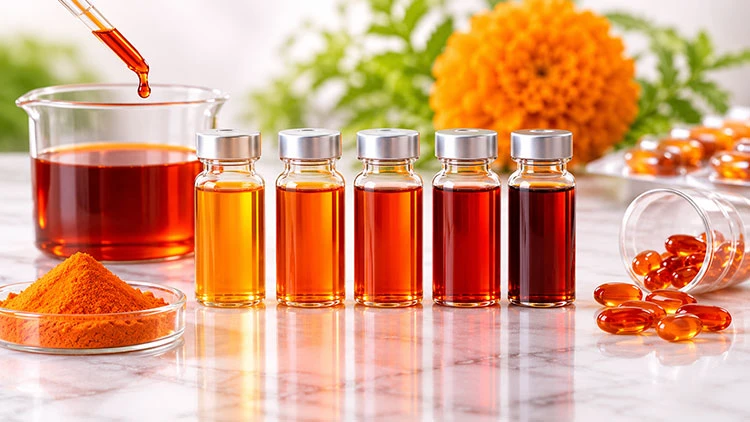
Beta Carotene Oil Stability During Processing
Beta-carotene can be oxidized or isomerized (converted) by light, oxygen, and heat. Avoid unnecessary exposure during processing.
1. Protect from light:
Avoid exposure when weighing and transferring; use light-resistant containers.
2. Limit oxygen:
Take care not to leave containers open for too long, and do not over-aerate when mixing.
3. Control heat:
Don't have long high-temperature holds; select an addition point that is validated for the process.
4. Monitor the oil:
Other tests of oil quality, such as peroxide value, can be included as part of the approved specification.
5. Validate shelf life:
Beware of stability – don't assume that because a carrier is called "stable" it is stable. Apply use of data to the actual grade, formulation and pack.
The role of carotenoids in food processing and storage is described in the research. Another study of the emulsion formulation reveals that the performance of beta-carotene can also be affected by the type and structure of the carrier lipid. The information and data required for shelf-life statements are thus product-specific.
Beta Carotene Oil Suspension: Handling and Quality
An oil suspension will not be a true solution of the oil. Particles may separate from the formulation (depending on formulation and storage history).
1. Inspect before sampling:
Look for any separation and follow the existing TDS.
2. Mix as instructed:
Sample or produce using the validated agitation procedure; use no more than the required amount of air.
3. Take representative samples:
Take samples only when the sample is uniform.
4. Confirm scale-up:
There may be differences between the performance in a laboratory mixer and a production tank.
To check for supplier approval, check the batch COA and TDS. Examine HPLC assay, identification, carrier declaration, appearance, and appropriate limits for oil quality, contaminants, and microbiological limits. The actual results from the batch and NOT representative examples of results should be included on the COA.
Beta carotene oil benefits
Lipid-phase compatibility, assay-based dosing, and carotenoid color contribution are benefits of the practical beta-carotene oil. Control of carrier compatibility, uniformity of suspensions, exposure during the process and storage, and batch verification is necessary for consistent results. Choose a grade from pilot trials, rather than concentration alone, and from current quality documents.
Do you have a different opinion? Or need some samples and support? Just email donna.zh@kingsci.com or Contact Us Directly to get free samples and more professional support!
FAQ
1. What are the main benefits of beta carotene oil in food formulation?
Main formulation benefits are that it is easy to add to compatible oil phases, allows for flexibility in concentration, and provides carotenoid color contribution benefits. The final performance is dependent on the food matrix and food processing conditions.
2. Is beta carotene oil suspension suitable for softgel manufacturing?
It can be used to assess softgel fill formulations. Before commercial production, manufacturers are recommended to evaluate the compatibility, viscosity, uniformity of the suspension, and filling conditions of the oil.
3. How do you calculate beta-carotene oil dosage?
Use HPLC assay to determine the necessary amount of ingredients needed. In addition to processing losses, for instance, a 30% grade will contain 10 mg of ingredient for 3 mg of active beta-carotene.
4. Does sunflower oil improve beta-carotene stability?
Sunflower oil can be used as an oil carrier, but this does not mean that stability will be enhanced. The stability of the final product is affected by light, oxygen, temperature, oil quality, and packaging.
5. What is the difference between beta carotene oil solution and suspension?
In a solution, the ingredient is dissolved, while dispersed particles are present in the oil phase of the solution in a suspension. Suspensions may need to be mixed and/or sampled under controlled conditions before use.
References
1. Boonlao, N., Rungsardthong Ruktanonchai, U., & Anal, A. K. (2022). Enhancing bioaccessibility and bioavailability of carotenoids using emulsion-based delivery systems. Colloids and Surfaces B: Biointerfaces, 209(Pt 2), 112211.
2. Gomes, A., Costa, A. L. R., Sobral, P. J. A., & Cunha, R. L. (2023). Delivering β-carotene from O/W emulsion-based systems: Influence of phase ratio and carrier lipid composition. Food Hydrocolloids for Health, 3, 100125.
3. Jalali-Jivan, M., Rostamabadi, H., Assadpour, E., Tomas, M., Capanoglu, E., Alizadeh-Sani, M., Kharazmi, M. S., & Jafari, S. M. (2022). Recent progresses in the delivery of β-carotene: From nano/microencapsulation to bioaccessibility. Advances in Colloid and Interface Science, 307, 102750.
4. Liu, C., Wang, W., Zhang, H., Luo, S., Wang, X., Li, Q., & Yu, D. (2023). Effects of α-tocopherol, β-carotene and epigallocatechin gallate on the oxidative stability of sunflower oil. Journal of Oleo Science, 72(5), 521–531.
5. Meléndez-Martínez, A. J., Esquivel, P., & Rodriguez-Amaya, D. B. (2023). Comprehensive review on carotenoid composition: Transformations during processing and storage of foods. Food Research International, 169, 112773.
6. Zhao, T., He, X., Yan, X., Xi, H., Li, Y., & Yang, X. (2024). Recent advances in the extraction, synthesis, biological activities, and stabilisation strategies for β-carotene: A review. International Journal of Food Science & Technology, 59(4), 2136–2147.


