

Synthetic Beta-carotene may be used to satisfy the identity and purity requirements when the conditions of use are under the destination market's conditions and is authorized for use in food. Use of supplements calls for individual assessment of intake and target population. Safety is not determined by the term "synthetic" alone; rather, it's related to intended use, formulation, and exposures.
1. Synthetic Beta Carotene Safety Depends on Intended Use
Synthetic beta carotene has the same chemical structure as beta carotene found in nature. It is dependent on the function and food category to be accepted for regulatory purposes.
Food colour: Check category permission and appropriate maximum level (or good manufacturing practice condition).
Nutrient source: Refer to the rules for the food or supplement group for which it is used as a provitamin A source.
Exposure: Take into account the size of the exposure, frequency of exposure, and beta carotene provided by other ingredients.
Market: Authorization in one country does not equate to authorization in another.
Synthetic beta carotene is classified in the United States as a food colour additive (21CFR §73.95) with its conditions of use.
2. Synthetic Beta Carotene Powder: Purity and Quality
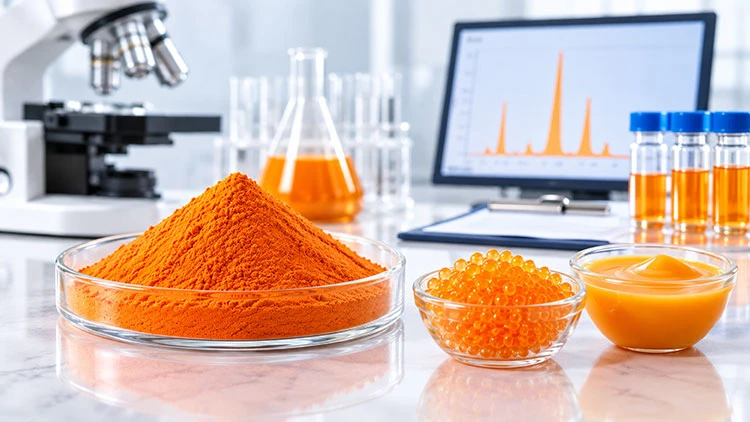
Crystalline beta carotene is not available as carrier-based powders, beadlets, or emulsions.
Crystalline powder: A concentrated ingredient that needs to be controlled in dispersion in the target matrix.
Beadlets or emulsions: Review the composition of the carrier and suitability for the desired process.
Check the batch COA assay, appearance, moisture, and related carotenoid limits and relevant contaminant limits. HPLC can be used to identify and determine the profile of beta-carotene isomers, while UV-Vis is a standard method for the determination of total colouring matter (TCM) as beta-carotene. Pair up the test parameter with the method.
3. Beta Carotene Dosage and Formulation Calculation
If the desired concentration has been specified, determine the amount of the ingredients required based on the batch assay:
The amount of ingredients added = Target beta-carotene / Assay fraction
A 96% ingredient will require a rough 2.08 mg/kg (2/0.96) for every 2 mg of beta-carotene per kg of finished product.
Do not use the nominal COA assay, but the actual COA assay.
Check the legal limit for the finished-food category.
Include other sources of beta-carotene in the food and the anticipated losses during processing.
Double-check the serving size.
This calculation shouldn't be used in place of regulatory review.
4. Synthetic Beta-Carotene Solubility and Applications
Beta-carotene is lipid-soluble and almost insoluble in water. The dispersion of crystalline powder will not be stable just by pouring the powder into an aqueous drink.
Oil-based products: Predisperse in the compatible oil phase and check temperatures, shear, and addition order.
Liquid beverages: Take an appropriate emulsified liquid or water-dispersible liquid.
Dry blends: Test particle size compatibility, uniformity, and segregation of blends.
Coloured foods: Check food matrix for colour distribution.
The appropriate commercial form will be determined by the food system and production process, and suitability for application is not just determined by assay.
5. Beta Carotene Stability During Processing and Storage
Beta carotene is easily oxidised by oxygen, light, and heat. It can also undergo changes in its isomer profile and colour retention during processing.
Minimise exposure to air and use light-resistant packaging materials: oxygen and light.
Heat: Check the time-temperature relationship and choose an appropriate addition stage.
Dispersion: If better distribution and/or protection is desired, consider emulsion or encapsulation.
Shelf life: Assess colour and assay in the final product under storage conditions that simulate intended conditions.
Stability in emulsions and encapsulated powders is a function of droplet size, wall materials, and processing parameters; validate the performance in food.
6. Synthetic Beta Carotene Safety: Food Colour Versus Supplements
There are differences in the safety assessment of a food colour when used in food and when used to boost nutritional value. According to EFSA's 2024 assessment, this distinction is made:
Use as a food colour: No potential adverse effects were found for background dietary intake of beta-carotene, which may be used as a food colour.
Supplemental use: There was no evidence for an upper intake level or for a safe supplemental intake level.
Target consumers: EFSA advises not to take beta-carotene as a supplement if you are a smoker, and recommends that the general public only use beta-carotene as a supplement to ensure vitamin A needs are met.
This does not represent a blanket prohibition on the use of food-colours, but instead an evaluation of the daily consumption of these food-colours by supplement manufacturers, and identification of their food-colour target consumer groups.
Is synthetic beta-carotene safe?
When there is a need for a food product and its market, and the identity, purity, and level of application of synthetic beta-carotene are appropriate, as is its physical form. There is a need to review food-colour applications separately from the supplemental applications, review assay-based calculations, and carry out finished-product testing for responsible use.
Are you interested in our products? Just leave a message on this website or contact donna.zh@kingsci.com directly to get free samples and more professional support!
FAQ
Q1: Is synthetic beta carotene safe for use as a food colour?
In specific food applications in a few markets, it is allowed, and the applicable purity specifications, food categories, and use conditions are adhered to.
Q2: Does synthetic beta carotene powder dissolve in water?
No. Crystalline beta carotene will not dissolve in water very well. For aqueous formulations, an appropriate emulsion or water-dispersible agent is required.
Q3: How do you calculate the addition rate of 96% synthetic beta carotene?
Divide the amount of active beta carotene needed by 0.96. However, a 96% ingredient is needed to mix with 10 mg of beta carotene to get about 10.42 mg of the ingredient.
Q4: What affects synthetic beta carotene stability in food products?
It can be affected by formulation parameters, processing time, temperature, and light. Packaging and finished-product testing are important.
Q5: What should manufacturers check before purchasing synthetic beta carotene powder?
Confirm and analyze the assay, batch COA, impurity profile, physical form, carrier composition (where applicable), and regulatory suitability to intended use and market.
References
1. EFSA Panel on Nutrition, Novel Foods and Food Allergens (NDA). (2024). Scientific opinion on the tolerable upper intake level for preformed vitamin A and β-carotene. EFSA Journal, 22(6), e8814.
2. Zhao, T., He, X., Yan, X., Xi, H., Li, Y., & Yang, X. (2024). Recent advances in the extraction, synthesis, biological activities, and stabilisation strategies for β-carotene: A review. International Journal of Food Science & Technology, 59(4), 2136–2147.
3. Lavelli, V., & Sereikaitė, J. (2022). Kinetic study of encapsulated β-carotene degradation in dried systems: A review. Foods, 11(3), 437.
4. Yin, X., Lu, J., Du, W., Wu, Q., Han, L., & Su, S. (2024). Encapsulation of β-carotene in Pickering emulsions stabilized by self-aggregated chitosan nanoparticles: Factors affecting β-carotene stability. International Journal of Biological Macromolecules, 277(Pt 1), 133696.
5. Drosou, C., & Krokida, M. (2024). A comparative study of encapsulation of β-carotene via spray-drying and freeze-drying techniques using pullulan and whey protein isolate as wall material. Foods, 13(12), 1933.


