

When purchasing Zeaxanthin Powder in bulk, the buyer must have a well-defined zeaxanthin assay, an applicable analytical method, batch-level quality documentation, and supply terms that are in line with the buyer's production needs.
A manufacturer, producer of a dietary supplement or functional ingredient, or buyer must recognize that the concentration that the supplier states on its label is only the beginning. The proper raw-material evaluation should determine the identity of the ingredient, the basis of the assay, physical properties required for processing, and the parameters of quality to be satisfied prior to the acceptance of a batch.
Define the Required Zeaxanthin Grade
The chemically different carotenoids are known as xanthophyll carotenoids, such as zeaxanthin. When they are both present in the same formulation, the two should be specified separately; however, if a zeaxanthin specification is used, it should state that zeaxanthin is the desired compound and not just use a general term for carotenoids without further clarification.
Kingsci's product page for Zeaxanthin Powder Bulk product provides information on the source of marigold flower, assay options, appearance, and testing methods. It is advisable for the buyer to check the current specification of the actual desired grade.
Establish the aim and limits of the quotations' target level of zeaxanthin before comparing quotations. Additionally, determine if the intended ingredient is a single carotenoid grade or a combination of other carotenoids and/or carriers. The differences may impact formulation calculations, product labelling, and interpretation of the analytical results.
Understand the Role of HPLC and UV Testing
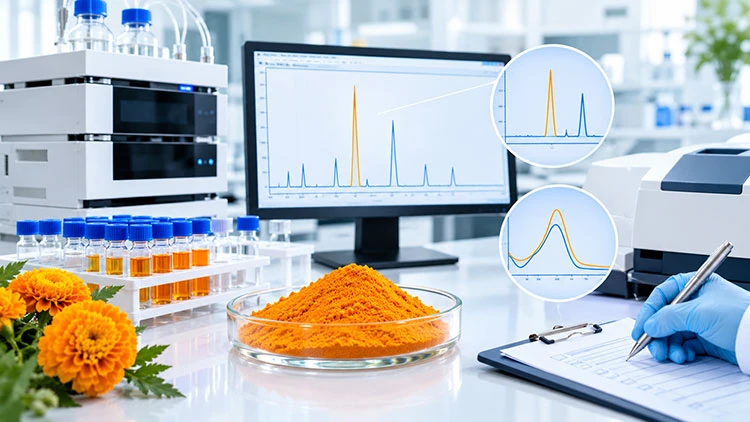
The choice of analytical methods is an important aspect in the qualification of zeaxanthin powder. If the method is suitable for the sample and appropriate carotenoid compounds and other components in the sample can be separated from the target compound using HPLC, it can support the quantification of zeaxanthin.
UV spectrophotometric analysis can also be applied for specific analytical purposes. However, the UV and HPLC results should NOT be automatically assumed to be the same, even if both are given as a percentage. The measured quantity, method, calculation, and specification should be considered as a single entity.
When evaluating a zeaxanthin powder supplier, request confirmation of the following:
Specific Analyte Test: Is the test result specific to zeaxanthin?
Test method: Is the test method suitable for the ingredient and for the assay?
Calculation basis: What is the percentage based upon?
Acceptance range: What should the range of the assays be?
Batch result: Is there a statement in the COA that is talking about the actual result and the method used?
If analytical separation between zeaxanthin and lutein is a critical factor, the buyer should make sure that the method they choose can be used for such separation. This is particularly significant when the specifications, customer requirements, and/or finished product calculations are based on the individual carotenoid content.
Review the COA for Each Purchased Batch
A Certificate of Analysis (CoA) for each batch is helpful in the raw-material approval process, because it links the analytical results to a specific batch of the product. Use of a generic specification sheet may be helpful for initial evaluation, but is not meant to substitute for a COA for the material being provided.
If you are using zeaxanthin powder, read through these categories, where they apply to the agreed product specification:
Identity and Assay
Ensure the result, method, and assay of zeaxanthin in the product match the specification. The need for a specific method or assay basis to be used should be agreed before ordering.
Physical and Processing Properties
Appearance is helpful as a first guess and consistency check, but is no indicator of zeaxanthin content alone. Depending on the process, and if they are part of the specification, other properties, like particle size, moisture, flow or bulk density, can be important.
Contaminant and Microbiological Limits
Check the respective limits for heavy metals, residual solvents, and microbiological parameters for the product, the destination market, and the buyer's quality requirements. Judge these tests by how they are performed and against their acceptance criteria, not by any generalized statement of quality control.
Traceability and Documentation
Check the batch number, analytical date, and document version (if applicable). Ensure that the approved specification and COA are attached to the purchasing record. This enables the buyer to determine the impact of any possible future alteration in the assay, the appearance, documentation, or supply conditions.
Assess the Ingredient's Fit for Your Formulation
It is not enough to simply have an appropriate assay to make sure that a powder will behave as needed in a final product. It is appropriate to take into account the intended dosage form and production process when approving bulk material.
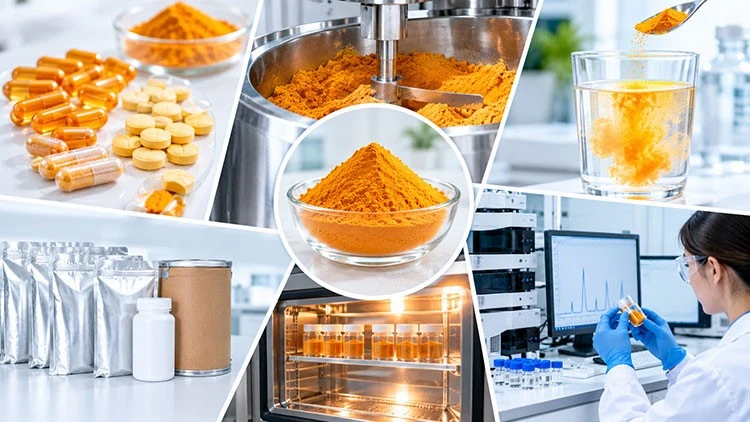
When developing formulations for capsules, tablets, and dry premixes, consider handling and blending uniformity, particle characteristics, and powder quantities needed to reach the desired formulation. When zeaxanthin is formulated with lutein or other carotenoids, specify the content contribution of each component in the formulation and double-check against the formulation specification.
In cases involving drinking water or other water-based systems, don't presume a conventional zeaxanthin powder will dissolve or disperse evenly. Verify if there is an appropriate dispersible format and verify the format in the real matrix.
When handling packaging and/or heat, light, and/or extended storage are involved, determine appropriate conditions for the handling and packaging of the particular grade. When preparing a product from an ingredient that contains a carotenoid, you should evaluate the stability of the ingredient or the finished product under the conditions appropriate for product preparation. The stability of a carotenoid should not be determined by the carotenoid name alone, but rather evaluated under conditions relevant to the product preparation.
Evaluate Bulk Supply and Purchasing Terms
The prospective bulk zeaxanthin supplier should be able to guarantee the purchase specification and its commercial terms. When comparing quotes, the buyer needs to ensure that they are from the same assay basis, in like form, in the same packaging, the same order quantity, and delivery dates.
Discuss with the company the minimum order quantities, availability of evaluation samples, packaging, lead time, destination, and shipping terms before placing a purchase order. Verify if the specification of the product provided is the same as the technically approved product.
If the product is to be produced on a regular basis, decide what the parameters should be for each batch and how they will be notified of changes. Consider including specific test panel, format, or document sets in the purchasing specification with the buyer rather than assuming they are necessary.
Kingsci can provide zeaxanthin powder for the ingredient evaluation and bulk purchase for B2B. Contact us with the following information to get a Quotation: Target zeaxanthin Assay, intended Application, estimated order quantity, destination market, preferred packaging, and any analytical or documentation requirements.
You can contact us directly or email donna.zh@kingsci.com to obtain further information and free samples.
Summary
More than just the percent stated, reliable bulk zeaxanthin powder is dependent on. It is the buyer's responsibility to verify the target analyte, basis of the assay, test method, batch-specific COA, processing requirements, and the terms of commercial supply. Results obtained from HPLC data will need to be interpreted in the context of the method and specification and, where applicable, the basis for the results obtained from the UV data should be checked before assuming that it can be directly compared.
To find out more information about the product and for any supply enquiries, please visit Kingsci Zeaxanthin Powder Bulk. For purchase of other similar carotenoid ingredients, please check Lutein Powder and Lutein Ester Powder.
FAQ
1. What should a zeaxanthin powder bulk specification include?
Should include zeaxanthin content, the basis of the assay, the assay method, acceptance limits, and physical and quality parameters.
2. Is an HPLC result directly comparable with a UV result?
Not automatically. The processes used for the measurement and/or calculation of results may vary, so there is a need to verify the analytical basis.
3. Can color confirm the zeaxanthin concentration?
No. Appropriate appearance is a good physical indication, but not a substitute for an appropriate assay.
4. Why is a batch-specific COA important?
It makes the connection between the reported analytical results and the actual batch supplied and the agreed specification.
5. What information helps a supplier quote bulk zeaxanthin powder?
The quotation is defined by the required quantity, application, required format, destination, and documentation requirements of the target assay.
References
1. Prado-Cabrero, A., Beatty, S., Howard, A., Stack, J., Bettin, P., & Nolan, J. M. (2016). Assessment of lutein, zeaxanthin and meso-zeaxanthin concentrations in dietary supplements by chiral high-performance liquid chromatography. European Food Research and Technology, 242, 599–608.
2. Milanowska, J., & Gruszecki, W. I. (2005). Heat-induced and light-induced isomerization of the xanthophyll pigment zeaxanthin. Journal of Photochemistry and Photobiology B: Biology, 80(3), 178–186.
3. Xiao, Y.-D., Huang, W.-Y., Li, D.-J., Song, J.-F., Liu, C.-Q., Wei, Q.-Y., Zhang, M., & Yang, Q.-M. (2018). Thermal degradation kinetics of all-trans and cis-carotenoids in a light-induced model system. Food Chemistry, 239, 360–368.
4. Carneiro, A. M., Lima, B. R., Chibli, L. A., Carneiro, R. L., & Funari, C. S. (2023). An updated procedure for zeaxanthin and lutein quantification in corn grains based only in water and ethanol. Food Chemistry, 427, 136589.


