

Examples of calcium salts are Calcium Carbonate, Calcium Citrate, Calcium Lactate, Calcium Gluconate, Calcium Chloride, Calcium Sulfate, and Calcium Phosphate. The structure of these compounds varies in terms of the amount of elemental calcium, solubility, and functional properties, which make them suitable for various food, nutraceutical, and industrial purposes. Calcium salts to be used should be chosen based on formulation requirements, processing conditions, and product specifications.
Common Examples of Calcium Salts
Calcium salts are the compounds which are produced by the combination of calcium with organic and inorganic acids. Calcium content and functional properties of the compounds are related to their chemical composition.
Calcium carbonate: This contains about 40% elemental calcium in its anhydrous state. It is used extensively in a variety of applications such as tablets, dry blends, mineral premixes, and food fortification systems. It is relatively insoluble in water, so dispersion is important.
Calcium citrate: It is a form of calcium citrate that provides about 21% of the element calcium. It is used in various mineral blends and powdered nutritional products, chewable formulations, and selected beverage premix products.
Calcium Lactate: This has approximately 13% (anhydrous) calcium. Used in specific formulations of food and drink.
Calcium gluconate: Is calcium in an anhydrous form and is approximately 9% elemental calcium. May be used in specialty ingredient blends and in liquid products.
Calcium chloride: A salt that is extremely soluble in water and used technically and in food. Because of its hygroscopic and taste characteristics, it needs to be taken into account when formulating.
Calcium phosphates: This contains monocalcium phosphate, dicalcium phosphate, and tricalcium phosphate. It may serve different purposes depending on the grade, such as a source of calcium, or it can be used as a technical ingredient in dry blends.
Calcium sulfate: Applied to some food processing operations, such as some setting and firming systems.
The percentages of calcium are given only as approximate for anhydrous compounds. Commercial grades may vary in some aspects of hydration, purity, or due to other factors affecting the formulation. It is the buyer's responsibility to check the actual assay on the Certificate of Analysis (COA) provided by the supplier.
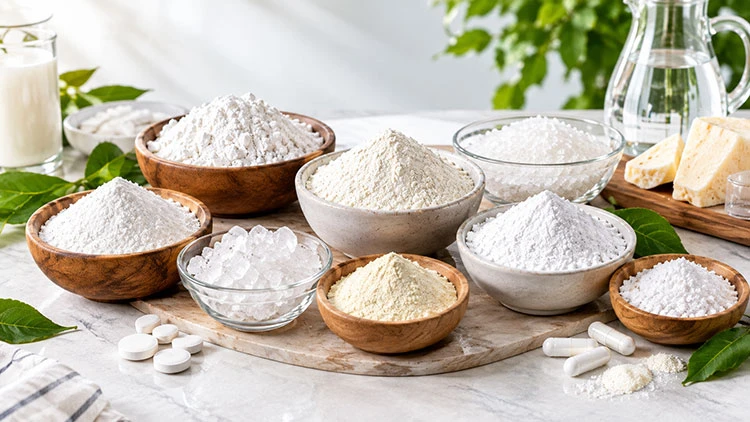
Other Types of Calcium Salts
There are additional calcium salts which are formulated for special purposes.
Calcium acetate: Applicable regulations in selected food and technical applications.
Calcium ascorbate: Calcium salt of ascorbic acid - used as an ingredient in ingredient systems.
Dicalcium phosphate (also known as calcium hydrogen phosphate): It is found in some powdered products, tablets, and dry blends.
The type required depends on the calcium requirement, processing conditions, and use.
Comparing Elemental Calcium Content
The elemental calcium content is a measure of the amount of calcium that a compound contains by weight. It's a key to help determine ingredient inclusion rates.
Calcium carbonate: approximately 40%.
Hydrogen citrate of calcium: about 25% anhydrous calcium citrate.
Calcium lactate (anhydrous): About 13%.
Calcium gluconate: ~ 9% anhydrous calcium gluconate.
Calcium chloride (anhydrous): ~36%.
Tricalcium phosphate: approximately 39%.
These are reference specifications and not commercial specifications. The actual value will vary according to the grade, purity, and state of hydration. When using suppliers' verified data, the formulator should use it for accurate calculation.
Solubility and Formulation Compatibility
Solubility has an impact on dispersion, processing, and stability of the finished product. The calcium salt that is suitable for making a dry blend may not be the same for a clear calcium beverage.
Liquid products: If solubility is a factor, use of calcium chloride or some organic calcium salts could be considered.
Powdered products: In some dry blends, it may be appropriate to use calcium carbonate and some calcium phosphate grades that do not have to dissolve completely.
Interaction with other minerals and ingredients: Calcium salts may interact with other ingredients and minerals, which may impact precipitation and stability.
Processing conditions: pH, temperature, moisture, water quality, and mixing order may affect the performance.
The manufacturers should evaluate the entire formulation and should do compatibility testing prior to commercial production.

Selecting Calcium Salts for Manufacturing
The following factors should be a part of a practical selection process:
Application: Determine if it is used in tablets or capsules, powder blends, beverage premixes, fortified foods, or processing systems.
Calcium target: Work out the target calcium inclusion rate based on the calcium elemental analysis.
Physical properties: Solubility, particle size, bulk density, flowability, and moisture sensitivity.
Quality and compliance: Check the identity, purity, impurity limits, and allowed applications in the destination market.
Documentation: Get a COA, product specification, technical data sheet, and safety documentation.
Quality Control and Storage
In order to supply reliable calcium salts, it is necessary to have consistent specifications and proper packaging. The parameters tested for quality checks vary according to ingredient and application and could include assay, moisture, heavy metals, and microbiological tests.
Store all moisture-sensitive materials in sealed packages in appropriate conditions and according to the supplier's instructions. Sample evaluation can be used to validate the blending performance and compatibility prior to the production process.
What are some examples of calcium salts?
Calcium salts include calcium carbonate, calcium citrate, calcium lactate, calcium gluconate, calcium chloride, calcium sulfate, and calcium phosphate. They have different levels of calcium, solubility, and processing qualities. The selection of the appropriate product for the manufacturer or ingredient purchaser will depend on the application, formulation, verified quality data, and regulations.
Do you have a different opinion? Or need some samples and support? Just Leave A Message on this page or email donna.zh@kingsci.com to get free samples and more professional support!
FAQ
1. What are the most common examples of calcium salts?
These are commonly referred to as calcium carbonate, calcium citrate, calcium lactate, calcium gluconate, calcium chloride, calcium sulfate, and calcium phosphate.
2. Which calcium salt has the highest elemental calcium content?
CaCO3 is a compound that is about 40% elemental calcium when pure and anhydrous. The composition of calcium phosphate is about 39% tricalcium phosphate.
3. Which calcium salts are water-soluble?
Calcium Chloride is very soluble in water. Other calcium salts have different solubility depending upon their chemical formulation and conditions.
4. How do manufacturers select a calcium salt?
They look at the elemental calcium content, solubility, physical characteristics, usage, regulations, and costs.
5. What documents should buyers request?
These documents are typically a COA, product specification, technical data sheet, and safety data sheet.
References
1. Bourassa MW, et al. Interventions to improve calcium intake through foods in populations with low intake. Annals of the New York Academy of Sciences. 2022. doi:10.1111/nyas.14743.
2. Nieto G, et al. Improved in vitro bioavailability of a newly developed functionalized calcium carbonate salt as a food ingredient and its comparison with available commercial calcium salts. Food Chemistry. 2021;348:128740. doi:10.1016/j.foodchem.2020.128740.
3. de Zawadzki A, et al. Increasing calcium phosphate aqueous solubility and spontaneous supersaturation combining citrate and gluconate with perspectives for functional foods. Food Chemistry. 2022;374:131701. doi:10.1016/j.foodchem.2021.131701.
4. U.S. Department of Agriculture, Agricultural Marketing Service. Calcium Chloride: Technical Report. 2024.


