

When used under local regulatory conditions and under purity specifications applicable to it, Calcium Sulfate is deemed to be suitable for specified food-processing uses. This will be dependent on the product grade, quantity, purpose, and food classification. Industrial and construction grade material should not be assumed to be suitable for food.
There are three forms of calcium sulfate, CaSO₄, which are the dihydrate, hemihydrate, and anhydrous variety. They have varying quantities of chemically bound water, which has an impact on processing behaviour and cannot be replaced without reference to specifications.
Calcium Sulfate Safety Depends on Grade and Purity
The suitability for food use cannot be determined from the chemical name.
Food grade: Should conform to the requirements of identity and purity for use in food.
Technical or construction grade: May be present in food at levels in excess of the food impurity limits and should not be used in food unless verified.
Contaminants: They may limit the level of lead, arsenic and other contaminants; see product data for details.
What Do Calcium Sulfate Safety Assessments Say?
Calcium sulfate (E 516) has been re-evaluated with other sulfate food additives by the European Food Safety Authority. It found that there was no safety concern with exposure at reported uses and levels, and a numerical ADI was not required. This conclusion is for the situation(s) evaluated, and not all grades or possible exposures.
Assessments: Exposure is evaluated, and dietary exposure is taken into account as well as uses specified.
Food-Additive Controls include purity: identity and contaminant limits.
Findings for permitted applications of food do not imply a blanket approval that the food is safe for industrial material.
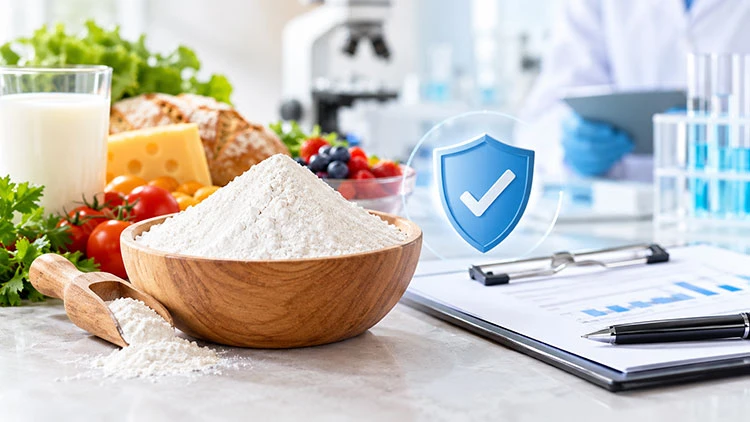
Calcium Sulfate Food Uses and Inclusion Levels
Calcium sulfate is used in many different applications in food. Permitted functions and limits for the category are listed in U.S. regulation 21 CFR § 184.1230.
Food-grade calcium sulfate may be used as a coagulant as appropriate (about tofu and plant-based foods). This varies according to the recipe, processing instructions, and local regulations.
Other foods: Do not move an inclusion rate between food categories unless it is clearly authorised and/or limited.
Test dispersion, texture, processing characteristics, and finished product specifications in formulation trials before scale-up.
Recipe review: Double-check the allowed function and use before completing a recipe.
Hydration Form, Mixing, and Stability
Not all forms of calcium sulfate hydration can be easily substituted for each other, and may have different processing characteristics.
Dihydrate – Formula unit contains 2 water molecules, called gypsum.
Chemically bound water (hemihydrate and anhydrous): Shorter amount of chemically bound water; consider substitution.
Mixing and storage: Batch uniformity and dispersion can be influenced by particle size, moisture content, and addition sequence. Store in a dry and cool area and follow label directions.
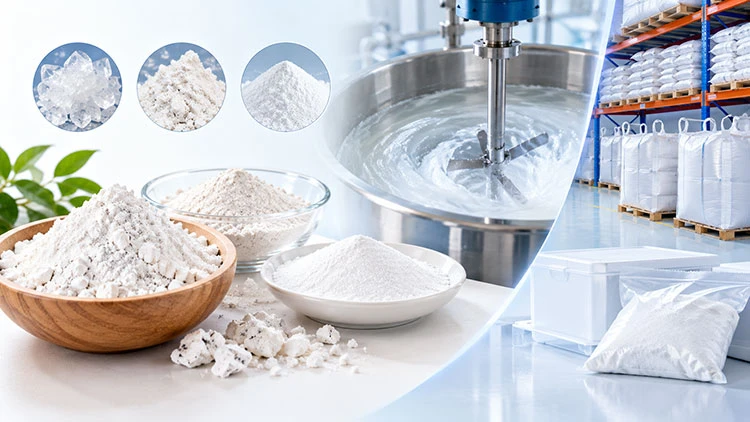
Calcium Sulfate Handling and Exposure
The suitability of foods for various purposes and the handling of foods in the workplace are different matters. When transferring or mixing, fine powder can be inhaled.
Dust management: Reduce dust, and practice proper dust control measures and work practice controls.
Selecting grades: Ensure that the grades of materials are in line with the specification for the application.
Calcium Sulfate Regulations and Documentation
It may have a different status in a different country and in different types of food. Calcium sulfate is listed in the U.S. regulations for specified functions and category-specific limits (good manufacturing practice). The Codex General Standard for Food Additives should be referred to, but the local rules should also be consulted.
Allowed use: Ensure its ingredients and function are approved in the intended country.
Specifications: Verify identity, purity, and appropriate contaminant information.
Documentation: A certificate of analysis for each batch can be used to evaluate, but can't be used as a replacement for the regulatory confirmation.
Is Calcium Sulfate Safe for Humans?
When the appropriate grade and under the conditions specified are used, calcium sulfate may be used in certain restricted foods. The suitability will be dependent on purity, function, levels of exposure, hydration form, and local rules. Not all products are "food grade," and granting permission for one use does not mean permission for another use.
Do you have a different opinion? Or need some samples and support? Just Leave A Message on this page or email donna.zh@kingsci.com to get free samples and more professional support!
FAQ
1. Is food-grade calcium sulfate safe for food processing?
It can be used under regulatory conditions in approved applications and, when used under appropriate regulatory conditions, meets appropriate purity requirements.
2. Is calcium sulfate used in tofu production?
Yes. If it is allowed to be used in tofu production, it can be used as a coagulant in tofu making.
3. Does calcium sulfate dosage vary by food product?
Yes. The food category, technical function, formulation, and local regulations determine the maximum level permitted in the food.
4. Can different forms of calcium sulfate be used interchangeably?
Not automatically. The processing properties and water content of the dihydrate, hemihydrate, and anhydrous forms are different.
5. How should powdered calcium sulfate be stored?
Store under sealed packaging in a dry place; for each grade, refer to the instructions for storage.
References
1. EFSA Panel on Food Additives and Flavourings. (2020). Re-evaluation of sulphuric acid and its sodium, potassium, calcium and ammonium salts (E 513, 514 (i), 514 (ii), 515 (i), 515 (ii), 516 and 517) as food additive. EFSA Journal, 18(2), 6038.
2. Electronic Code of Federal Regulations. (2026). 21 CFR § 184.1230-Calcium sulfate. Current online edition, accessed October 13, 2026.
3. European Commission. (2025). Commission Implementing Regulation (EU) 2025/973 of 23 May 2025 amending and correcting Implementing Regulation (EU) 2021/1165 authorising certain products and substances for use in organic production and establishing their lists. Official Journal of the European Union.
4. FAO/WHO Codex Alimentarius Commission. (2026). General Standard for Food Additives (GSFA) Online Database. Current online database, accessed October 13, 2026.
5. European Commission. (2024). Commission Delegated Regulation (EU) 2024/3085 of 30 September 2024 amending Delegated Regulation (EU) 2019/934 as regards authorised oenological practices. Official Journal of the European Union.


