

Chemical names can't determine which calcium salt is the most easily absorbed, but Calcium Citrate is generally less affected by stomach acidity than Calcium Carbonate. The calcium source, elemental calcium dose, formulation environment, and reference information are the factors affecting absorption.
Bioavailability data is critical to the selection of a calcium ingredient for nutraceutical, food, and dietary supplement manufacturers, along with the concentrations of elemental calcium, dissolution characteristics, processing, and stability of the finished product. The properties of calcium citrate, calcium carbonate, calcium lactate, calcium gluconate, tricalcium phosphate, and calcium bisglycinate are different and should be evaluated specifically for application.
What Determines Calcium Salt Absorption?
The bioavailability of calcium is the availability of calcium for absorption. Water solubility is important, but it doesn't make a difference on its own as to how much calcium will be absorbed.
Chemical form: Any of the salt forms of calcium are soluble in different ways. Calcium citrate requires a lesser degree of stomach acid for absorption than does calcium carbonate.
Content of elemental calcium: Calcium carbonate has around 40% elemental calcium, whereas calcium citrate has around 21% calcium by weight. The actual specifications are dependent upon the grade of material.
Fractional absorption: The amount of elemental calcium provided at a certain serving size may influence fractional absorption. The actual dose of calcium needs to be taken into account when comparing.
The acidity, other minerals, organic acids, and food ingredients will affect the dissolution and availability of calcium in the formulation matrix.
Calcium Citrate VS Calcium Carbonate: Which Is Better Absorbed?
Both these ingredients have a wide range of applications in nutrition products, but their efficacy will vary depending on the circumstances of their testing.
Calcium citrate: Dissolves less readily in acidic gastric juice; thus, it is a preferred choice when it is necessary to use a formulation that is flexible.
Calcium carbonate: It has more elemental calcium content, which can decrease the quantity of raw material needed. Its dissolution is more pH sensitive.
Comparative evidence: There are differences in these salts in particular circumstances reported in research; but not all studies report the same results. Under appropriate conditions, calcium carbonate has been found to have similar absorption rates – even when eaten as part of a meal.
Selection criteria: Manufacturers should consider the product format and compare the equivalent elemental calcium content rather than depend on a universal ranking of the absorbencies of the different manufacturers.

How Other Calcium Salts Compare
There are several calcium sources, other than citrate and carbonate, that have unique formulation requirements.
Calcium lactate: Organic calcium salt that can be assessed in specific food and beverage systems. It is suitable depending on the formulation conditions, taste, and calcium loading.
Calcium gluconate: May be used for certain applications that have a particular requirement for an organic source of calcium. The amount of ingredients required should be based on the amount of elemental calcium in the ingredients.
Tricalcium phosphate: Used in dry food blends and in mineral fortification systems. It is not very soluble in water and needs to be considered with regard to dispersion and sedimentation in liquids.
Calcium – glycine chelate (calcium bisglycinate): A calcium glycine chelate that has been suggested for use in special nutrition products. The chemical structure alone does not indicate the absorption rate qualities of the grade over other calcium salts; comparative evidence of the specific grade is required.
Elemental Calcium Calculations for Formulators
The weight of ingredients and calcium content of elements are two different measures. The calcium assay in the formulation should be based on the verified amount of calcium and not the total weight of the raw material.
Determine the amount of calcium contribution: Ingredient's weight x elemental calcium fraction. An example of this is that using 500 mg of an ingredient with a 20% elemental calcium content will provide 100 mg of calcium.
Compare equivalent quantities: When looking through research or supplier data, compare the ingredients based on the same elemental calcium level if possible, based on the design of the research.
Consider dosage-form size limitations: Tablets and capsules have limited fill; powders and fortified foods might have higher loading limits for raw materials.
Double-check the commercial grade: Make sure of the assay and composition by checking with the supplier's specification and batch-specific Certificate of Analysis (COA).
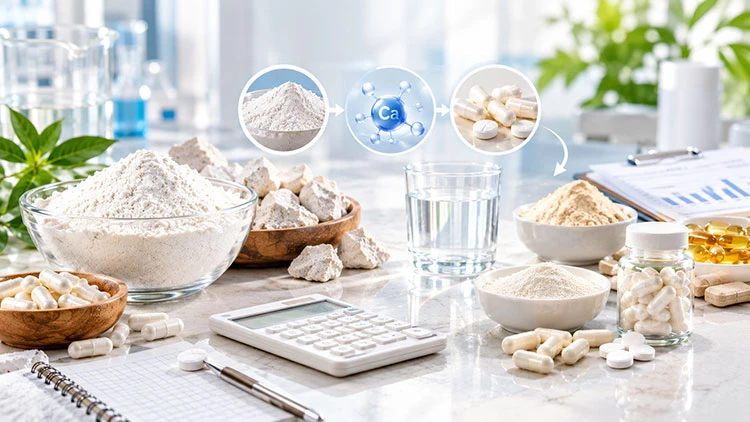
Processing, Stability, and Quality Control
The calcium salt chosen should also be able to work well during manufacture and storage.
Flowability, particle size, bulk density, and compressibility of capsules and tablets should be evaluated. Ensure adequate uniformity and compatibility of the blend(s) with the chosen excipients.
Particle size and/or density variations may lead to segregation during powder mixing, transfer and filling. The staged blending and particle-size matching process can be used to help enhance distribution.
Liquid formulations: Dissolve or disperse in the intended formulation pH, temperature, and concentration. When evaluating the solubility of ingredients, evaluate sedimentation and suspension stability instead of assuming complete dissolution of less soluble ingredients.
Calcium combinations: Calcium could be combined with phosphate, citrate, and other minerals. Keep track of the precipitation, pH, and physical changes during development and storage.
Quality assurance: Identity, elemental Calcium content, moisture, limits of relevant impurities, and traceability. Verify the performance of finished products under the process and storage conditions used.
Which calcium salt is best absorbed?
To sum up, calcium citrate is not as reliant on the amount of stomach acid required for absorption; however, calcium carbonate provides more elemental calcium in terms of weight. For specific formulation needs, other calcium salts might be better suited. No single source of calcium is best absorbed in all uses; the most defensible is the one that is based on the calcium absorption data available, has verified composition, processing parameters, and verification testing on the finished product.
Do you have a different opinion? Or need some samples and support? Just Leave A Message on this page or email donna.zh@kingsci.com to get free samples and more professional support!
FAQ
1. Which calcium salt is best absorbed?
Calcium citrate requires a lesser degree of stomach acid for absorption than does calcium carbonate. The comparative result is, however, dependent on the dose of calcium, the formulation conditions, and what evidence exists for each of the ingredients.
2. Is calcium citrate better than calcium carbonate?
Not in all circumstances. Calcium citrate has various dissolution properties, and calcium carbonate provides more calcium per gram. Depending on the application, the right one is required.
3. Is calcium bisglycinate more bioavailable than calcium citrate?
Absorption is better than calcium citrate, but this cannot be assumed without similar comparative studies with a well-defined amount of calcium.
4. How do manufacturers calculate elemental calcium content?
Multiply the weight of the raw material by the weight % of its verified elemental composition of calcium. Make sure to use the supplier's specification and batch-specific assay for accurate calculations.
5. What should manufacturers evaluate when purchasing calcium salts in bulk?
Check the COA, compatibility with the intended finished product formulation, physical properties, traceability, and impurity limits, as well as the identity of the ingredients.
References
1. National Institutes of Health, Office of Dietary Supplements. (2026). Calcium: Fact sheet for health professionals.
2. Nieto, J. A., Soriano-Romaní, L., Tomás-Cobos, L., Sharma, L., & Budde, T. (2021). Improved in vitro bioavailability of a newly developed functionalized calcium carbonate salt as a food ingredient and its comparison with available commercial calcium salts. Food Chemistry, 348, 128740.
3. Liu, X.-C., Kirkensgaard, J. J. K., & Skibsted, L. H. (2021). Hydrates of calcium citrate and their interconversion in relation to calcium bioaccessibility. Food Research International, 140, 109867.
4. Bourassa, M. W., Abrams, S. A., Bel-Serrat, S., et al. (2022). Interventions to improve calcium intake through foods in populations with low intake. Annals of the New York Academy of Sciences.


