

High-purity Magnesium Oxide Powder is not a dangerous substance when handled and formulated following industrial practice, but it still has some mechanical dangers because of the exposure to particulate dust during the bulk processing in industries, mainly in the respiratory system, which are non-toxic and local in nature.
Procurement leads, product formulators, and compliance managers need to have a good technical understanding of the safety profile of magnesium oxide fine material and its physical behavior. This powder is a vital inorganic mineral essential in a variety of nutraceutical, agricultural, and industrial applications and follows known chemical reactions. Commercial companies can safely use this mineral raw material in continuous pipelines without endangering the safety of the manufacturing facility by taking the following precautions: take steps to control dust; follow recommended dosages; and store in proper locations.
Technical Safety Profile and Physical Handling Factors
To assess the hazard of magnesium oxide powder, the behavior of the powder under enterprise bulk processing operations needs to be analyzed.
1. Inhalation Risks and Dust Control Solutions
Fine particulate airborne dust from bulk discharges or transfers may irritate the upper respiratory tract, but only temporarily and/or locally. Local exhaust ventilation systems, dust extraction systems with negative pressure, and normal personal protective equipment (PPE) are being used in the facilities to meet the occupational exposure limits for nuisance dust.
2. Ocular and Dermal Interaction Characteristics
Magnesium oxide finely ground powder is a mild alkaline substance, which can abrade tissues of the eyes and skin if it comes in direct contact with the tissue. Direct contact may also cause mild transient dryness because it is a mild alkaline dry material. Contact risk is avoided during raw material loading/batch blending operations by standard industrial hygiene precautions such as protective safety goggles and gloves.
3. Non-Combustible Chemical and Thermal Stability
The powdered form of magnesium oxide is extremely stable when it comes to temperature and melts at more than 2,800°C. Under ambient conditions, it is non-flammable, non-explosive, and chemically inert; thus, it is safe to be stored in a warehouse for long periods of time or processed in thermal processes.
Formulation Parameters and Dosing Thresholds
From a commercial product development point of view, safety relates to correct dose management, matrix compatibility, and formulation development:
1. Elemental Yield and Concentration Calculations
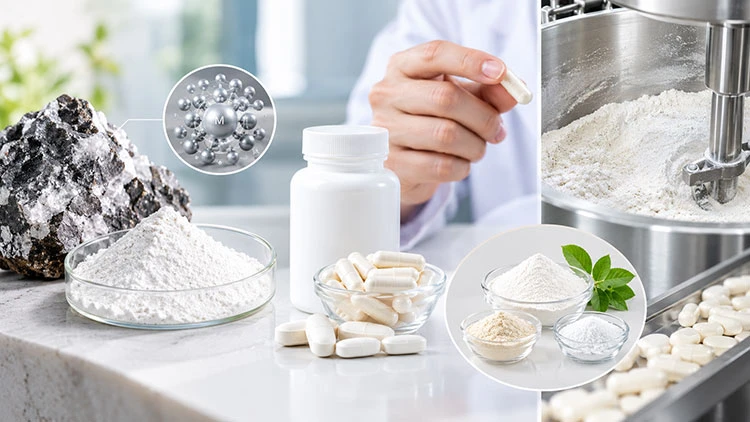
Magnesium oxide fine mineral material has a high active yield with about 60.3% elemental magnesium. Inclusion ratios are carefully determined to ensure an accurate level of inclusion in the final product (solid oral dosage form, compressed tablet or hard capsule).
2. Standard Finished Product Intake Benchmarks
The typical range for the amount of magnesium delivered by completed dietary supplements is 250 mg to 400 mg per serving. Therefore, the goal of contract manufacturers is to ensure that their product does not lead to hyper-fortification and to ensure that it does not cause mild acceleration of gastrointestinal transit, by measuring and matching reference intakes in their region against their product.
3. Excipient Synergy and Matrix Buffering
Formulators finely mill and mix powdered magnesium oxide with food-grade anti-caking agents and binders when engineering various blends. Correct dispersion in the matrix avoids the possibility of localised concentrations of alkalinity in the matrix and ensures optimal powder flowability at the end of the process.
Industrial Application Techniques for Bulk Feedstock
There are several commercial applications for safe and efficient use of the bulk feedstock of magnesium oxide, each with unique handling procedures:
1. Nutraceutical and Oral Supplement Manufacturing
In high-speed tableting and encapsulation, the powder is used as a high-density source of active mineral. Granulated or micronised particle profiles are used by manufacturers for dry-blend hoppers to avoid segregation and to provide a constant tablet hardness.
2. Functional Food and Beverage Fortification
Formulators can choose a controlled particle size range when adding these to ready-to-mix nutrition powders and meal replacement blends to ensure a smooth mouthfeel and avoid rapid sedimentation in liquid systems.
3. Agricultural Premix and Animal Nutrition Formulations
In livestock feed production, fine MgO is an indispensable macroelement feed supplement. In large bulk pre-mix, it is essential to have a uniform distribution in the coarse feed matrices to ensure a uniform daily feed of minerals.
Physical Stability, Environmental Control, and Storage
Due to the physical characteristics and non-hazardous properties of bulk magnesium oxide powder, storage must be done according to 'climate-controlled storage principles':
1. Hygroscopic Behavior and Moisture Barrier Measures
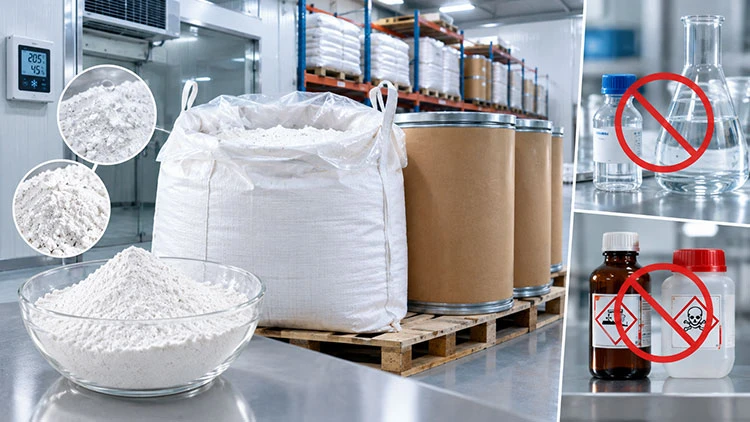
Fine powder of MgO is chemically resistant, but it is naturally subject to moisture and CO2 in the atmosphere over longer periods of time, forming surface magnesium hydroxide. Bulk raw material needs to be kept in polyethylene-lined multi-wall paper bags or fibre drums.
2. Warehouse Maintenance and Chemical Incompatibility
Cool, dry stock warehouses will not allow caking or loss of flow properties. Bulk stocks of magnesium oxide powder must be kept away from strong mineral acids and reactive halogenated compounds for fear of a possible exothermic reaction.
Quality Assurance and Regulatory Compliance
Conducting analytical testing and recording the supply chain to ensure that commercial lots of MgO powder are safe, uniform, and completely in compliance is challenging:
1. Trace Element Profiling and Particle Size Control
All lots are tested by the quality assurance staff using ICP-MS to ensure that any trace heavy metals are kept well below safe limits. Because Laser diffraction testing ensures that bulk lots meet close particle size specifications (d50), the amount of dust generated is unpredictable.
2. Global Quality Certification Alignment
Commercial procurement teams confirm that suppliers are using certified Quality Management Systems such as cGMP, ISO 9001, Kosher and Halal standards and utilize batch-specific Certificates of Analysis (COA) and Safety Data Sheets (SDS).
Is magnesium oxide powder dangerous?
In conclusion, the handling of magnesium oxide powder in industry is safe and non-dangerous if routine industrial hygiene practices, proper dust suppression, and proper formulation control can be achieved. It is not flammable and has a high elemental density, along with remarkable chemical stability, and is a reliable, safe, and efficient raw material choice for B2B formulators and industrial manufacturers around the world.
Do you have a different opinion? Or need some samples and support? Just Leave A Message on this page or email donna.zh@kingsci.com to get free samples and more professional support!
FAQ
Q1: Is magnesium oxide powder dangerous to handle during bulk factory processing?
A: No, it's a raw material that is not toxic and not flammable. The main operational problem is the nuisance dust in the air; this can be taken care of by applying dust extraction systems, exhaust ventilation, and using general protective equipment.
Q2: Does magnesium oxide fine powder cause skin or eye irritation upon contact?
A: It can cause mild, temporary mechanical irritation and/or physical dryness due to its fine powder structure and mild alkalinity when it comes into direct contact with the skin. Localised irritation is avoided using basic workplace PPE and by thoroughly rinsing with water.
Q3: What precautions should contract manufacturers take to ensure the stability of magnesium oxide powder?
A: The material should be kept in moisture-proof containers with double PE liners in cool, dry warehouses where it does not come in contact with the atmosphere, so that it will not absorb moisture and form a "glue" that causes it to clump.
Q4: Why is high-density magnesium oxide powder preferred over organic magnesium salts in dietary supplement manufacturing?
A: Magnesium oxide has an elemental mineral concentration of about 60.3%; with higher elemental mineral content per unit weight, the manufacturer can produce tablets with smaller footprints and produce them more cost-effectively.
References
1. National Center for Biotechnology Information (NCBI). (2023). PubChem Compound Summary for CID 14792: Magnesium Oxide. PubChem, U.S. National Library of Medicine.
2. European Food Safety Authority (EFSA) Panel on Food Additives and Nutrient Sources added to Food. (2021). Re-evaluation of magnesium oxide (E 530) as a food additive and nutrient source in dietary supplements. EFSA Journal, 19(4), e06521.
3. U.S. Food and Drug Administration (FDA). (2022). Code of Federal Regulations Title 21: Direct Food Substances Affirmed as Generally Recognized as Safe (GRAS) - Magnesium Oxide (21 CFR 184.1431). U.S. Government Publishing Office.
4. World Health Organization (WHO) & Food and Agriculture Organization (FAO). (2020). Compendium of Food Additive Specifications: Joint FAO/WHO Expert Committee on Food Additives (JECFA). FAO JECFA Monographs, 25.


