

The biological activity of Lutein and Zeaxanthin has been documented, but it depends on the formulation, dose, bioavailability, and the type of outcome measured. These carotenoids are utilized in dietary supplements and are useful for nourishment.
How Lutein and Zeaxanthin Function
Leafy greens, corn, and egg yolk are foods that naturally contain lutein and zeaxanthin. Lutein is commonly found in commercial lutein supplements from marigold.
Lutein: A yellow-orange xanthophyll that is added to supplements or foods.
Zeaxanthin: A carotenoid that is similar to lutein and often used in combination with it.
Combined use: Both are found in the retina macular pigment and have been investigated with regard to visual function.
Not all products are guaranteed to be produced due to biological activity.
What Research Says About Effectiveness
Findings will vary based on study design, formulation, and endpoints measured.
Clinical evidence: AREDS2 used lutein (10 mg) and zeaxanthin (2 mg) as part of a specific nutrient formula. The results do not necessarily apply to all supplements.
A 2022 trial with 90 adults showed that there were variations in the amount of carotenoids obtained in the serum levels of the formulations, which had the same nominal doses.
Evidence limitations: Better long-term results do not necessarily mean higher levels in the blood, and results from one formulation may not apply to all ingredients.
Compare evidence with the makeup, transportation, and application of the product.
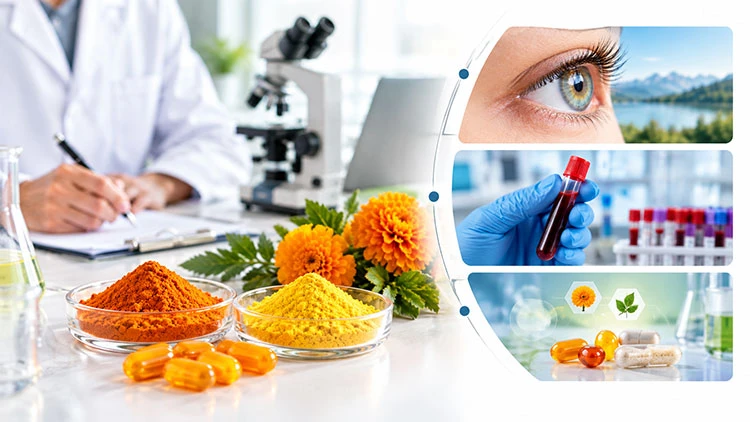
Lutein and Zeaxanthin Dosage Factors
Dosage is a characteristic of a product. Separate the weight of ingredients from the amount of active.
The 10 mg lutein and 2 mg zeaxanthin per day was used in the AREDS2 research; this is a researched formula, but not a requirement for all products.
The inclusion rate is the ratio of material required to get a certain amount of lutein; e.g., 20% lutein powder requires less material than 5% lutein ingredient to provide the same level of lutein. Use the given assay to calculate.
Feasible inclusion is impacted by serving format (capsule capacity, gummy weight, beverage volume).
Assay control: If both lutein and zeaxanthin are present, then check their presence separately.
Set specifications based on product requirements and/or rules for the target market.
Formulation Techniques for Lutein and Zeaxanthin
These carotenoids are fat-soluble, and so compatibility is an issue.
Oil-based systems are supported by lipid carriers (softgels).
Powders: Encapsulated powders can enhance handling and blending, as well as beadlets.
Beverages: Water-based systems may require emulsification or encapsulation to obtain the desired dispersion.
Gummies: See if they're uniform, if they've been processed at the right temp, if there's too much moisture, and if ingredients have interacted.
Make selections based on: Active Content Target, Equipment, Sensory Needs, Cost, and Testing.

Lutein and Zeaxanthin Stability
Retention can be a problem due to light, oxygen, and heat. Test the final formulation.
Light and oxygen: Take into account the protective packaging and look at package permeability and headspace.
Assess time and temperature during processing, especially as regards heating steps.
Moisture: Investigate its influence on encapsulated powders and the form.
Shelf life: Determine both carotenoids at certain time periods under proper storage conditions.
The first COA is no guarantee that shelf life will be retained.
Selecting Commercial Lutein and Zeaxanthin Ingredients
Check suppliers for quality and suitability of production.
Identity: Identify and trace.
Assay: Check the individual content specifications, test methods, and the batch-specific COA.
Physical properties: Colour, particle size, flow, dispersibility, and compatibility of dosage forms.
Quality data: Check all the relevant contaminant and microbiological data, as well as residual solvents (when applicable).
Identify the consistency of batches, packaging, lead time, and technical support.
Capsules, softgels, gummies, powdered blends, fortified foods, and beverages are all covered by these checks.
Evaluating Lutein and Zeaxanthin Product Claims
Evidence alignment: Don't copy and paste evidence from one formula to another product.
Content verification: Have a comparison of declared amounts and assay results, and calculations of servings.
Clear communication: Technology description of composition and delivery (with no promise of results).
Local requirements: Please ensure that local requirements are checked prior to finalisation of labels for regulatory review.
Do lutein and zeaxanthin actually work?
To conclude, lutein and zeaxanthin are biologically active, but their performance will vary depending on the formulation, the active content, bioavailability, and stability. The commercial development should include appropriate research, approved specifications, an appropriate delivery system, and product testing.
Are you interested in our products? Please leave a message on this website or contact donna.zh@kingsci.com directly to get free samples and more technical support!
FAQ
1. Do lutein and zeaxanthin actually work in dietary supplements?
These carotenoids are absorbed in supplements that are properly formulated. Specific evidence for specific outcomes differs depending on the formulation, study population, intake, and endpoint measured.
2. What is the commonly studied lutein and zeaxanthin ratio?
One of the most frequently studied combinations is 10 mg lutein to 2 mg zeaxanthin (LZ), which is a 5:1 ratio. This does not apply to all formulations; this was applied in AREDS2 research.
3. How can manufacturers improve lutein and zeaxanthin bioavailability?
Manufacturers are able to test oil-based carriers, emulsification and encapsulation methods, as well as other delivery methods. Comparative testing is needed to determine the performance of a particular system.
4. Are lutein and zeaxanthin stable during supplement manufacturing?
Light, oxygen, and high temperatures can all have an effect on the carotenoids. Proper processing controls, protective packaging, and finished product stability testing can assist in determining proper storage conditions.
5. Which lutein and zeaxanthin ingredients are suitable for gummies and beverages?
Powders or beadlets, oil dispersion, or emulsified preparations might be appropriate. Selection is based on the concentration, dispersibility, sensory properties, processing conditions, and stability.
References
1. Chew EY, Clemons TE, Agrón E, et al. Long-term outcomes of adding lutein/zeaxanthin and ω-3 fatty acids to the AREDS supplements on age-related macular degeneration progression: AREDS2 Report 28. JAMA Ophthalmology. 2022;140(7):692–698.
2. Kotagiri SR, Morde A, Rai D, et al. Superior bioavailability of a novel lutein and zeaxanthin formulation in healthy human subjects. Ophthalmology and Therapy. 2022;11(4):1463–1477.
3. Green-Gómez M, Prado-Cabrero A, Moran R, Power T, Gómez-Mascaraque LG, Stack J, Nolan JM. The impact of formulation on lutein, zeaxanthin, and meso-zeaxanthin bioavailability: A randomised double-blind placebo-controlled study. Antioxidants. 2020;9(8):767.
4. National Eye Institute. AREDS/AREDS2 Frequently Asked Questions. National Institutes of Health.


