

In terms of formulation and ingredients, NMN is usually applicable to most oral supplement products, although there are some aspects of industrial considerations where the implementation of NMN should be handled or avoided cautiously.
Understanding NMN as a Product Keyword in Applications
The chemical stability, solubility, and versatility of NMN (nicotinamide mononucleotide) in powder, tablet, and capsule formulations have enabled NMN to dominate the industrial markets of the supplement and functional ingredients sector. NMN is used as a precursor ingredient in oral formulations as opposed to a final consumer product as a Product Keyword. NMN is viewed by manufacturers as having a batch-to-batch consistency, simplicity in blending, and has been found to be compatible with regulations. Nevertheless, NMN might not be suitable for all manufacturing situations, even at the enterprise level, and some conditions of formulation or the capability of a supply chain can restrict its use.
Molecular and Chemical Considerations
Sensitivity to Moisture
NMN is a film with moderate hygroscopy, i.e., it can take in moisture in the surroundings.
In case the conditions of storage or processing are too humid, NMN can form clumps or degrade, which affects the consistency of powders, tablets, or capsules.
Heat Stability
Although NMN is fairly resistant to the routine working temperatures, active content and solubility may be decreased or modified by prolonged exposure to high temperatures during drying, granulation, or compression of the tablet.
pH Sensitivity
NMN demonstrates optimal stability within a neutral pH range.
The excipients may be highly acidic or alkaline, and molecular integrity can be affected, leading to the problem of variability of formulations in complex multi-ingredient blends.
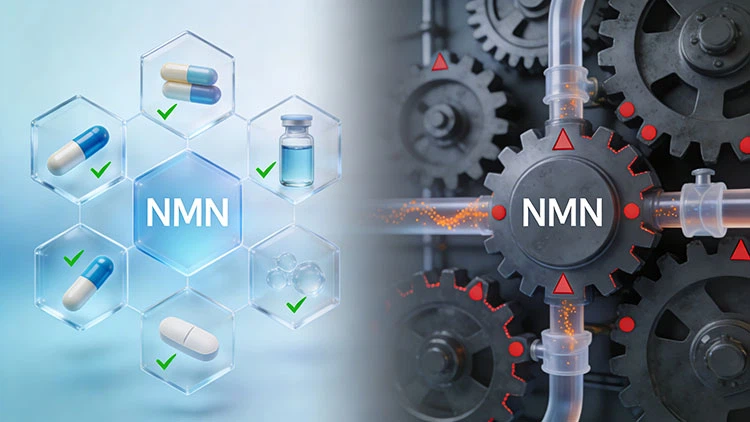
Formulation and Dosage Factors
High-Dose Blends
NMN is incompatible with certain carriers, and in high-concentration formulations, it is necessary to carefully mix with the other components.
Failure to appropriately choose excipients may cause segregation, flowability problems, or uneven compression of tablets due to over-concentration.
Multi-Component Formulations
NMN can react in the course of storage or processing when interacting with reactive or hygroscopic products.
Formulators should consider compatibility testing, especially in premixes or proprietary blends.
Delivery Form Constraints
NMN is best integrated in powders, capsules, or tablets designed for oral intake.
NMN should be incorporated in powders, capsules, or oral tablet form.
In making efforts to administer NMN in non-traditional dosage forms without optimization of formulation, handling efficiency, and batch reproducibility, these could be compromised.
Supply Chain and Handling Limitations
Extended Storage Periods
Although NMN can be stored in controlled conditions, storage in non-airtight or non-controlled temperatures is likely to affect the quality of the product in the long run.
Sealed packaging and monitored warehouse conditions should be the top priority of enterprise manufacturers who are dealing with inventory.
Cross-Contamination Risks
NMN can take up the smell or water of other nearby ingredients when not stored properly.
When using multi-ingredient manufacturing facilities, segregation and proper packaging conditioning must be practiced.
Regulatory and Documentation Compliance
NMN suppliers provide COAs and stability documentation.
In the case of large-scale production, NMN can create a traceability issue in cases where the testing needed for analytical verification is not possible.
Industry Applications Where NMN Use Requires Caution
Specialized Product Lines
NMN can require protective excipients in very differentiated or temperature-sensitive oral supplements in order to achieve consistency.
High-Throughput Manufacturing
The flow properties of NMN should be checked in the fast-speed capsule lines or tablet production lines to prevent batch inconsistency.
Novel Dosage Forms
When NMN is to be incorporated into liquid, effusive, or chewable systems, the composition must be confirmed through the use of formulations that will guarantee its solubility and homogeneity.
Conclusion
To conclude, NMN is generally appropriate from a manufacturing perspective; however, it must be cautiously considered in a high-moisture setting, high-temperature processing, multi-component mix, or lengthy storage. When determining the applicability of NMN to particular product lines, enterprise users should take into account the stability of the molecules, their ability to be used together with various formulations, and supply chain management. Although it is not objectionable in nature, NMN has to be under technical control to guarantee some consistency between batches, predictable solubility, and be regulator-compliant in the production of oral supplements.
Do you have a different opinion? Or need some samples and support? Just Leave A Message on this page or Contact Us Directly to get free samples and more professional support!
FAQ
Can NMN be used in high-humidity manufacturing facilities?
In bulk powders or capsules, NMN must be kept and handled in a low-humidity environment to ensure that the compound is not clumped together.
Is NMN compatible with multi-ingredient premixes?
Yes, but they need to be tested to ensure that they do not segregate, react, or become unstable when mixed with other components.
What dosage forms are recommended for NMN integration?
The most suitable one will be powders, capsules, and tablets, because NMN has a favorable solubility profile and blends well; liquid or effervescent formulations will have to undergo further formulation optimization.
How should NMN be stored for extended periods?
A controlled environment, such as sealed airtight containers, and stable temperature and low exposure to light are suggested to prevent deviation and poor quality.
References
1. Yoshino, J., Baur, J. A., & Imai, S.-i. (2018). NAD+ intermediates: The biology and therapeutic potential of NMN and NR. Cell Metabolism, 27(3), 513–528.
2. Nadeeshani, H., Li, J., Ying, T., Zhang, B., & Lu, J. (2022). Nicotinamide mononucleotide (NMN) as an emerging ingredient in functional supplements: Stability and formulation insights. Journal of Advanced Research, 37, 267–278.
3. International Society for Nutraceutical Research. (2023). Technical guidance on NMN integration in oral dosage forms.
4. National Institutes of Health. (2021). Dietary supplement ingredient database: Nicotinamide mononucleotide.


