

Lycopene Oil is a special lipid-based cosmetic and nutritional ingredient system that consists of a combination of the natural, highly lipophilic carotenoid lycopene and a suitable carrier oil to improve the chemical stability, bioavailability, and formulate-ability of the lycopene. This powerful phytochemical is isolated into an oil-soluble matrix, overcoming the traditional difficulty of the raw lycopene crystal being insoluble and delivering a stable and functional liquid raw material to formulation scientists to develop skin care formulations, softgels, and personal care innovations.
Technical Specifications and Chemical Nature of Lycopene Oil
For ingredient technologists in either topical or dietary applications, knowledge of the structure of lycopene oil is crucial. Natural lycopene is an unsaturated hydrocarbon (13 conjugated double bonds) found naturally in tomato skins and seeds, which is a non-provitamin A carotenoid.
Pure lycopene exists as dark red crystalline solids which are very water-insoluble and very poorly lipid-soluble at room temperature. However, in order to overcome this processing problem, lycopene oil solutions use lipid carriers that are edible or cosmetic-grade, such as cold-pressed tomato seed oil, refined sunflower oil, extra virgin olive oil, and medium-chain triglycerides (MCT), to suspend or completely solubilize micro-dispersed lycopene molecules.
|
Technical Parameter |
Standard Specification |
|
Active Concentration |
Standardized from 1.0% to 10.0% pure lycopene |
|
Physical Appearance |
Deep red to orange-red viscous liquid |
|
Solubility |
Fully miscible in lipid/oil phases, insoluble in water |
|
Primary Active Isomer |
All-trans lycopene (convertible to cis-isomers for elevated bioavailability) |
|
Lipid Carriers |
MCT oil, Sunflower seed oil, Tomato seed oil, Olive oil |
Formulating with Lycopene Oil: Compatibility and Phase Integration
Emulsion systems are extremely complex, and a precise understanding of the phase chemistry and mechanical emulsification methods is required to ensure uniformity of the product while incorporating a lycopene oil extract.
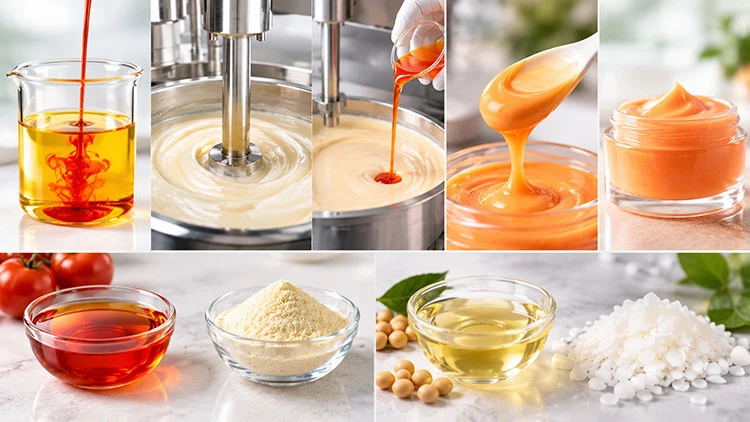
Oil-Phase Incorporation: The lycopene oil matrix is always incorporated in the hydrophobic (oil) phase of O/W (oil-in-water) or W/O (water-in-oil) emulsion. Do not add the raw lycopene ingredients to the aqueous phase, because the ingredients will immediately separate the phases and cause severe graininess in the batch.
Low-Temperature Addition Point: Lycopene will heat up and become cis to trans isomerized if long exposed to high temperatures. Lycopene oil is added after primary emulsification (when the temperature of the mixture is below 40°C to 45°C) during the cool-down process in the manufacturing.
Emulsifier Selection: Use non-ionic emulsifiers or lecithin-based emulsifiers that are very effective with the oil mixture. Lecithin can thus not only help to emulsify, but it can also be used synergistically as a co-solvent to maintain lycopene's homogeneity throughout shelf life.
Viscosity and Viscoelastic Modifiers: If clear oil serum or anhydrous balms are used, use a structuring agent such as silica dimethyl silylate or natural wax esters to prevent pigment settling but not affect the rich orange color.
Stability Factors and Protecting Natural Lycopene Oil Formulations
The polyunsaturated carbon skeleton which makes lycopene oil an outstanding free-radical scavenger also renders it very sensitive to environmental oxidation, UV radiation, heat, and trace metal ions.
Photodegradation Defenses: Lycopene is destroyed by exposure to visible and ultraviolet light, and this causes bright red formulations to turn pale yellow or colorless liquids. Use opaque, amber, or UV-blocking packaging for finished products.
Antioxidant Synergy: Protect the lycopene oil ingredient system with antioxidant synergy, combining with fat-soluble antioxidants. The use of a mixture of mixed tocopherols (Vitamin E) 0.2-0.5% and ascorbyl palmitate gives high protection against peroxyl radicals and a great overall stability to the product.
Chelating Agents: Rapid auto-oxidation of carotenoid oils can be catalyzed by metal ions like Fe2+/Fe3+ and Cu2+ (chelating agents). Add oil-phase chelators that can be dispersed in water or water-phase EDTA/phytic acid to emulsion formulations to complex with micro-contaminants.
pH and Nitrogen Flushing: Keep pH (4.5 to 6.5) neutral to slightly acidic for emulsion vehicles and Flush with nitrogen in the emulsion. To prevent the presence of dissolved oxygen in the nitrogen gas, purge the vessel headspace with nitrogen gas during bulk storage and fill lines during manufacturing.
Dosing Strategies and Usage Guidelines in Personal Care and Foods
The exact dose of lycopene oil will be determined depending on the type of product to be developed, whether for topical cosmetics, functional use in personal care, or for oral dietary supplements.
Topical Facial Serums (0.05% - 0.5% active lycopene concentration): Gives serums a visual color tint and offers antioxidant skin barrier support against environmental stressors such as ambient pollution and blue light.
After-Sun Care (0.01% to 0.1% active lycopene concentration): Gives warm golden hues to emulsions, nourishes dry skin and stimulates the repair of the lipid barrier without staining fabrics.
Anhydrous Facial Oils and Balms (1.0% to 3.0% lycopene oil blend): Carries the lipids in conjunction with the carotenoids to calm the micro-inflammation of the skin.
Oral Softgel Supplements (5-15 mg pure lycopene per serving): Provide lycopene in the form of oil suspensions in oil matrices, which allows for greater micellarization in the gastrointestinal tract and absorption in the cells.

Broad Industry Applications of Lycopene Oil Systems
Lycopene oil has gone from being a little-known botanical extract to a multi-sector workhorse ingredient for several high-dollar manufacturing industries throughout the world.
Advanced Skincare and Cosmeceuticals: Due to its great ability to neutralize singlet oxygen species (O2), advanced skincare and cosmeceuticals are developed in the form of anti-pollution serums, environmental defense night oils, and urban skin rescue creams.
Nutraceuticals and Dietary Supplements: Acts as the active oil ingredient of softgel capsules designed to support general cardiovascular, eye nutrition, and systemic cellular antioxidant support.
Clean-Beauty Color Cosmetics: Employed as a natural, plant-based biological colourant in lip balms, tinted moisturiser bases and blush oils, instead of synthetic red and orange lakes (such as Red 40 and Yellow 6).
Functional Food and Beverage Matrices: Functional spread in high-quality culinary oil blends, dietary fortification systems with oil solubility for even color and nutritional value.
You can contact us directly or email donna.zh@kingsci.com to obtain further information and free samples.
What is Lycopene Oil?
To sum up, lycopene oil is a novel and functional ingredient to overcome the past difficulties in formulating pure crystalline lycopene. Ingredient engineers can effectively use this natural ingredient in cosmeceuticals, dietary supplements, and personal care products through stabilizing natural lycopene in a high-purity lipid matrix. Processed at lower temperatures, formulated with adequate antioxidant protection, and packaged away from direct light, lycopene oil provides vibrant visual appeal, extensive skin-nurturing benefits, and strong environmental protection in a variety of formulation platforms.
FAQ
What is the main difference between lycopene oil and lycopene powder?
Lycopene oil is natural lycopene carotenoids pre-dispersed or dissolved in a lipid carrier medium, and is completely soluble in oil and ready for use in liquid formulations. Lycopene powder, typically, on the other hand, consists of isolated crystalline clusters or micro-encapsulated dry powders that need higher shear, heating, or certain solubilizers to get them evenly dispersed into liquid product bases.
How does carrier oil selection impact lycopene oil stability?
The shelf life and rate of oxidation of the final ingredient will depend on the choice of carrier oil used. While saturated oils, such as Medium-Chain Triglycerides (MCT oil), are the most resistant to auto-oxidation, some polyunsaturated carriers, like seed oils, also have skin benefits, with greater amounts of added antioxidants, like mixed tocopherols, needed to prevent rancidity.
Can lycopene oil stain skin or cosmetic packaging?
Because natural lycopene possesses an intense deep red hue, raw lycopene oil can stain light-colored clothing or porous plastic packaging if used at extremely high concentrations. However, when formulated into cosmetics at recommended functional levels (typically below 0.5% lycopene oil blend), it absorbs smoothly into the stratum corneum, imparting a subtle, healthy glow without staining the skin.
Is lycopene oil suitable for sensitive skin formulations?
Yes, high-purity lycopene oil derived from natural tomato extracts is non-comedogenic, gentle, and well-tolerated by sensitive skin types. Its inherent ability to calm environmental skin irritation and support natural skin barrier lipids makes it an excellent addition to soothing, fragrance-free facial oils and sensitive skin barrier repair creams.
References
1. García-Alonso, F. J., & Periago, M. J. (2020). Assessment of chemical stability, carotenoid profile, and solubilization of lycopene-rich tomato oleoresins dissolved in vegetable oil carriers. Journal of Agricultural and Food Chemistry, 68(14), 4210–4219.
2. Moñino, I., & Rodríguez-Mora, A. (2021). Microencapsulation and lipid-based carrier delivery systems for lipophilic antioxidants in topical skin care applications. International Journal of Cosmetic Science, 43(3), 305–318.
3. Perez-Conesa, D., & Cao-Ho, L. (2022). Thermal degradation kinetics and cis/trans isomerization of lycopene in edible oil matrices during heating and cool-down cycles. Food Chemistry, 371, 131120.
4. European Food Safety Authority (EFSA) Panel on Nutrition, Novel Foods and Food Allergens. (2023). Scientific opinion on the re-evaluation of lycopene oil extracts from Solanum lycopersicum as food supplements and cosmetic ingredients. EFSA Journal, 21(5), e07982.


