

The Korean ginseng extract is a ginseng standardized herb extract that contains a fixed and known proportion of ginsenosides, has adjustable process behaviour, and is suitable for B2B industrial formulation systems such as beverages, supplements, cosmetics, and functional food development.
Korean Ginseng Extract and Ginsenoside Structural Profile
The complexity of Korean ginseng extract in terms of triterpene saponins (ginsenosides) makes it difficult to discuss its functionality in terms of consumer positioning.
Polarity and molecular weight differences between the various fractions of the ginsenoside spectrum enable the flexibility to incorporate these different ginsenoside fractions into different delivery systems (Rb, Rc, Rd, and Rg groups).
The solubility behavior is due to polarity, which allows part of the compounds to be soluble in both an aqueous and an emulsified matrix.
The extraction-dependent composition variability – The composition of ginsenosides in the extract is affected by the extraction process parameters (time, solvent ratio, and temperature), and the product needs to be tightly controlled in the manufacturing process to ensure uniformity.
Physical Processing Characteristics in Manufacturing Systems
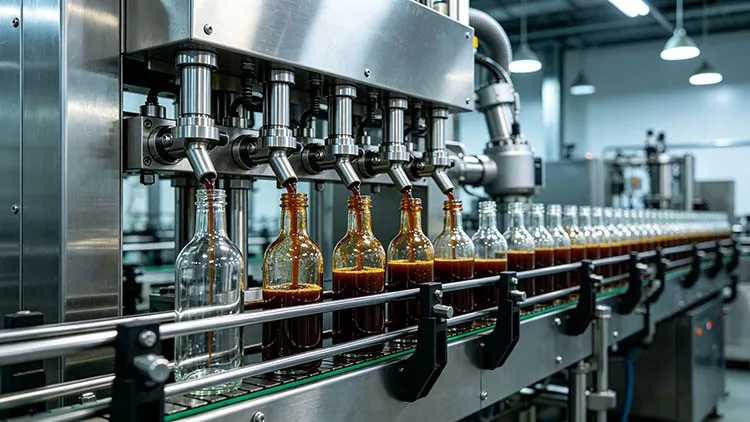
In terms of industrial use, Korean ginseng extract has been developed to be used in a mass production environment rather than for solid consumption.
Automated filling systems (capsule, tablet, and sachet) can be better supported by the flowability of powder extract conditions and extract powders using spray drying with or without a carrier.
Hygroscopic tendency management – The material can absorb moisture in the air during the storage stage and pre-blending stage, and needs to be placed at a certain humidity.
Adaptability for Particle Engineering – Particle size distribution can be modified to enhance downstream processing, such as dissolution rate, uniformity of mixing, and compression.
Formulation Integration and Compatibility Factors
Formulators often assess the activity of Korean ginseng extract by its activity in multiple component systems instead of its composition.
Carrier system compatibility – Usually mixed with maltodextrin, starch derivatives, and/or plant-based carriers for ease of handling and dispersion.
Emulsion integration potential – Amphiphilic components have a certain degree of stability in an oil-water mixture with the help of emulsifiers or homogenization processes.
Flavor interaction profile – Sensory attributes of earthiness and bitterness that will naturally occur will need to be balanced in beverage and chewable applications.
Manufacturing Process Control Considerations
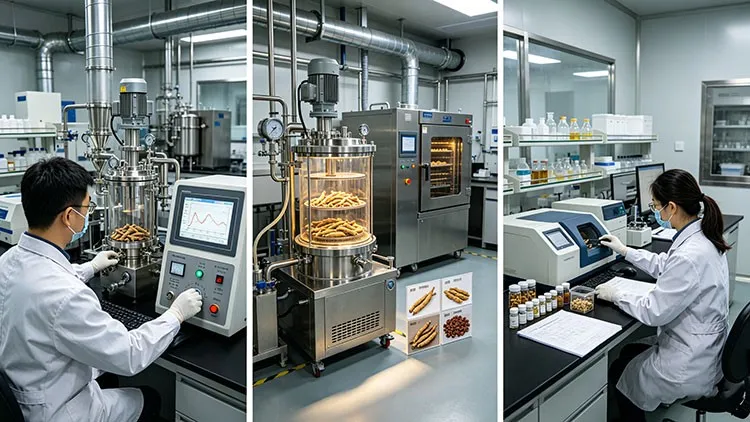
Processing parameters need to be controlled and input materials standardized to a great extent to ensure consistency in production.
Extraction parameter sensitivity – slight changes in the formulation parameters, such as solvent composition or thermal exposure, can result in changes in ginsenoside ratios, which can influence the formulation behavior in the downstream processing.
Influence of drying method – Spray drying is different from vacuum drying, and leads to different particle morphology and moisture content.
The need for batch standardization – Industrial buyers will usually use the standardised marker compounds to give them assurance that the product will perform in a repeatable manner from batch to batch.
Stability and Handling Behavior in Industrial Use
There is a need for specific handling procedures in the case of Korean ginseng extract to ensure the physical and chemical integrity during storage and production.
Exposure sensitivity to light and oxygen – It may gradually have an effect on color and compositional stability, and protective packaging is crucial.
Reconstitution performance – uniformity and sedimentation risk can be minimized by pre-dispersion (high shear mixing) in liquid systems.
Temperature interaction behaviour – High processing temperatures may affect the solubility and dispersion properties, and so need to be controlled in such a way as to ensure that they are added at the correct point in the manufacturing process.
Application-Oriented Functional Positioning in B2B Systems
Unlike being used as a standalone ingredient, Korean ginseng extract is usually used as a "modular" botanical ingredient.
Multi-ingredient formulation role – Often included in complex botanical formulations in which it is important to standardize and ensure compatibility.
Flexible integration at system level – Can be modified for powder, liquids, emulsions, and semi-solid systems according to the processing design.
OEM Production customization – Extract ratio, carrier type, and particle size can be changed for customized product development for various markets.
Conclusion
Korean ginseng extract is a technically versatile botanical ingredient in terms of its degree of complexity in its ginsenoside content, its tuning characteristics in physical properties, and its versatility in industrial formulation systems. Where it's useful for B2B manufacturers is not in its isolated applications, but in how well it adapts to and can be integrated into multi-ingredient product architectures, and the flexibility of the manufacturing process. Its added value for B2B manufacturers is in being adaptable to and suitable for multiple-ingredient product architectures and its potential for process standardization. If properly controlled, through extraction consistency, particle engineering, and stability management, it is a good functional ingredient in today's product development pipelines for botanicals.
Do you have a different opinion? Or need some samples and support? Just Leave A Message on this page or Contact Us Directly to get free samples and more professional support!
FAQ
1. What makes Korean ginseng extract suitable for industrial formulation systems?
It has flexible particle properties and a multiple-component ginsenoside profile, which can be integrated into various types of products.
2. Why is extraction control important for Korean ginseng extract?
Due to the sensitivity of the composition of the product and its formulation to slight variations in processing conditions.
3. Can Korean ginseng extract be used in both dry and liquid manufacturing systems?
Yes, but there are different dispersion or blending methods to be used in each system to keep the system uniform.
4. What is the main technical consideration for storage?
Moisture control and environmental stability to maintain powder flow and consistency of chemistry.
References
1. Wang, C. et al. (2021). Advances in ginsenoside research and extraction technologies. Journal of Ginseng Research, 45(3), 386–397.
2. Kim, J. H. et al. (2020). Processing effects on chemical composition of Panax ginseng extracts. Food Chemistry, 328, 127083.
3. Lee, S. M. et al. (2022). Physical properties and formulation behavior of ginseng extract powders. International Journal of Food Science, 2022, 1–9.
4. European Medicines Agency (2023). Assessment report on herbal preparation of Panax ginseng.


