

The high levels of saponins, fibers, and bioactive compounds found in the fenugreek seed extract have rendered the extract a popular functional ingredient in food, dietary, and cosmetic formulations because of its ability to maintain formulation stability, performance, and nutritional value.
Overview of Fenugreek Seed Extract Applications
Fenugreek seed extract is a standardized botanical ingredient derived from Trigonella foenum-graecum; it has multiple functions. Various applications in technique and nutrition are made possible by its key constituents, i.e., steroidal saponins, galactomannan fibers, and alkaloids.
Nutritional fortification: Provides plant-based functional ingredients to fortified preparations.
Textural properties: Behaves as a natural thickening and stabilizing agent.
Widely compatible: Compatible with powders, capsules, beverages, and topical systems.
Functional Advantages of Fenugreek Seed Extract in Product Development
1. Bioactive Composition for Value-Added Formulas
Fenugreek seed extract is usually standardized based on the amount of saponin, and can be used in high-specification formulations.
Improves the placement of vegetarian supplements.
Delivers the active content in a consistent manner in order to be accurate in formulations.
Synergistically works with other botanical ingredients.
2. Natural Thickening/stabilizing agent.
Its galactomannan fraction provides a lot of viscosity and stabilization of emulsions.
Enhances the mouth feel of functional drinks and shakes.
Stabilizes liquid formulations that are dispersed.
Lessens the use of artificial hydrocolloids.
3. Flavor Modulation and Sensory Enhancement.
Fenugreek provides a bitter taste of maple with mild bitterness.
Balances the profile of flavors in compound herbs.
Removal of proteins or minerals from the note by masks.
Improves the functional foods with respect to sensory.

How to Use Fenugreek Seed Extract in Formulations
Recommended Forms and Delivery Systems
The extracts have different formats that are flexible to the end-use applications.
Powder extract (10:1, 20:1): Suitable in capsules, tablets, and dry mixes.
Standardized extract (>50 percent saponins): Can be used in high-quality formulations.
Liquid extract: used in liquids and beverages.
Practical Formulation Techniques
To optimize performance, there is a need to have proper processing strategies.
Blend with complementary fibers in order to be more dispersed.
Regulate releases of flavors with microencapsulation.
Use homogenization in drinks to make them more stable.
Dosage and Inclusion Level Considerations
Typical Usage Levels
Proper dosage varies according to the concentration of the extract and the type of application.
Dietary supplements: 300- 600 mg/day (standardized basis)
Functional foods: inclusion rate of 0.5%-2%.
Beverage systems: Solubility and sensory adjusted.
Key Influencing Factors
The level of standardization (saponin or fiber content)
Serving size and target product format.
Compliance with the regulations in various markets.
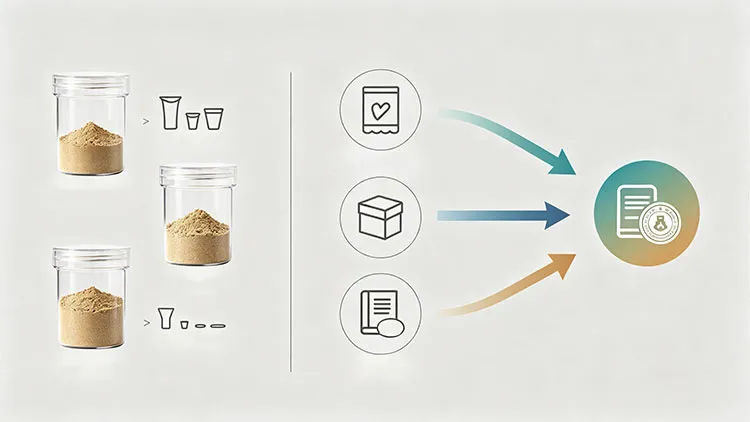
Stability and Processing Characteristics of Fenugreek Seed Extract
Processing Stability
Fenugreek seed extract is stable to usual manufacturing conditions.
Solid at moderately high temperatures (<120 °C)
Grows well in a neutral to slightly acidic pH system.
Heating can cause depletion of the amount of active compounds.
Storage and Shelf Life.
Keep in cool, dry, and light-free places.
Apply waterproof, air-tight containers.
Normal shelf life is a maximum of 24 months in controlled conditions.
Industrial Applications of Fenugreek Seed Extract
1. Dietary Supplement Industry
Applied in capsules, tablets, and powder blends.
Added to vegetable and plant preparations.
2. Functional Food and Beverage Sector
Utilized in protein powders, nutrition bars, and herbal drinks.
Offers texture and functionality as well.
3. Cosmetics and Personal Care
Part of the skin and hair formulations.
Has a conditioning and film-forming effect.
4. Animal Nutrition
Include in feeds as a palatability-improving ingredient.
Helps in creating consistency of formulations and stability in processing.
Conclusion
Fenugreek seed extract is a multi-purpose botanical compound, which can be used in formulations to enhance performance by its thickening effect, bioactive constituents, and its ability to be used in various product types. Its worth is that it improves texture, stability, and positioning of functionality in supplements, foods, and personal care products, which is a sure bet in developing products in the modern world.
Do you have a different opinion? Or need some samples and support? Just Leave A Message on this page or Contact Us Directly to get free samples and more professional support!
FAQ
1. What is fenugreek seed extract commonly used for in supplements?
The saponin and fiber content of fenugreek seed extract is also used in dietary supplements, and this aspect boosts standardized botanical blends.
2. How do you use fenugreek seed extract powder in food products?
It can be added to protein powders, nutrition bars, and beverages to give them a better feel, boost their stability, and add functional plant compounds.
3. What is the typical dosage of fenugreek seed extract in formulations?
The most common use is between 300-600mg each day in supplements, and in food, the most common usage is between 0.5-2% inclusion, depending on the formulation requirements.
4. Is fenugreek seed extract stable during processing?
Yes, this is rather stable in the presence of moderate temperature (heat) and neutral pH conditions, but it can be affected by over-processing, which can affect the integrity of active components.
References
1. Smith, J., & Lee, A. (2021). Functional properties of fenugreek (Trigonella foenum-graecum) in food systems. Journal of Food Science and Nutrition, 56(4), 1123–1135.
2. Gupta, R., et al. (2020). Nutritional and industrial applications of fenugreek seed extract. Plant-Based Ingredients Journal, 8(2), 45–59.
3. European Food Safety Authority (EFSA). (2022). Safety evaluation of botanical extracts in food supplements.
4. Patel, K., & Singh, D. (2023). Stability and formulation strategies for herbal extracts in functional beverages. International Journal of Food Engineering, 19(1), 77–89.


