

Lutein Powder is best taken along with the lipids in food and can be taken as a regular daily dose due to its lipophilic nature, which facilitates uptake in the gut.
Optimal Consumption Methods and Dietary Integration
Lutein powder is best taken with meals that include healthy fats, like avocados, extra-virgin olive oil, or raw nuts, which can have a big impact on how well the micellar incorporation occurs and on how well it is transported into the intestine.
Aqueous Emulsion Blending: The natural food-grade emulsifiers pre-dissolved in warm or ambient water and blended with the lutein powder grades will help ensure that the powder is uniformly suspended and dispersed before consumption.
Routine administration schedule: If supplementation is to be continued for long periods of time, it's important to have a consistent schedule of administration to minimize fluctuations in physiological tissue concentrations, or peaks and valleys.
Divide Dosing: For sensitive individuals, giving the entire daily dose in two doses at different times of the day will not overload the digestive system and can maximize the absorption efficiency of the dose.
Precision Dosage Parameters and Formulation Guidelines
The daily use recommendations for commercial dietary formulations are 6 milligrams to 20 milligrams of active lutein powder equivalents for daily use to help meet daily wellness goals.
Raw Material Certificate of Analysis (CoA) Purity and Assay: Formulators and consumers should always verify a Certificate of Analysis (CoA) to ensure that the exact carotenoid content is known before formulation of a custom blend of carotenoids for a particular food or dietary product.
Molecular Mass Calculations: If manufacturers change grades of raw materials, they need to pay attention to the percentage of active components to make sure that the same amount of active components is used for each product manufactured.
Carrier agent choice: Use suitable excipients to ensure that they are compatible with active agents and will not affect their functionality in dry-blended functional foods, capsules, and instant beverage powders.

Stability Factors and Environmental Protection Protocols
Thermal Sensitivity Management: If raw lutein powder is subjected to high temperatures during preparation, it is important to avoid degradation of the small carotenoid bonds and the activity of the isomers.
Light Exposure Prevention: Dry powder format should be stored in opaque, airtight containers to prevent photo-oxidation and maintain the shelf life of these dry products.
During long-term storage in the warehouse, moisture control measures such as storage in a low-humidity environment are important to ensure that caking, clumping, and moisture-induced breakdown of microencapsulated powder matrices are avoided.
Oxidative Defense Systems: By using natural antioxidant co-ingredients (mixed tocopherols), another protection against oxidative degradation by ambient oxygen during the shelf life is added.
Advanced Product Formulation and Delivery Techniques
The microencapsulation technology in the form of advanced beadlet processing helps to ensure gastrointestinal stability of active lutein powder particles and facilitates their overall stability in other delivery matrices, such as functional foods.
Complementary Fat Soluble Antioxidants: When used with the addition of the ingredient, the combination of the fat-soluble antioxidant and other complementary ingredients will help to protect the integrity of the molecular structure and increase formulation stability.
Particle Size Optimization: Use of micronized powder grades enhances the amount of surface area to which the enzyme can interact, which leads to a better dissolving rate in a target delivery system.
Viscosity and Flow Control: Control of the flow characteristics of powder in the industrial environment is optimized by using special granulation techniques, allowing the capsules to be automatically filled and the tablets compressed without any problems.
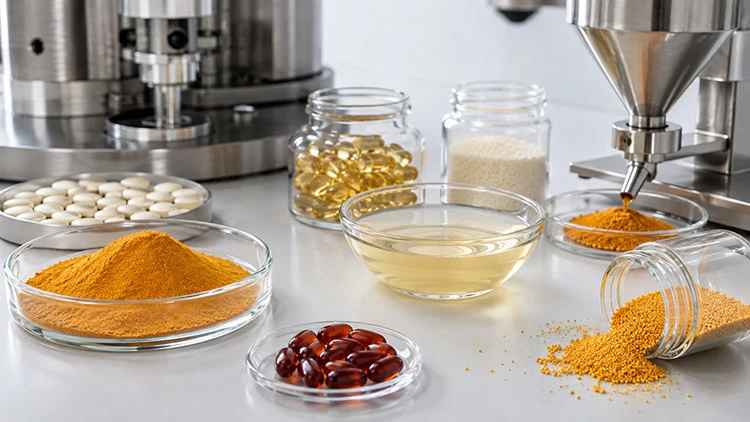
Industrial Applications in Functional Foods and Supplements
Lutein powder dietary supplement is an indispensable active ingredient in daily health capsules, softgels, and multi-nutrient supplements used in the worldwide B2B market.
Cold-water soluble grades: Functional Beverage Mixes are designed to easily blend with powdered drink mixes, sports nutrition drinks, and formulations of liquid concentrates for active lifestyle consumers.
Nutritional Confectionery Products: There are heat-stable variants that can be added to functional gummy matrices, chewable tablets, and special functional food products.
Specialized technical grades are used in manufacturing animal nutrition products to aid specific pigmentation and nutritional products in different segments of the livestock industry in agricultural and feed inputs.
How To Eat Lutein Powder For Best Absorption?
Whether in nutritional or cosmetic supplements, knowing how to properly use lutein powder, the correct dosage, and environmental stability parameters will guarantee optimal bioavailability, product performance, and user satisfaction for all functional uses.
You can contact us directly or email donna.zh@kingsci.com to obtain further information and free samples.
FAQ
Q: Does lutein powder require dietary fats for proper assimilation in the body?
A: Yes, it is a fat-soluble carotenoid and thus is greatly absorbed when eaten with a meal that has healthy fats or dietary lipids.
Q: What is the recommended daily intake range for standard dietary supplements?
A: Typical commercial products contain 6 milligrams – 20 milligrams of lutein per serving.
Q: How should raw lutein powder be stored to maintain maximum stability?
A: A: Should be stored in the dark, dry, and cold in opaque and airtight containers to avoid degrading from light, heat, and moisture.
Q: Can lutein powder be easily blended into cold beverages?
A: Specialized grades with beadlet technology are available, which can be easily dispersed in a range of liquid formulations to create special formulations for cold water applications.
References
1. Johnson, E. J. (2020). The role of dietary lipids in the bioavailability of lutein and related carotenoids from supplements and food matrices. Nutritional Research Reviews, 33(2), 115-128.
2. Wang, Y., et al. (2021). Enhancing stability and intestinal absorption of lutein powder through advanced microencapsulation and lipid emulsion systems. Food Hydrocolloids, 112, 106342.
3. Roberts, R. L., et al. (2022). Dietary carotenoid absorption dynamics: Impact of meal composition, dosing frequency, and molecular configuration. Journal of Agricultural and Food Chemistry, 70(15), 4580-4592.
4. Smith, J. A., & Davis, M. K. (2023). Stability and degradation kinetics of unesterified lutein powder under varying thermal and light storage conditions. Food Chemistry, 401, 134150.


